
Matching Gift Processing FAQ: Your Top Questions, Answered
Many nonprofits miss out on significant funding pools simply because the mechanics of how corporate dollars move from a boardroom to a bank account remain unclear. By exploring the core operations involved with matching gift fundraising, your development team can establish a highly efficient processing system that reduces friction and scales your annual revenue.
These are the most common inquiries we hear from nonprofits like yours:
- How does the matching gift fulfillment lifecycle typically work?
- Why does a significant portion of matching gifts go unprocessed each year?
- What role do CSR platforms play in matching gift processing?
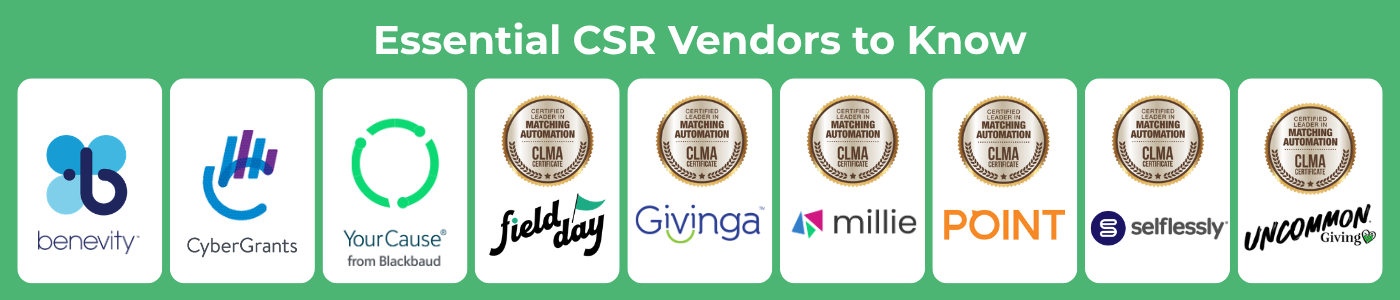
- Who are the major CSR platforms that nonprofits should be familiar with?
- How does matching gift processing vary by online vs. offline submissions?
- What steps must a gift-processing team take to verify a donation?
- How do tools like HEPdata or Double the Donation impact match processing?
- How long does it take for a company to disburse matching gift funds?
- How should a nonprofit record corporate disbursements within its CRM?
- How can past workplace giving data be used to improve processing?
- What KPIs should be tracked within a matching gift processing workflow?
- What does the future of matching gifts hold, and how can AI improve operations?
In this FAQ guide, we’ll walk through each one, providing detailed responses to guide your organization’s processing efforts. Let’s begin!
How does the matching gift fulfillment lifecycle typically work?
Matching gift fulfillment is a structured progression that transforms a donor’s charitable intent into realized corporate funding through their employer. While it can vary from one company to the next, here’s how it generally works:
- The cycle begins immediately when an individual contributor makes a donation to a nonprofit.
- Once the initial gift is completed, the donor triggers the next stage by submitting a formal match request, typically through an external CSR portal selected by their company.
- After the donor submits this request, the process moves into the verification phase. The employing company or its designated tech vendor notifies the nonprofit to confirm both the original transaction and the organization’s valid 501(c)(3) status.
- Once the nonprofit’s gift processing team confirms the transaction details within the portal, the employer reviews the submission against its pre-determined guidelines.
- When the request passes corporate inspection, the company officially authorizes the allocation of matching funds.
- The final stage of the lifecycle involves the financial disbursement, which frequently occurs via batch electronic fund transfers or paper checks. The lifecycle concludes when the nonprofit receives the corporate payment, reconciling the funds against the original donor’s record.
From there, the organization is encouraged to issue personalized stewardship communications to close the loop with the supporter.
Why does a significant portion of matching gifts go unprocessed each year?
An estimated $4 billion to $7 billion in corporate matching gift revenue remains entirely untouched each fiscal year. The primary driver behind this massive deficit is a severe lack of donor awareness. While research indicates that over 26 million individuals work for companies with matching gift programs, an estimated 78% of eligible employees have no idea that their employers offer this benefit.
Additionally, there are severe technical roadblocks within nonprofit advancement departments that stall the remaining matching opportunities. For example, manual tracking systems often rely on decentralized spreadsheets, creating data silos and increasing human error. Not to mention, Double the Donation’s recent Nonprofit Corporate Engagement report revealed that 62% of nonprofits take more than a week to process a single matching gift request.
Such operational delays frequently result in missed deadlines, fragmented donor records, and expired requests. Ultimately, without integrated tools designed to flag eligibility in real time, matching gift opportunities remain overlooked.
What role do CSR platforms play in matching gift processing?
Corporate social responsibility (CSR) platforms act as the vital digital infrastructure and technical intermediaries that connect corporate treasuries to the nonprofit sector. Major corporations rarely manage the complex logistics, compliance requirements, and employee tracking of their philanthropic programs in-house. Rather, they outsource these extensive workflows to specialized, third-party CSR software systems to handle administrative vetting, validation, and capital disbursement.
For nonprofits, these solutions host dedicated (no-cost) organizational portals where gift processors must register their causes and regularly verify receipt of donations. Because every vendor maintains its own interface, verification logic, and registration requirements, it is essential to maintain active administrative credentials for each.
Who are the major CSR platforms that nonprofits should be familiar with?
The three legacy giants that handle the vast majority of Fortune 500 workplace giving programs are Benevity, YourCause by Blackbaud, and CyberGrants, which is now a core component of Bonterra. These robust corporate tools manage massive volumes of employee requests, corporate grants, and payroll deduction distributions worldwide.
However, in addition to these leading providers, a new generation of corporate giving platforms has emerged to prioritize seamless automation and nonprofit advancement. These CLMA-designated platforms adhere to strict accessibility standards and support matching gift auto-submission through a direct partnership with Double the Donation. Currently, such platforms include Field Day, Givinga, Millie, POINT, Selflessly, and Uncommon Giving.
How does matching gift processing vary by online vs. offline submissions?
The administrative workflow for processing matching gifts can vary significantly depending on whether the individual’s employer uses a modern digital submission pathway or offline, PDF, or mailed-in forms. That’s because online match processing is highly automated and initiated almost instantly at the point of transaction. If the company uses a platform that has earned the Certified Leader in Matching Automation (CLMA) designation, the donor can even auto-submit their request with a single click from the confirmation page.
Conversely, offline processing often requires substantial manual intervention and is highly susceptible to administrative friction. Offline tracking begins when a donor manually obtains paper forms, resulting in a higher rate of untracked matches, messy records, and extensive administrative chase time. However, the actual disbursement and reconciliation phases remain largely unchanged.
What steps must a gift-processing team take to verify a donation?
Verifying a matching gift request is a critical security measure that confirms a transaction occurred and authorizes a corporate partner to release funds. The verification process is typically triggered when the nonprofit discovers a pending request within a portal or receives an automated email like this:
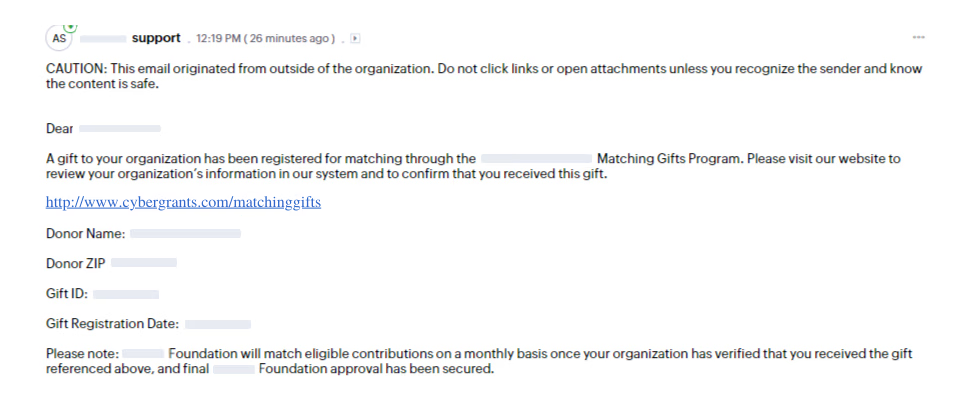
To move the request through the approval pipeline, the gift-processing team must execute the following steps:
- Access the specific CSR portal using the organization’s active login credentials.
- Locate the pending transaction queue within the platform’s transaction dashboard.
- Cross-reference the employee’s name, submission date, and match amount against the nonprofit’s central CRM records.
- Review the initial gift details to confirm it complies with the employer’s minimum and maximum thresholds.
- Confirm that the organization’s 501(c)(3) tax status and banking information remain up-to-date within the portal.
- Approve the transaction to officially release the match into the corporate payout queue.
Maintaining a strict, recurring schedule for auditing these portals is vital for operational success. If an advancement team overlooks notification emails or fails to log into corporate portals in a timely manner, the matching gift lifecycle will stall indefinitely. Such a delay can cause viable requests to expire, resulting in the forfeiture of expected revenue.
How do tools like HEPdata or Double the Donation impact match processing?
In the years since corporate matching gifts became particularly widespread, specialized fundraising software has emerged as a way for organizations to transform passive efforts into a highly proactive revenue engine.
Historically, nonprofits relied on manual research, anecdotal donor conversations, or static legacy indexing tools to identify matching opportunities. However, the primary impact of advanced matching gift software is the immediate elimination of back-office administrative burden. When you embed interactive search tools throughout the donation process, the systems can automatically tag donor records with verified employer data and trigger immediate, personalized follow-ups to drive next steps.
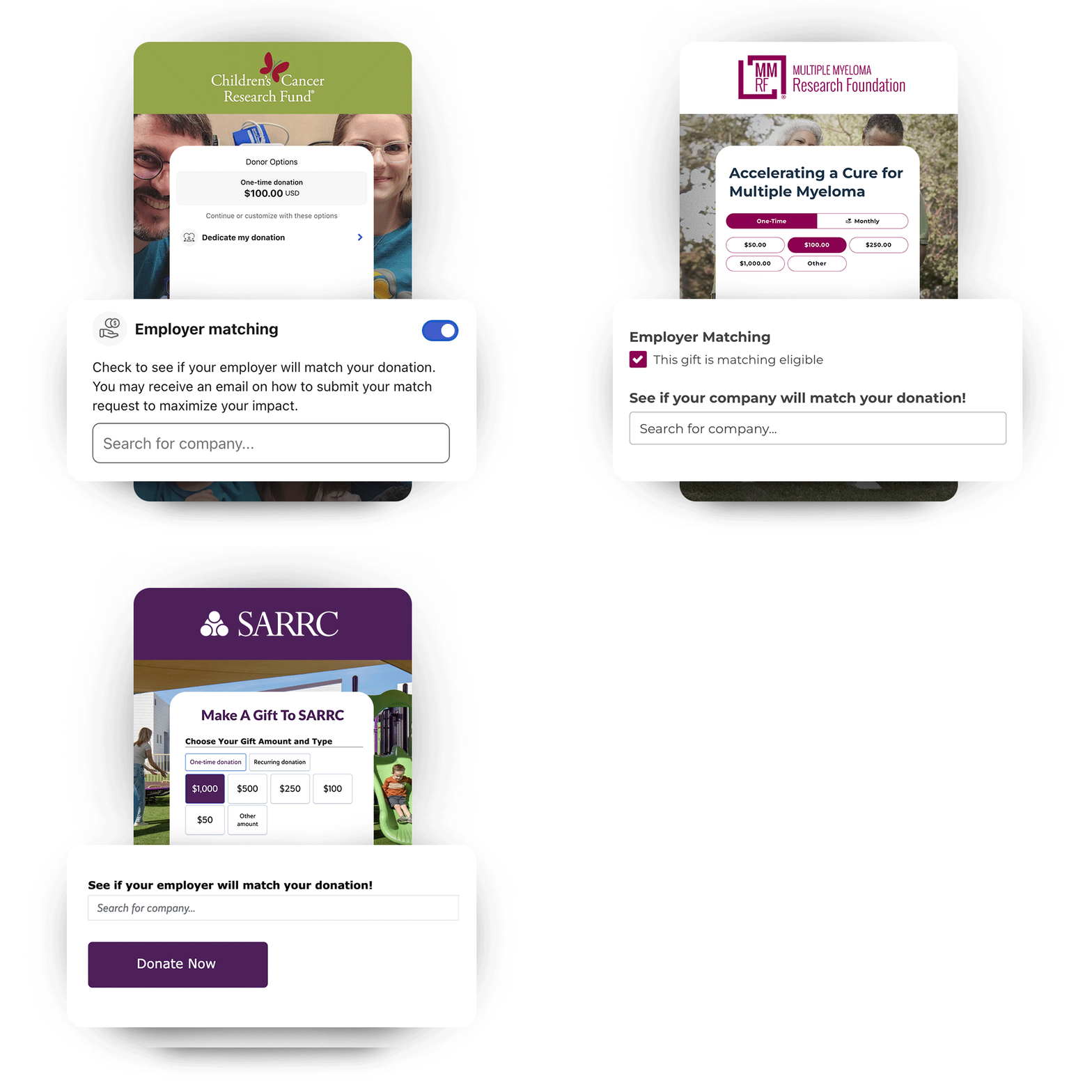
By replacing manual spreadsheet tracking with real-time data syncs, advanced matching gift tools like Double the Donation and HEPdata accelerate verification speeds and ensure financial accuracy. This automated framework removes the friction that leads to donor drop-off, allowing staff to spend less time on data entry and more time on stewardship.
Take a look at our comparison between the top platforms here!
How long does it take for a company to disburse matching gift funds?
The timeline for a corporation to officially disburse matching gift funds can vary widely depending on the company’s internal approval workflows and the distribution methods selected. For businesses utilizing CSR software, this review can be nearly instantaneous, whereas companies relying on manual donation confirmation may take several weeks or months to process requests.
Once a match is officially approved, the actual transfer of capital is generally dictated by fixed corporate payout schedules. Most major CSR vendors disburse funds on a monthly or quarterly basis rather than issuing single rolling payments for individual gifts. Furthermore, companies frequently batch multiple donations to reach minimum payout thresholds before releasing a distribution.
As a result of these technical batching and verification parameters, nonprofits should expect a delay of 30 to 90 days before funds reach their accounts.
How should a nonprofit record corporate disbursements within its CRM?
Accurately recording corporate matching funds in a donor database is essential for maintaining clean financial records, preventing duplicate tracking, and accurately reflecting donor impact. The most technical hurdle occurs during reconciliation, as corporate distributions frequently arrive as lump-sum checks or EFTs.
Therefore, to process these payouts correctly, a nonprofit’s gift-processing team must follow a standardized reconciliation methodology:
- Parse the corporate check stub or download the complete digital reconciliation sheet directly from the CSR vendor portal.
- Match the transaction IDs, payment dates, and split amounts back to the corresponding individual donor records in the CRM.
- Record the actual corporate cash receipt under the specific name of the contributing company or the distributing CSR vendor.
- Apply a soft credit to the individual donor’s record for the exact amount of the corporate match.
- Update the internal property or status field of the initial gift record from “initiated” or “pending” to “received.”
Utilizing a soft crediting strategy is the premier method for tracking lifetime constituent impact with complete precision. If a donor personally gives $500 and secures a 1:1 employer match, applying a soft credit ensures the system recognizes them as a $1,000-impact supporter without double-counting your cash flow.
How can past workplace giving data be used to improve processing?
Historical gift records contain critical markers (such as previous corporate matching patterns, individual employment histories, and past transaction velocities) that can optimize back-office workflows throughout the matching gift lifecycle.
For example, let’s say a bulk corporate disbursement arrives, but it’s missing donor context. An organization’s gift processing team can utilize past matching gift data to successfully cross-reference and reconcile the unknown payment. If its historical database shows that a group of Microsoft employees regularly request matches that take exactly 45 days to disburse, your system can automatically flag those pending records when an anonymous batch payment totaling that amount is received.
What KPIs should be tracked within a matching gift processing workflow?
Consistently tracking quantifiable benchmarks within your matching gift processing pipeline is the only way to uncover hidden operational friction and demonstrate a clear return on investment to leadership. While your specific goals and objectives can vary, the primary reporting metrics that every nonprofit team should monitor include:
- Processing velocity, or the average number of days that elapse between an initial individual donation, the corporate validation request, and final financial reconciliation
- Match identification rate, or the percentage of total incoming donations for which the system successfully captures verified employment data during checkout
- Match conversion rate, or the volume of identified matching gift opportunities compared directly against the final volume of completed corporate disbursements
- Average matching gift amount, or the typical financial size of incoming corporate matches, which helps teams calculate standard corporate match ratios
- Staff hours reclaimed, or the reduction in manual data-entry time achieved by shifting from spreadsheets to automated workplace giving tools
Regularly auditing these foundational data points allows financial managers to identify specific corporate portals that cause administrative delays. For example, let’s say the match conversion rate dips or processing velocity slows beyond a 48-hour window. In that case, leadership can quickly intervene to refine outreach timing, update portal credentials, and optimize systems to maximize yield.
What does the future of matching gifts hold, and how can AI improve operations?
The future of workplace gift processing currently centers on transitioning from isolated, clerical routines to fully integrated, real-time data pipelines. As the corporate giving landscape continues to scale, relying on manual spreadsheet maintenance creates severe operational friction. However, artificial intelligence and other automated solutions are fundamentally streamlining this backend ecosystem.
Here are some ways these tools can help, essentially serving as a specialized extension of your administrative staff:
- CSR portal optimization – Feed corporate portal taxonomies and character limits into large language models (LLMs) to instantly enhance program descriptions. Doing so can increase organizational discoverability across thousands of internal searches.
- Donor data hygiene – Instruct AI to scan your database to identify life statuses, detect statistical outliers, adjust formatting discrepancies, and flag duplicate profiles. The cleaner your data, the better your fundraising results!
- Advanced import logic – Tired of manually coding hundreds of employee contributions? An AI-enabled pipeline can automatically route each gift based on geographic identifiers such as ZIP codes and state-level data.
By flipping the script with artificial intelligence, organizations enable their systems to manage routine tasks. This frees fundraising staff to focus the majority of their time on cultivating high-touch individual and corporate donor relationships.
Wrapping Up
Understanding the intricacies of matching gift processing empowers your fundraising team to eliminate confusion and grow support through corporate channels. Leveraging modern automation tools further supercharges these efforts, removing friction for both your staff and your donors.
With these structured operational insights in place, your organization will be perfectly positioned to capture unclaimed matching gift funds and drive greater long-term impact for your core mission. Best of luck!
If you’re interested in learning more about next-level matching gift processing, we recommend the following resources:
- Matching Gift & Donation Processing Glossary: Key Terms to Know. Master the foundational vocabulary of standard donation and matching gift processing with our comprehensive reference guide. This resource breaks down complex industry language into clear definitions to eliminate administrative confusion.
- A Nonprofit’s Guide to Effective Matching Gift Processing Workflows. Streamline your internal operations and accelerate your funding timelines with this step-by-step operational manual. Learn how to map out clear, team-wide responsibilities, set up verification schedules, and eliminate critical bottlenecks.
- How to Manage Workplace Giving Disbursements & Reconciliation. Take the stress out of financial reporting with our practical guide to accounting for workplace giving disbursements. Explore actionable strategies to identify, track, and reconcile complex bulk electronic fund transfers and corporate checks.
Ready to Streamline Your Matching Gift Processing Efforts?
See why 8,000+ nonprofits and schools trust Double the Donation to enhance workplace giving identification, tracking, reconciliation, and more!