
How to Manage Workplace Giving Disbursements & Reconciliation
Before diving into the complex world of corporate philanthropy management, fundraising leaders must establish a clear framework for handling incoming corporate funds. Managing workplace giving disbursements and reconciliation is a critical yet frequently overlooked component of a modern nonprofit toolkit. This guide explores how to establish rigorous tracking systems, navigate corporate vendor portals, leverage automation technology, and centralize processing operations to ensure your organization captures, attributes, and reconciles every single dollar of workplace giving revenue.
- The Anatomy of Workplace Giving Disbursements
- Operational Challenges of Disbursement Detective Work
- Navigating Corporate CSR Vendor Portals for Clean Reconciliation
- Centralization Strategies for Large Nonprofits and Federated Chapters
- Data Architecture & the Power of Soft Credits in CRM Management
- Actionable Frameworks for Modern Gift Processing Teams
The final phase of the workplace giving lifecycle begins when a corporation releases funds; yet for many accounting departments, this milestone marks the start of a prolonged administrative bottleneck. When a corporate entity approves employee-driven philanthropic actions, the financial distribution does not arrive as an instantaneous or perfectly transparent transaction. Instead, the revenue moves through external digital channels, clearinghouses, and payment processors before reaching your bank account. To maintain financial compliance and prevent severe reporting discrepancies, development teams must understand the precise backend mechanics that govern how corporate funds are grouped, transmitted, and verified.
The Anatomy of Workplace Giving Disbursements
To build efficient accounting workflows, you must understand that workplace giving disbursements are fundamentally different from standard individual online donations. Individual gifts typically flow directly from a donor credit card into your merchant account, generating immediate donor metadata. Corporate workplace giving revenue, however, is almost always aggregated and distributed on fixed temporal schedules by third-party intermediaries.
These disbursements encompass multiple programmatic streams, each with unique operational workflows. Let’s take a closer look at the three main channels that workplace giving disbursements are likely to come through:
- Corporate Matching Gifts: These distributions require an initial, verified contribution from an eligible employee to a qualifying 501(c)(3) organization. Once the donor submits the request, the company reviews it against minimum and maximum thresholds and specific matching ratios.
- Volunteer Grants: Often referred to as “Dollars for Doers” programs, these grants convert accumulated employee volunteer service hours into direct corporate funding. These programs rely on specific service thresholds, such as a minimum requirement of 20 hours per calendar year, before a financial payout is triggered.
- Payroll Giving: This stream enables employees to set up a recurring payroll deduction from their paychecks. These transactions are typically processed on a pre-tax basis, lowering the employee’s taxable income immediately while consolidating the accumulated funds into a singular corporate distribution.
Corporate disbursements rarely happen in real time. Instead, companies or their processing agents combine hundreds of individual employee actions into a single lump-sum disbursement. This aggregation occurs on fixed monthly, quarterly, or bi-annual payout cycles.
Because of this delay, a match marked as “verified” or “approved” within a corporate portal does not indicate that the cash is in-house. As workplace giving continues to grow (a key trend we’re seeing in corporate philanthropy), managing internal expectations regarding these payout delays is essential to maintaining accurate cash flow projections.
The Operational Challenges of Disbursement Detective Work
Unfortunately, workplace giving disbursements can introduce a few administrative bottlenecks within the gift processing cycle. Therefore, it’s essential to examine the primary hurdles that can slow down your operations when handling incoming corporate funds.
Why? Establishing structured workflows to proactively address these issues can significantly lower the administrative burden on your staff. When you identify these specific roadblocks early, your development team can shift from one-off troubleshooting to establishing a highly scalable reconciliation system.
Here are the primary operational challenges that turn your fundraising reconciliation into complicated detective work:
Lump-Sum Payments Missing Donor Context
The most common roadblock occurs when a financial team discovers a substantial direct deposit or physical check from an entity such as “Pfizer” or even “Benevity” with no documentation attached. This lack of information forces staff to perform intensive administrative sleuthing to reconcile the revenue with the correct accounts.
Stripped Remittance Paperwork Due to Corporate Anonymity Settings
This challenge is severely compounded by donor anonymity settings on corporate social responsibility platform interfaces. When an employee checks an “anonymous” box within their company’s internal giving portal, the system intentionally strips the donor’s name, email, and specific fund designations from the standard remittance paperwork.
Manual Pattern Identification and Internal Data Cross-Referencing
Without structured automation systems, gift entry teams often seek visual patterns to resolve these payout mysteries. Staff are forced to spend hours cross-referencing the incoming lump-sum amount against pending matches, historical donor records, and known employment affiliations within their database. And if internal searches fail, they may resort to manual searches on Google or LinkedIn to track potential donor employment changes.
Inefficient Outreach Tactics and Interdepartmental Guesswork
When internal database records provide no clear answers, processing teams may resort to blasting emails across departments to determine if anyone is expecting a specific corporate match. If this guesswork also fails, staff are left with no choice but to call the company or corporate social responsibility vendor to hunt down the missing information.
Displaced Revenue Tracking for Peer-to-Peer Events
For P2P fundraising organizations, a lack of disbursement clarity creates massive friction when match funds should almost certainly go to a specific participant. When a peer fundraiser works tirelessly to raise funds for an event, a missing or uncredited match can damage trust and hurt retention. If the processing team cannot accurately identify the target account, matching funds may sit in a general corporate holding account, ultimately stalling your stewardship efforts.
Navigating Corporate CSR Vendor Portals for Clean Reconciliation
To move from chasing payments to systematically managing them, your organization must go beyond paper remittance slips to master CSR vendor platforms. CSR (corporate social responsibility) vendors act as technical intermediaries hired by companies to host giving portals, track volunteer hours, verify eligibility, and distribute aggregated funding.
These CSR vendors can be extremely valuable resources in the workplace giving disbursement process, but the first step is registering for the various platforms.
While workplace fundraising software like Double the Donation identifies matching and other employee-led opportunities for nonprofits at the front end of the giving experience, CSR vendor platforms are where backend verification and payout processing occur.
To unlock the data required for accurate reconciliation, your gift processing team must maintain secure login credentials for every CSR platform used by your donors’ employers. When an email or check arrives without an explicit data breakdown, the necessary information is almost always waiting inside the portal.
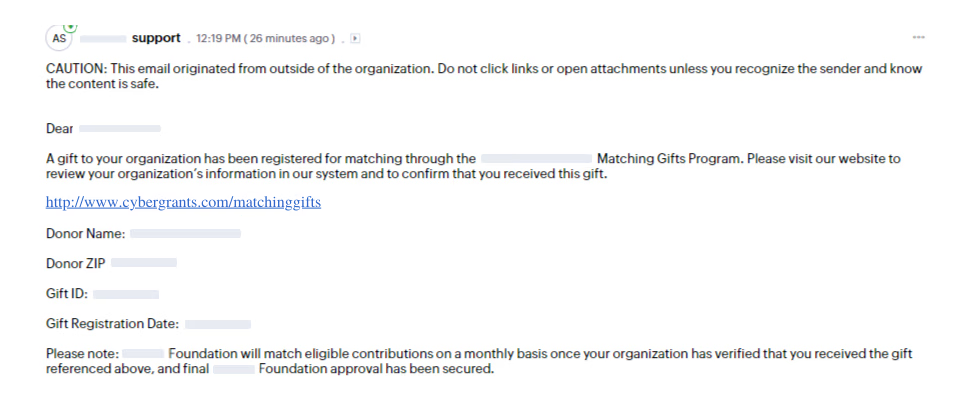
While it can vary from one platform to the next, the reconciliation workflow typically follows five operational steps:
- Securely log into the target third-party CSR vendor platform.
- Navigate to the backend admin dashboard and locate the “Giving,” “Payments,” or “Transactions” infrastructure.
- Access the comprehensive list of historical and pending disbursements for your specific organization.
- Enter the physical check number, deposit amount, or unique payment reference ID into the portal’s search database to locate the correct transaction.
- Review the online ledger, which typically lists names of contributing employees, donation amounts, match ratios, and program types associated with the payment.
Rather than manually copying this information, experts recommend that gift processing teams download the reconciliation spreadsheet (typically a CSV or Excel export) directly from the vendor portal. This asset provides a comprehensive audit trail that your finance team can use to upload the data to your internal database.
Centralization Strategies for Large Nonprofits and Federated Chapters
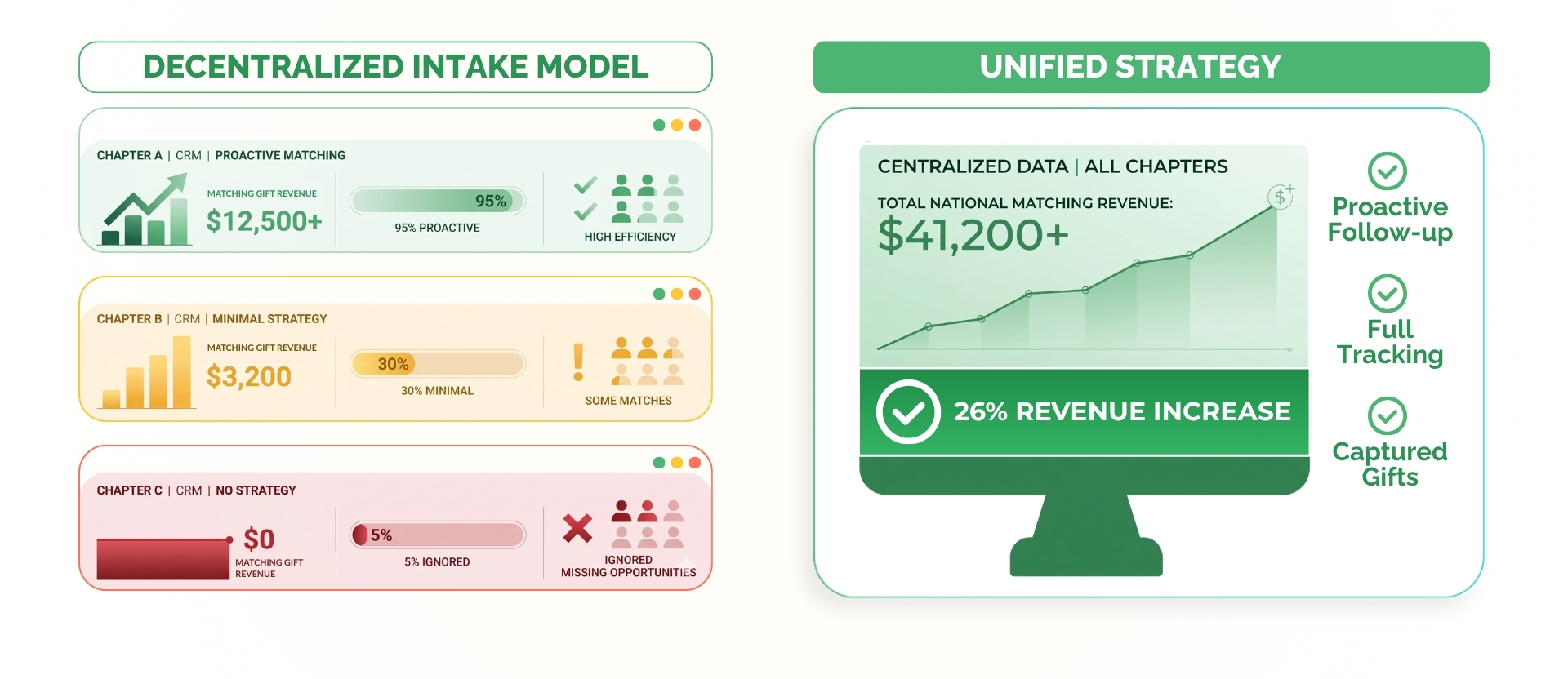
For large, multi-chapter organizations or nationwide federated nonprofits, a decentralized gift-processing model (or leaving each chapter or affiliate to its own devices) can lead to significant revenue loss and messy data.
To combat these inefficiencies, leading organizations are increasingly routing corporate philanthropy inquiries through a single, centralized team. Workplace giving centralization streamlines operations and drives massive revenue growth.
Standardizing corporate gift-processing delivers several clear organizational benefits. These include:
- Accelerated Verification Speeds. A single dedicated team can establish a highly efficient (and consistent) turnaround time for confirming corporate matching gift requests, helping your organization beat rolling corporate submission deadlines.
- Minimized Administrative Errors. Eliminating multiple uncoordinated hands from touching the same corporate gift prevents duplicate entries, accidental profile creation, and fractured records.
- Optimized Workflow Capacity. Funneling complex corporate workflows away from local teams allows field staff to stop wearing so many hats and instead focus entirely on increasingly impactful local programming. Meanwhile, advanced operations teams can build next-level automated data import systems to code and process high-volume data files with ease.
The results of such a transition can be astounding! When the Crohn’s & Colitis Foundation centralized its workplace giving process, the organization achieved a 26% increase in matching gift revenue and a 48-hour verification turnaround time in its first fiscal year.
Data Architecture & the Power of Soft Credits in CRM Management
To maintain clean donor data, your CRM architecture must distinguish between financial recognition and actual revenue. Legally, a matching gift or volunteer grant is a direct contribution from the company. That means the corporate entity must receive the hard credit within your financial ledger. However, to track donor engagement metrics accurately, the employee who initiated the match should receive a soft credit. This allows your development team to capture a 360-degree view of an individual’s impact without double-counting cash-in-the-door.
Take a look at the following example:
Let’s say a donor personally contributes $500 but secures an additional $500 via a matching gift from their employer. A properly structured CRM will reflect a $500 hard credit on the donor’s record, a $500 hard credit on the corporate record, and a $500 soft credit tied back to the donor.
This structure accurately indicates a $1,000-level supporter, ensuring they are appropriately recognized during annual giving tier evaluations.
By establishing and sustaining clean data-entry practices and integrating your fundraising software with tools like Double the Donation, your team can build a comprehensive tracking system. This will also provide you with real-time visibility into corporate giving engagements, allow you to follow up on incomplete requests, and identify top corporate partners with whom your organization can deepen relationships.
Actionable Frameworks for Modern Gift Processing Teams
To convert these insights into a reliable day-to-day routine, your development team should implement structured frameworks designed to minimize cognitive load and streamline gift processing. Here’s what we recommend:
#1: Establish a Dedicated Matching Gift Inbox
Rather than letting notifications and verification requests flood your general email accounts, we suggest creating a single, dedicated email address. (For example, matchinggifts@university.edu or workplacegiving@yournonprofit.org.) This isolates all incoming digital confirmations, portal links, and supporter inquiries into a single repository.
#2: Implement Batch Processing and Structured Imports
It’s generally not a great idea to manually key in individual matching gifts or payroll deductions as they trickle in. Instead, batch similar administrative tasks together. Processing staff can then step away from day-to-day firefighting and block out specific times to enter “workplace giving mode.” This enables them to regularly handle batch verifications and portal updates when focused and ready.
To get started, set aside a weekly two-hour window to download data from each CSR platform you’ve registered for. From there, you can clean up duplicate contacts, match transaction details, and upload large quantities of corporate payments at once.
#3: Set Realistic Timeline Expectations Across the Board
To protect donor trust, explicitly communicate corporate processing delays across all fundraising channels. Clearly state that corporate matching gifts can take weeks or months to officially arrive. This proactive transparency prevents supporters from worrying about missing credits.
Then, when the match clears the reconciliation pipeline, update the individual’s fundraising total and trigger a follow-up celebrating the win.
#4: Standardize Your Corporate Policy Reviews
Corporate philanthropic guidelines are not set in stone. Companies frequently update their match caps, adjust hour minimums for volunteer grants, or change their focus pillars. Therefore, task your gift-processing team with using a company database tool to conduct a comprehensive policy review once or twice a year. If you discover a change in your eligibility status for a specific program, log it within the company’s CRM record.
This prevents your team from wasting time chasing invalid requests and ensures your outreach strategies reflect the most accurate guidelines.
Wrapping Up & Next Steps for Workplace Giving Disbursements
Managing workplace giving disbursements and reconciliation does not have to be a huge undertaking for your team. By moving away from fragmented processing and leaning into a unified model supported by the right technology and clear data tracking, your organization can eliminate administrative bottlenecks and drive more corporate revenue to completion.
Doing so protects your data integrity, saves valuable staff time, and strengthens corporate relationships. Plus, it allows your team to focus on what matters most: advancing your mission.
Ready to Power Up Your Workplace Giving Workflows?
Find out how Double the Donation can help! Join 8,000+ nonprofits and schools in using the industry’s #1 automation solution.