Integrating Employer Data into Higher Ed Prospect Research

Prospect research is a cornerstone of modern higher education advancement. Advancement teams spend significant time analyzing wealth indicators, real estate holdings, and past giving behaviors to build donor profiles. However, traditional wealth screening often overlooks a dynamic and highly actionable variable: where an alumnus works. Relying strictly on real estate equity or static financial records frequently paints an incomplete picture, missing the liquid capital and timely opportunities that drive transformative institutional support.

Employer data is not just a line item on a spreadsheet. It is a shifting indicator of financial capacity, professional network strength, and corporate alignment. When advancement teams prioritize employer enrichment early in the research lifecycle, they move beyond static wealth estimates and gain a multi-dimensional view of an alumnus’s true giving potential. This approach allows teams to uncover major gift leads, maximize matching gift opportunities, and structure innovative corporate partnerships before a single solicitation occurs.

Revolutionizing major gift pipelines with employer data

Traditional advancement strategies often rely heavily on backward-looking metrics to determine a donor’s current affinity and capacity. By weaving real-time professional data into your cultivation strategies, your research team can uncover hidden liquidity and build an active pipeline informed by current economic indicators. This proactive approach ensures that major gift officers focus their energy on prospects with immediate, verifiable giving capacity.

Integrating employer data into higher ed prospect research for wealth screening

Traditional wealth-screening tools assess real estate values, stock holdings, and political contributions to estimate giving capacity. While these metrics are valuable, integrating employer data into higher ed prospect research provides immediate context to an individual’s liquid wealth and financial trajectory. Knowing an alumnus’s exact job title and company allows researchers to estimate salary ranges, stock options, and upcoming corporate liquidity events, such as public offerings or acquisitions. For example, when a mid-sized technology firm announces an initial public offering, a university advancement team can immediately cross-reference their database to identify alumni holding pre-IPO equity, shifting those prospects from standard annual fund tracks into major gift cultivation before their valuation surges.

Leveraging executive status to identify high-capacity alumni

Alumni who hold executive, C-suite, or foundational roles within their companies possess distinct philanthropic potential. These individuals not only have greater personal capacity but also control or influence CSR budgets, corporate foundations, and discretionary business spending. Identifying executive status in the early stages of prospect research enables advancement offices to segment these high-value leads and design highly customized cultivation tracks that appeal to both personal and corporate legacy-building.

To maximize the impact of these insights, establish a dedicated monitoring track within your CRM specifically for venture-backed and fast-growing corporate entities. Tracking when an alumnus elevates to a senior leadership role or when their company secures a major funding round provides a perfect, natural milestone for a university leadership greeting that can later mature into a principal gift conversation.

Maximizing matching gift revenue through early identification

Corporate philanthropy programs represent one of the largest pools of underutilized revenue in higher education fundraising. When advancement teams uncover these programs during the initial qualification phase rather than after a gift is processed, they can strategically scale incoming donations. Early identification transforms matching gifts from a reactive administrative task into a proactive solicitation tool.

Uncovering corporate matching gift opportunities in your alumni database

A significant portion of higher education fundraising potential goes untapped because matching gift opportunities are overlooked during the initial research phase. Thousands of companies match donations made by their employees to higher education institutions, often doubling or tripling the impact of a single gift. By systematically analyzing employer data, advancement teams can flag match-eligible prospects well before annual fund campaigns or major gift asks launch, ensuring that no corporate revenue is left on the table.

Transforming annual fund donors into major institutional impact

Matching gifts are not solely for mid-level or annual fund donors. When applied to major gifts, corporate matching programs can significantly elevate the total value of a campaign. For instance, a major donor employed by a company with a high annual matching cap can leverage their employer’s program to fulfill a significant portion of a pledge. Prospect researchers who identify these corporate guidelines early can coach gift officers to incorporate matching gift strategies directly into their solicitation proposals.

When presenting major gift proposals, researchers should provide gift officers with a personalized corporate match summary sheet for the prospect. Showing a donor exactly how their company’s specific foundation policy will absorb a portion of a five-year pledge frequently encourages the donor to increase their total commitment, knowing their personal impact is legally amplified by their employer.

Scaling fundraising impact with collaborative corporate strategies

When individual employment records are aggregated across an entire database, they reveal powerful patterns of corporate concentration. Shifting your perspective from tracking individual alumni to institutional corporate mapping enables your advancement team to design multi-tiered engagement strategies. These collaborative approaches yield higher response rates and deeper corporate integration than isolated alumni outreach.

Pooling alumni employer networks for challenge matches

When prospect research reveals a high concentration of alumni working at the same corporation, advancement teams can shift from individual tracking to an institutional strategy. A cluster of alumni at a single company represents a powerful micro-community. Advancement offices can leverage this data to establish dedicated challenge match campaigns, inviting an executive alumnus or the company’s CSR department to sponsor a challenge that incentivizes all other alumni at that firm to give, effectively pooling their collective impact.

Building strategic corporate partnerships beyond traditional giving

Employer data serves as a bridge between individual alumni giving and holistic corporate partnerships. When advancement teams understand the corporate landscape of their graduate base, they can identify broader opportunities for institutional collaboration. This includes securing corporate grants, arranging in-kind equipment donations for academic departments, opening pipelines for student internships, and creating tailored skills-based volunteer initiatives that align corporate goals with university needs.

To operationalize these networks, consider forming corporate alumni chapters at enterprises where you employ more than fifty graduates. Appointing a high-level alumnus as a corporate chair creates an internal champion who can advocate for university research grants and coordinate corporate foundation pitches directly from within the company boardroom.

Implementing automated data enrichment for long-term success

The modern workforce moves quickly, making manual database maintenance an impossible task for even the largest advancement operations. Implementing automated verification systems ensures that your prospect research team works with reliable, real-time intelligence. This systemic foundation reduces administrative friction and maximizes the ROI of your research software.

Overcoming the limitations of self-reported employment information

Alumni data degrades rapidly as graduates change jobs, earn promotions, and relocate. Relying on self-reported information from surveys or occasional email updates creates gaps and inaccuracies in the donor database. To maintain an actionable prospect pipeline, higher education institutions must shift toward automated data enrichment, ensuring that workplace profiles are updated continuously and accurately without relying on manual entry from busy advancement staff.

Creating a seamless workflow for advancement and research teams

Integrating continuous employer data enrichment into the institutional CRM removes friction across multiple departments. Prospect researchers save valuable hours that would otherwise be spent on manual verification, while gift officers receive real-time alerts about portfolio updates, such as an alumnus securing a major promotion or changing employers. This systemic approach ensures that the university’s outreach remains relevant, timely, and positioned to capture every available dollar of corporate and individual revenue.

Ensure your automated data enrichment workflows include a data governance policy that flags significant professional updates for immediate review. When an alumnus updates their title to vice president or higher, the system should instantly trigger a workflow task for the prospect research team to run a fresh capacity screening, ensuring high-value career milestones never go unnoticed in your database.

By transforming employer data into a core pillar of your advancement strategy, your institution can build a self-sustaining pipeline of deeply engaged, high-capacity supporters. Prioritize automated professional enrichment to equip your fundraising team with the actionable, real-time intelligence needed to secure transformative major gifts and optimize corporate partnerships.


Wrapping Up

Transforming employer data from a passive field in a database into a dynamic fundraising catalyst requires a deliberate shift in advancement strategy. When higher education institutions move beyond static wealth indicators, they position themselves to capture immediate liquidity, maximize corporate matching revenue, and build deeper, institutional-level partnerships.

Prioritizing automated data enrichment ensures that your prospect research team spends less time manually verifying outdated records and more time delivering actionable intelligence to major gift officers. This proactive methodology transforms the cultivation process, allowing universities to engage alumni at the exact moments of peak career milestones and corporate alignment.

To sustain this momentum over the long term, establish an annual audit of your database enrichment workflows to measure the correlation between updated corporate profiles and increases in matching gift revenue. This concrete data not only validates your technology investment but also provides clear metrics to guide your advancement team’s future solicitation priorities.
Modernizing the Gift Processing Cycle: A Higher Ed Guide


QUICK SUMMARY
A modern gift processing cycle is the operational backbone of any successful college or university advancement team. In the fast-paced world of higher education fundraising, the speed, accuracy, and security with which a donation is processed directly impact an institution’s bottom line. An efficient workflow turns administrative tasks into strategic opportunities for growth, stewardship, revenue, and more.

Transitioning an advancement office away from legacy systems toward a digital-first framework requires a comprehensive review of every operational touchpoint. From the moment a donor lands on your giving page to the final ledger entry in your institution’s financial database, every step must be optimized for speed and clarity.

By embracing modern financial technology and automated tracking, university fundraisers can eliminate processing friction, protect donor intent, and uncover substantial pools of unclaimed corporate support. And we’re here to show you how you can do so!

  1. Enable modern payment methods.
  2. Integrate matching directly within the donation process.
  3. Automate designated fund accounting (and route matches to those same funds).
  4. Implement split-receipting for event tickets and more.
  5. Track and report on donor engagement metrics.
  6. Prioritize registration and recertification with CSR portals.
  7. Plan for Donor-Advised Funds and Qualified Charitable Distributions.
  8. Count soft-credited donations toward higher giving levels.

Read on to explore our expert-proven processing strategies, recommended by institutions like the Florida Institute of Technology, University of San Diego, and more.

1) Enable modern payment methods.

Modern donors expect the same seamless transaction experience on a university giving website that they encounter when shopping online. Requiring a supporter to locate their physical wallet, pull out a credit card, and enter a 16-digit number introduces significant friction into the gift-processing cycle. This friction frequently leads to abandoned shopping carts and incomplete donations, especially during time-sensitive fundraising campaigns like annual giving days.

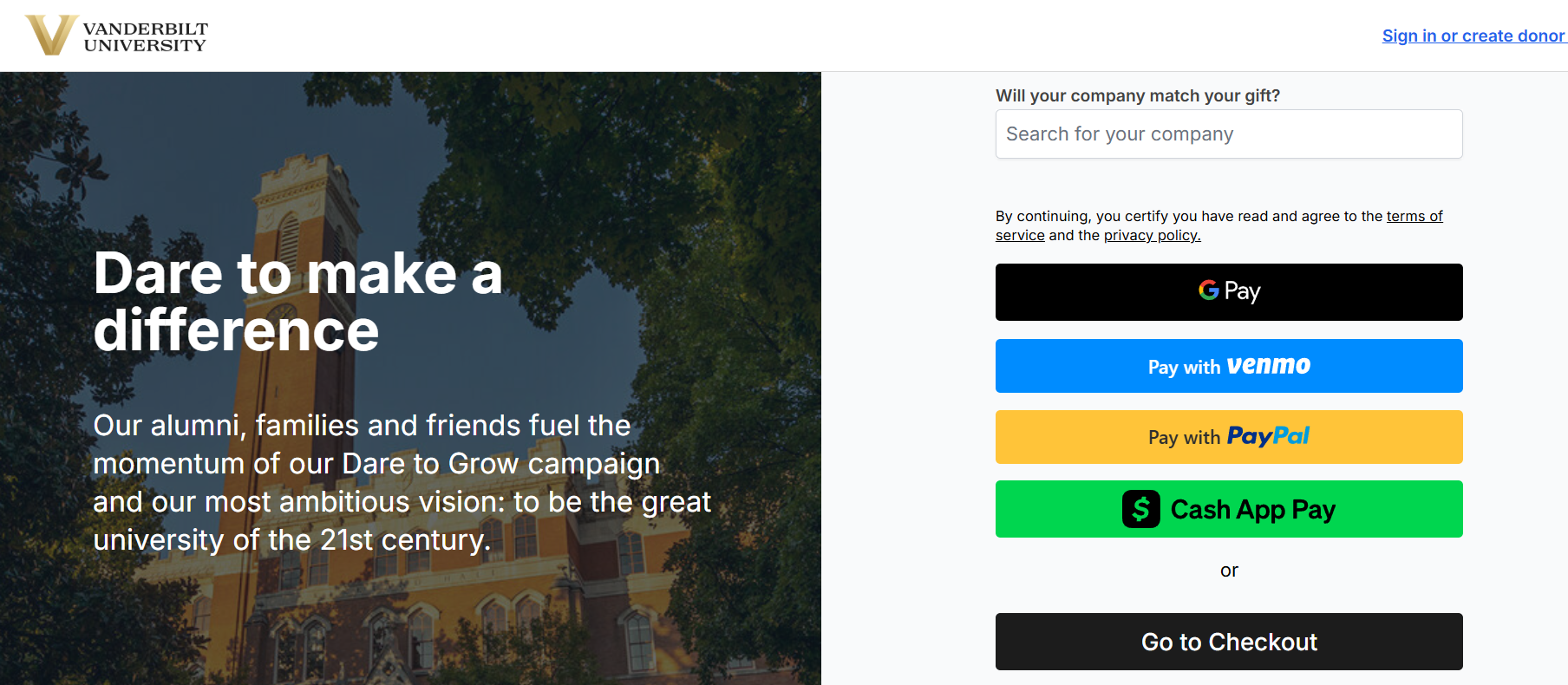
To maximize conversion rates, higher education institutions should be integrating modern digital payment options into their checkout systems. Adding digital wallets like Apple Pay and Google Pay allows mobile users to complete a secure transaction in seconds with a simple biometric scan. Not to mention, offering modern bank transfers through services like Venmo and PayPal, or direct ACH processing, gives donors the flexibility they desire while reducing standard credit card transaction fees.

How Vanderbilt University modernized the gift processing cycle

2) Integrate matching directly within the donation process.

Corporate matching gift programs represent a multi-billion-dollar opportunity for higher education institutions, yet a massive portion of these funds goes completely unclaimed because donors simply do not know that their employers offer the benefit. And unfortunately, waiting until weeks after a transaction has cleared to mail out a matching gift appeal rarely yields results. To capture these lucrative corporate dollars, advancement offices must integrate employer lookup tools directly into the primary donation interface.

Daniel Blucker, FIT’s Director of Advancement Services, recently joined a panel at Double the Donation’s Workplace Fundraising Summit to discuss effective matching gift processing and its role in donor stewardship. In this conversation, Blucker shared many actionable strategies that other higher ed institutions can draw on. Notably, he emphasized that matching should never be treated as an administrative burden tacked onto the end of a transaction, but rather as an essential, organic element of the primary giving pipeline.

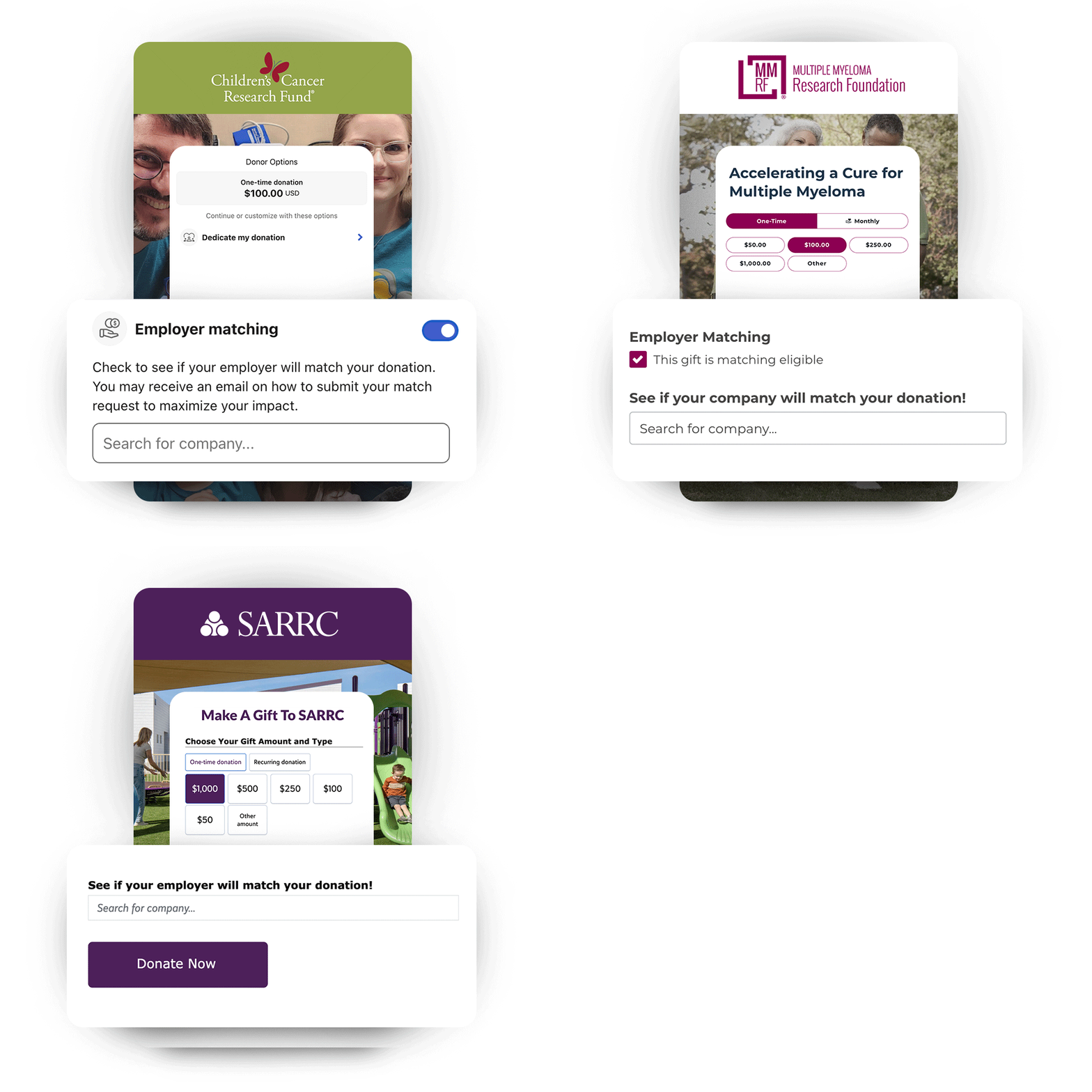
By implementing matching gift search tools directly within their giving forms, the Florida Institute of Technology empowers donors to check their companies’ matching gift policies in real time as they give. This continuous integration ensures that each online supporter is prompted to double their impact before they even leave the page.

3) Automate designated fund accounting (and route matches to those same funds).

Colleges and universities often manage complex, multi-tiered financial structures containing hundreds of distinct restricted accounts, varying from specific athletic teams to niche academic research funds. Tracking individual donor restrictions manually can quickly become an absolute operational nightmare for your advancement services team. For this reason, experts typically recommend opting for a single primary donation form with multiple designation options rather than implementing a unique form for every need.

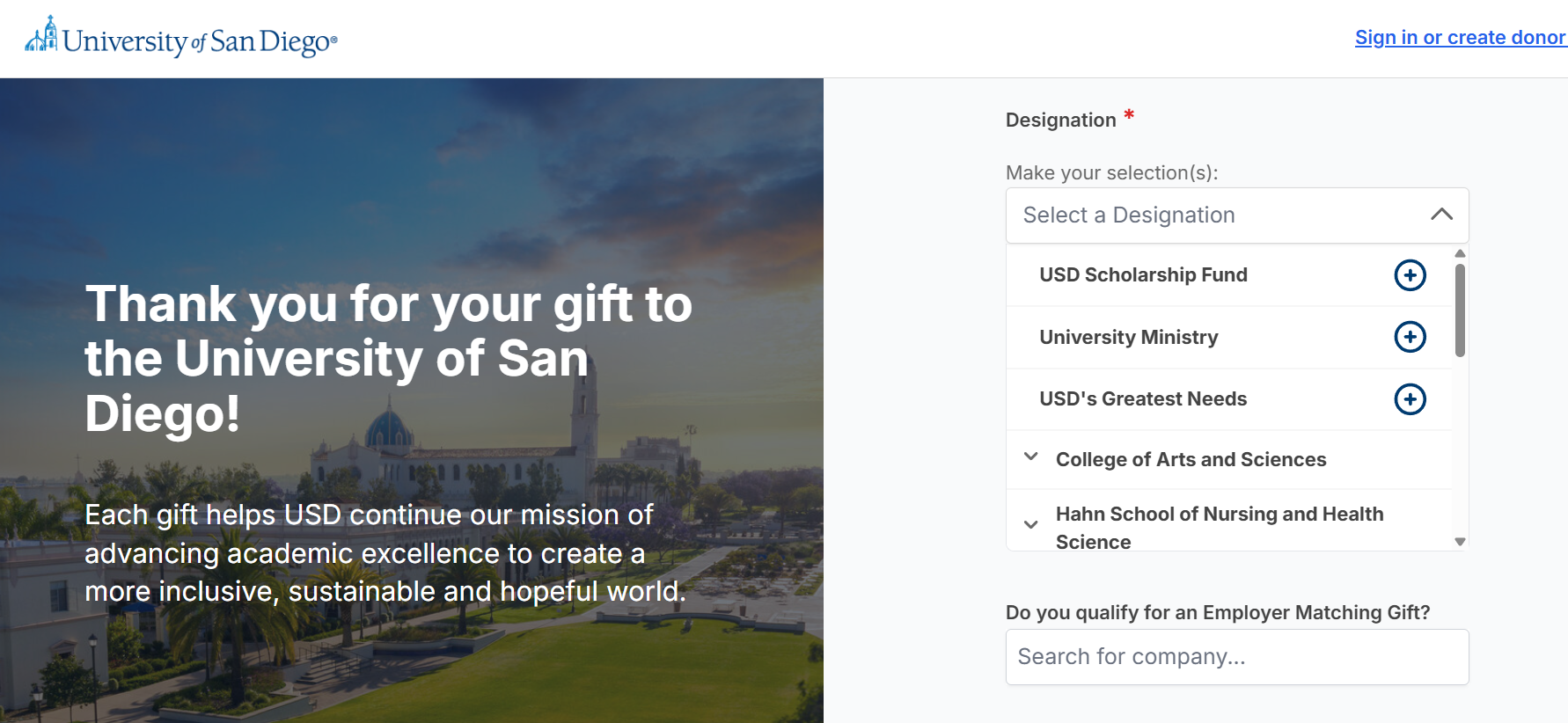
To address this challenge, the University of San Diego successfully optimized its digital footprint by shifting away from a massive library of more than 150 separate forms. Instead, its advancement team built a single streamlined form with a searchable field for intended designations.

How USD modernized the gift processing cycle

Streamlining your front-end web forms also makes it much easier to automate restricted fund accounting on the backend. When a donor selects a specific designation from a dropdown menu, your fundraising software should instantly tag the transaction with the correct general ledger allocation code.

From there, the automated tagging should also extend to any incoming corporate match funds generated by that transaction. When a matching gift check or electronic payout arrives later, the system must recognize the original donor intent and route the matching portion to that same designation.

4) Implement split-receipting for event tickets and more.

Higher education fundraising often involves complex transactions where a donor receives something of material value in exchange for their payment. Typical examples include purchasing a ticket to an alumni gala dinner, buying a spot in a university charity golf tournament, or participating in a high-value charity auction. In these scenarios, the transaction cannot be treated as a purely tax-deductible contribution, which requires your advancement services team to execute split-receipting.

Split-receipting divides the total transaction value into two clear components: the Fair Market Value of the goods or services received by the participant, and the remaining tax-deductible donation amount. For instance, when an alumnus purchases a $200 ticket to a fundraising gala that includes a catered meal worth $50, only $150 would count as a tax-deductible contribution.

Isolating these values at the time of purchase makes tax season and matching gift requests much simpler for your supporters. Most corporate matching guidelines strictly prohibit matching the non-deductible portion of a gift that includes personal benefits such as meals, entertainment, or merchandise. By providing a clean, pre-split receipt, you give donors the exact documentation they need to submit an accurate match request to their employer’s CSR portal.

This transparency reduces payment processing delays, protects your institution’s compliance with Internal Revenue Service regulations, and prevents corporate audits from stalling your incoming matching revenue.

5) Track and report on donor engagement metrics.

Data-driven higher education advancement operations rely on clean, accessible metrics to evaluate the overall health of their fundraising pipelines. Tracking basic donation totals is no longer enough. Instead, teams must monitor detailed donor engagement metrics to understand how supporters interact with the institution. These metrics should include donor retention rates, gift frequency, email click-through rates, and more across all supporter segments.

Plus, experts recommend that schools and other nonprofits explicitly include KPIs related to matching gift performance in their broader engagement metrics to increase organizational buy-in for corporate matching.

During his panel presentation, Daniel Blucker of Florida Tech highlighted how tracking matching behaviors within the school’s broader internal engagement scoring system motivated its entire advancement team to prioritize corporate giving:

“We included matching in our engagement metrics. We make sure that when somebody donates and completes a match, they get boosted above someone who just donates. That helps provide more visibility to those particular donors. When we focus on them for annual fund appeals and similar campaigns, we make sure those people are in the mix because they are worth more than a donor who is not engaged with matching.”

In other words, when matching gift milestones are tracked as primary success indicators, university fundraisers begin to view workplace giving as a strategic revenue driver rather than a back-office administrative task.

6) Prioritize registration and recertification with CSR portals.

Corporate social responsibility (or CSR) vendors serve as technical gatekeepers for corporate support, including matching gifts, payroll giving, volunteer grants, and more. When an employee submits a request on behalf of your university, the payout is typically processed through one of these secure third-party portals. If your institution fails to register with or provide banking details for these platforms, the match requests will stall and eventually be canceled.

For this reason, university advancement teams must prioritize official platform registration and complete the required annual recertifications across all major CSR systems to maintain a smooth gift processing cycle. The FIT team recently emphasized the value of securing portal access:

“My gosh, all the information is there, but if you don’t register and maintain that login, you won’t have it.”

Ensuring your team maintains active login credentials and keeps your federal tax ID numbers, direct deposit details, and institutional name listings up to date is essential to unlocking the data needed to effectively reconcile lump-sum corporate checks.

7) Plan for Donor-Advised Funds and Qualified Charitable Distributions.

Major gift pipelines at higher ed institutions are increasingly driven by non-traditional giving vehicles like Donor-Advised Funds (DAFs) and Qualified Charitable Distributions (QCDs). Therefore, having a clear operational workflow for processing these contributions is vital.

Because these funds arrive from financial custodians rather than personal accounts, gift processing teams must follow distinct accounting workflows to maintain regulatory compliance:

  • Manage hard and soft credit splits: For DAFs, the primary hard credit belongs to the financial sponsor (e.g., Fidelity Charitable), while the individual supporter receives a soft credit. For QCDs, on the other hand, the hard credit is assigned directly to the individual, but must be explicitly flagged as an IRA distribution.
  • Verify origin and sponsor rules: Ensure that QCD funds originate directly from an IRA trustee, as these transfers cannot touch the donor’s personal account and cannot legally be transferred into a DAF or private foundation.
  • Deploy specialized acknowledgment language: Written receipts for QCDs must explicitly state that the contribution came from an IRA custodian and that no goods or services were provided. However, it should omit standard tax-deductible language so the donor does not accidentally double-claim the deduction.

Connecting these asset-based contributions to dynamic matching programs allows advancement teams to maximize the value of every incoming distribution. Many prominent employers (such as Bank of America, Chevron, and American Express) match grant distributions recommended by DAF accounts, provided the employee presents valid documentation from the receiving university. In this case, using a matching gift database makes it easy for donors to navigate complex corporate guidelines and double their institutional impact.

8) Count soft-credited donations toward higher giving levels.

Soft-crediting is an essential administrative tool that allows a university to recognize a supporter’s influence over a financial contribution, even when the legal tax credit belongs to a separate entity. This scenario occurs every time a donor initiates a corporate matching request or recommends a grant from a Donor-Advised Fund. If your system only tracks hard-coded legal tax receipts, your data will fail to reflect your supporters’ true institutional impact.

Counting soft credits toward university giving circles and leadership levels enables advancement teams to accurately reflect their supporters’ true lifetime value. If a loyal alumnus contributes $5,000 personally every year and consistently uses their employer’s matching program to bring in an additional $5,000, their true annual value to your campus amounts to $10,000 or more.

FIT’s Daniel Blucker highlighted that higher education institutions should intentionally factor these matches into their internal recognition ladders:

“As we connect the credit for matching gifts, we include it [within giving level tracking] so we can boost them into whatever category or other goals they are trying to reach all the faster.”

Refining your processing workflows to count soft-credited funds toward lifetime giving totals drastically improves the quality of your stewardship efforts. Donors appreciate it when an institution acknowledges the full scope of their philanthropy, and such recognition paves the way for higher retention rates and future engagements. Plus, by ensuring matches actively elevate donors into higher engagement tiers, universities create a powerful incentive for supporters to complete their corporate match requests each time they give.


Final Thoughts for Colleges and Universities

Modernizing your gift processing cycle is far more than a simple back-office software upgrade. It’s a strategic evolution that empowers your advancement office to operate at peak efficiency.

Higher education institutions no longer afford to rely on fragmented, legacy systems that slow down processing times, obscure donor metrics, and allow valuable corporate support to slip through the cracks. By breaking down internal silos and embracing fully integrated technology systems, your university can build a smooth, frictionless giving experience that delights your supporters and protects their true intent. Investing in a modern, automated workflow ensures that every donation is captured with ease, giving your advancement team the clean data and financial resources required to drive long-term institutional success.

To continue learning, check out the following insightful resources:

Ready to Power Up Your Gift Processing Cycles?

Find out how Double the Donation can streamline processing workflows for matching gifts, volunteer grants, payroll deductions, and more!

Book a Demo With the Industry’s #1 Automation Solution →

Matching Gift Processing FAQ: Your Top Questions, Answered


QUICK SUMMARY
Implementing a structured system for matching gift processing is essential in modern fundraising. This guide addresses frequently asked questions from organizations seeking to streamline corporate philanthropy, eradicate administrative bottlenecks, and capture a share of the billions in unclaimed match revenue still sitting on the table.

Many nonprofits miss out on significant funding pools simply because the mechanics of how corporate dollars move from a boardroom to a bank account remain unclear. By exploring the core operations involved with matching gift fundraising, your development team can establish a highly efficient processing system that reduces friction and scales your annual revenue.

These are the most common inquiries we hear from nonprofits like yours:

In this FAQ guide, we’ll walk through each one, providing detailed responses to guide your organization’s processing efforts. Let’s begin!

How does the matching gift fulfillment lifecycle typically work?

Matching gift fulfillment is a structured progression that transforms a donor’s charitable intent into realized corporate funding through their employer. While it can vary from one company to the next, here’s how it generally works:

  1. The cycle begins immediately when an individual contributor makes a donation to a nonprofit.
  2. Once the initial gift is completed, the donor triggers the next stage by submitting a formal match request, typically through an external CSR portal selected by their company.
  3. After the donor submits this request, the process moves into the verification phase. The employing company or its designated tech vendor notifies the nonprofit to confirm both the original transaction and the organization’s valid 501(c)(3) status.
  4. Once the nonprofit’s gift processing team confirms the transaction details within the portal, the employer reviews the submission against its pre-determined guidelines.
  5. When the request passes corporate inspection, the company officially authorizes the allocation of matching funds.
  6. The final stage of the lifecycle involves the financial disbursement, which frequently occurs via batch electronic fund transfers or paper checks. The lifecycle concludes when the nonprofit receives the corporate payment, reconciling the funds against the original donor’s record.

From there, the organization is encouraged to issue personalized stewardship communications to close the loop with the supporter.

Why does a significant portion of matching gifts go unprocessed each year?

An estimated $4 billion to $7 billion in corporate matching gift revenue remains entirely untouched each fiscal year. The primary driver behind this massive deficit is a severe lack of donor awareness. While research indicates that over 26 million individuals work for companies with matching gift programs, an estimated 78% of eligible employees have no idea that their employers offer this benefit.

Additionally, there are severe technical roadblocks within nonprofit advancement departments that stall the remaining matching opportunities. For example, manual tracking systems often rely on decentralized spreadsheets, creating data silos and increasing human error. Not to mention, Double the Donation’s recent Nonprofit Corporate Engagement report revealed that 62% of nonprofits take more than a week to process a single matching gift request.
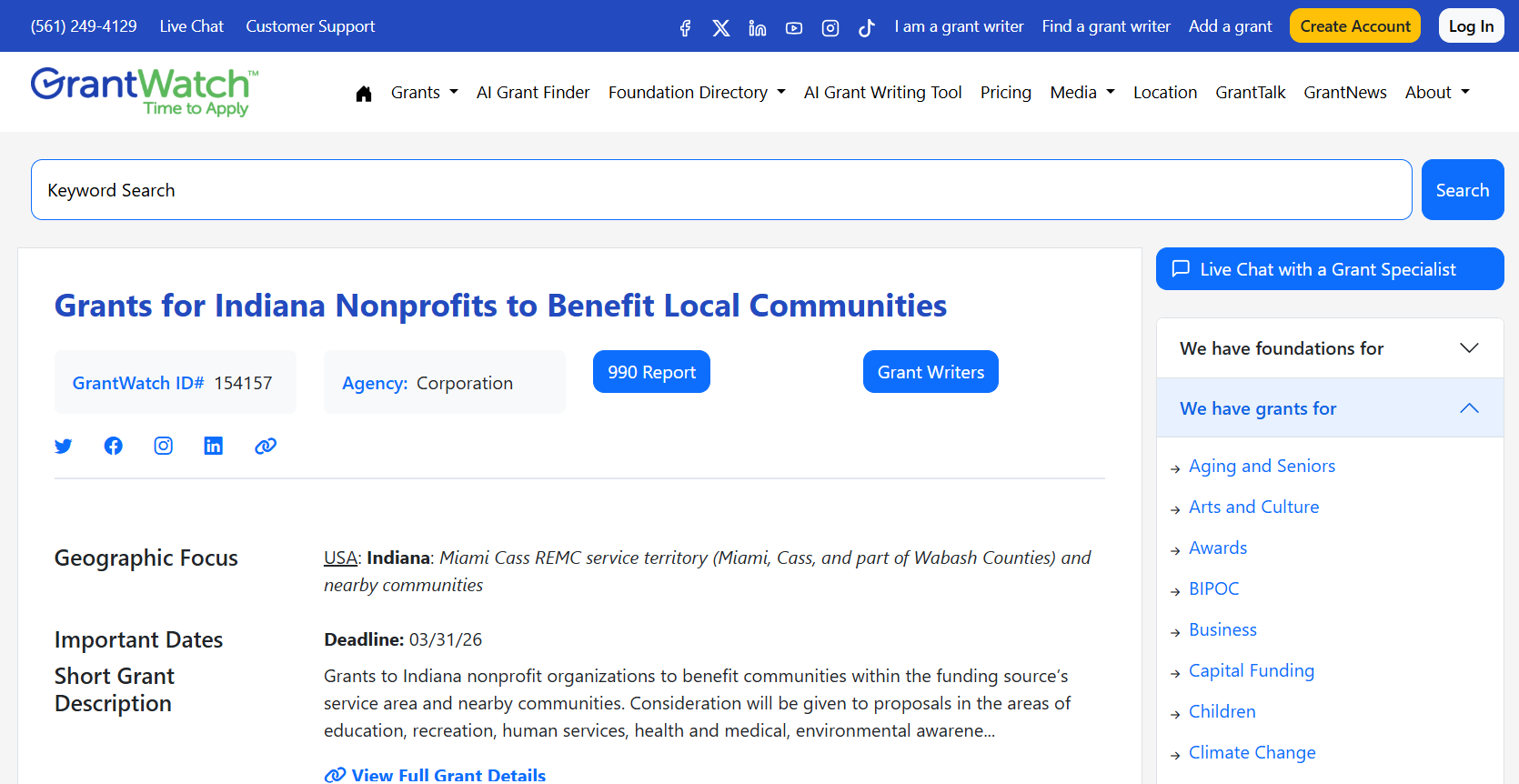
Such operational delays frequently result in missed deadlines, fragmented donor records, and expired requests. Ultimately, without integrated tools designed to flag eligibility in real time, matching gift opportunities remain overlooked.

What role do CSR platforms play in matching gift processing?

Corporate social responsibility (CSR) platforms act as the vital digital infrastructure and technical intermediaries that connect corporate treasuries to the nonprofit sector. Major corporations rarely manage the complex logistics, compliance requirements, and employee tracking of their philanthropic programs in-house. Rather, they outsource these extensive workflows to specialized, third-party CSR software systems to handle administrative vetting, validation, and capital disbursement.

For nonprofits, these solutions host dedicated (no-cost) organizational portals where gift processors must register their causes and regularly verify receipt of donations. Because every vendor maintains its own interface, verification logic, and registration requirements, it is essential to maintain active administrative credentials for each.

Who are the major CSR platforms that nonprofits should be familiar with?

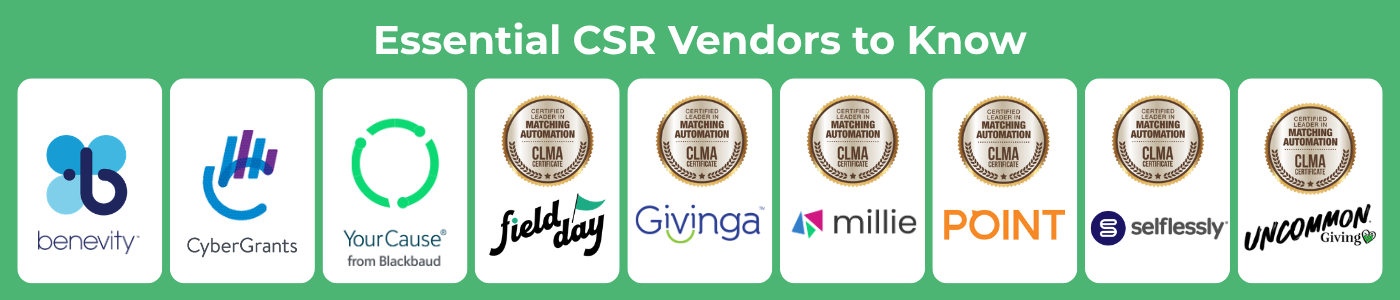
The three legacy giants that handle the vast majority of Fortune 500 workplace giving programs are Benevity, YourCause by Blackbaud, and CyberGrants, which is now a core component of Bonterra. These robust corporate tools manage massive volumes of employee requests, corporate grants, and payroll deduction distributions worldwide.

However, in addition to these leading providers, a new generation of corporate giving platforms has emerged to prioritize seamless automation and nonprofit advancement. These CLMA-designated platforms adhere to strict accessibility standards and support matching gift auto-submission through a direct partnership with Double the Donation. Currently, such platforms include Field Day, Givinga, Millie, POINT, Selflessly, and Uncommon Giving.

Essential CSR Vendors to Know to Improve Matching Gift Processing

How does matching gift processing vary by online vs. offline submissions?

The administrative workflow for processing matching gifts can vary significantly depending on whether the individual’s employer uses a modern digital submission pathway or offline, PDF, or mailed-in forms. That’s because online match processing is highly automated and initiated almost instantly at the point of transaction. If the company uses a platform that has earned the Certified Leader in Matching Automation (CLMA) designation, the donor can even auto-submit their request with a single click from the confirmation page.

Conversely, offline processing often requires substantial manual intervention and is highly susceptible to administrative friction. Offline tracking begins when a donor manually obtains paper forms, resulting in a higher rate of untracked matches, messy records, and extensive administrative chase time. However, the actual disbursement and reconciliation phases remain largely unchanged.

What steps must a gift-processing team take to verify a donation?

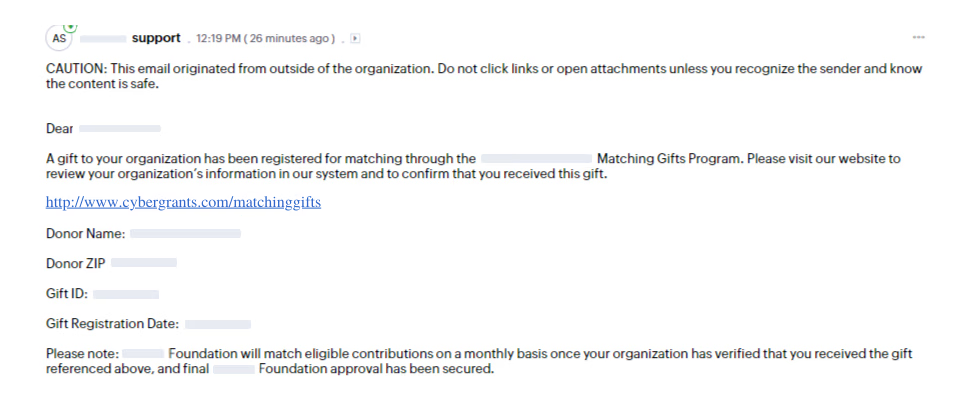
Verifying a matching gift request is a critical security measure that confirms a transaction occurred and authorizes a corporate partner to release funds. The verification process is typically triggered when the nonprofit discovers a pending request within a portal or receives an automated email like this:

Centralizing workplace giving disbursement and reconciliation with insights from CSR portal vendors

To move the request through the approval pipeline, the gift-processing team must execute the following steps:

  1. Access the specific CSR portal using the organization’s active login credentials.
  2. Locate the pending transaction queue within the platform’s transaction dashboard.
  3. Cross-reference the employee’s name, submission date, and match amount against the nonprofit’s central CRM records.
  4. Review the initial gift details to confirm it complies with the employer’s minimum and maximum thresholds.
  5. Confirm that the organization’s 501(c)(3) tax status and banking information remain up-to-date within the portal.
  6. Approve the transaction to officially release the match into the corporate payout queue.

Maintaining a strict, recurring schedule for auditing these portals is vital for operational success. If an advancement team overlooks notification emails or fails to log into corporate portals in a timely manner, the matching gift lifecycle will stall indefinitely. Such a delay can cause viable requests to expire, resulting in the forfeiture of expected revenue.

How do tools like HEPdata or Double the Donation impact match processing?

In the years since corporate matching gifts became particularly widespread, specialized fundraising software has emerged as a way for organizations to transform passive efforts into a highly proactive revenue engine.

Historically, nonprofits relied on manual research, anecdotal donor conversations, or static legacy indexing tools to identify matching opportunities. However, the primary impact of advanced matching gift software is the immediate elimination of back-office administrative burden. When you embed interactive search tools throughout the donation process, the systems can automatically tag donor records with verified employer data and trigger immediate, personalized follow-ups to drive next steps.

Improve your matching gift processing with integrated software

By replacing manual spreadsheet tracking with real-time data syncs, advanced matching gift tools like Double the Donation and HEPdata accelerate verification speeds and ensure financial accuracy. This automated framework removes the friction that leads to donor drop-off, allowing staff to spend less time on data entry and more time on stewardship.

Take a look at our comparison between the top platforms here!

How long does it take for a company to disburse matching gift funds?

The timeline for a corporation to officially disburse matching gift funds can vary widely depending on the company’s internal approval workflows and the distribution methods selected. For businesses utilizing CSR software, this review can be nearly instantaneous, whereas companies relying on manual donation confirmation may take several weeks or months to process requests.

Once a match is officially approved, the actual transfer of capital is generally dictated by fixed corporate payout schedules. Most major CSR vendors disburse funds on a monthly or quarterly basis rather than issuing single rolling payments for individual gifts. Furthermore, companies frequently batch multiple donations to reach minimum payout thresholds before releasing a distribution.

As a result of these technical batching and verification parameters, nonprofits should expect a delay of 30 to 90 days before funds reach their accounts.

How should a nonprofit record corporate disbursements within its CRM?

Accurately recording corporate matching funds in a donor database is essential for maintaining clean financial records, preventing duplicate tracking, and accurately reflecting donor impact. The most technical hurdle occurs during reconciliation, as corporate distributions frequently arrive as lump-sum checks or EFTs.

Therefore, to process these payouts correctly, a nonprofit’s gift-processing team must follow a standardized reconciliation methodology:

  1. Parse the corporate check stub or download the complete digital reconciliation sheet directly from the CSR vendor portal.
  2. Match the transaction IDs, payment dates, and split amounts back to the corresponding individual donor records in the CRM.
  3. Record the actual corporate cash receipt under the specific name of the contributing company or the distributing CSR vendor.
  4. Apply a soft credit to the individual donor’s record for the exact amount of the corporate match.
  5. Update the internal property or status field of the initial gift record from “initiated” or “pending” to “received.”

Utilizing a soft crediting strategy is the premier method for tracking lifetime constituent impact with complete precision. If a donor personally gives $500 and secures a 1:1 employer match, applying a soft credit ensures the system recognizes them as a $1,000-impact supporter without double-counting your cash flow.

How can past workplace giving data be used to improve processing?

Historical gift records contain critical markers (such as previous corporate matching patterns, individual employment histories, and past transaction velocities) that can optimize back-office workflows throughout the matching gift lifecycle.

For example, let’s say a bulk corporate disbursement arrives, but it’s missing donor context. An organization’s gift processing team can utilize past matching gift data to successfully cross-reference and reconcile the unknown payment. If its historical database shows that a group of Microsoft employees regularly request matches that take exactly 45 days to disburse, your system can automatically flag those pending records when an anonymous batch payment totaling that amount is received.

What KPIs should be tracked within a matching gift processing workflow?

Consistently tracking quantifiable benchmarks within your matching gift processing pipeline is the only way to uncover hidden operational friction and demonstrate a clear return on investment to leadership. While your specific goals and objectives can vary, the primary reporting metrics that every nonprofit team should monitor include:

  • Processing velocity, or the average number of days that elapse between an initial individual donation, the corporate validation request, and final financial reconciliation
  • Match identification rate, or the percentage of total incoming donations for which the system successfully captures verified employment data during checkout
  • Match conversion rate, or the volume of identified matching gift opportunities compared directly against the final volume of completed corporate disbursements
  • Average matching gift amount, or the typical financial size of incoming corporate matches, which helps teams calculate standard corporate match ratios
  • Staff hours reclaimed, or the reduction in manual data-entry time achieved by shifting from spreadsheets to automated workplace giving tools

Regularly auditing these foundational data points allows financial managers to identify specific corporate portals that cause administrative delays. For example, let’s say the match conversion rate dips or processing velocity slows beyond a 48-hour window. In that case, leadership can quickly intervene to refine outreach timing, update portal credentials, and optimize systems to maximize yield.

What does the future of matching gifts hold, and how can AI improve operations?

The future of workplace gift processing currently centers on transitioning from isolated, clerical routines to fully integrated, real-time data pipelines. As the corporate giving landscape continues to scale, relying on manual spreadsheet maintenance creates severe operational friction. However, artificial intelligence and other automated solutions are fundamentally streamlining this backend ecosystem.

Here are some ways these tools can help, essentially serving as a specialized extension of your administrative staff:

  • CSR portal optimization – Feed corporate portal taxonomies and character limits into large language models (LLMs) to instantly enhance program descriptions. Doing so can increase organizational discoverability across thousands of internal searches.
  • Donor data hygiene – Instruct AI to scan your database to identify life statuses, detect statistical outliers, adjust formatting discrepancies, and flag duplicate profiles. The cleaner your data, the better your fundraising results!
  • Advanced import logic – Tired of manually coding hundreds of employee contributions? An AI-enabled pipeline can automatically route each gift based on geographic identifiers such as ZIP codes and state-level data.

By flipping the script with artificial intelligence, organizations enable their systems to manage routine tasks. This frees fundraising staff to focus the majority of their time on cultivating high-touch individual and corporate donor relationships.


Wrapping Up

Understanding the intricacies of matching gift processing empowers your fundraising team to eliminate confusion and grow support through corporate channels. Leveraging modern automation tools further supercharges these efforts, removing friction for both your staff and your donors.

With these structured operational insights in place, your organization will be perfectly positioned to capture unclaimed matching gift funds and drive greater long-term impact for your core mission. Best of luck!

If you’re interested in learning more about next-level matching gift processing, we recommend the following resources:

Ready to Streamline Your Matching Gift Processing Efforts?

See why 8,000+ nonprofits and schools trust Double the Donation to enhance workplace giving identification, tracking, reconciliation, and more!

Book a Demo With the Industry’s #1 Automation Solution →

Matching Gift & Donation Processing Glossary: Key Terms

QUICK SUMMARY
An optimized donation processing glossary is essential for modern fundraising teams to capture both individual contributions and corporate revenue. This guide explores technical terms that bridge the gap between standard donation systems and advanced workflows, giving your nonprofit a clear roadmap to eliminate backend friction.

Managing a high-performing charitable organization requires a deep understanding of the digital infrastructure that powers modern transaction ecosystems. When a supporter decides to contribute to your mission, their transaction triggers a complex chain of data exchanges that extends far beyond a simple credit card authorization. To maximize your revenue potential, your staff must be equipped to navigate the technical frameworks. And that’s why we put together this helpful glossary resource!

By building a unified understanding of these operational mechanics, your development team can protect data integrity, streamline financial audits, and unlock scalable revenue streams without increasing administrative friction.


#ABCDEFGHI – J – K – LMNOPQRSTUVW – X – Y – Z

Donation processing glossary - terms that start with a number

501(c)(3)

The specific section of the Internal Revenue Code that grants federal tax-exempt status to qualifying nonprofit organizations operated exclusively for religious, charitable, scientific, literary, or educational purposes. Within donation and workplace giving processing lines, this regulatory designation serves as the primary legal baseline that payment gateways, donor databases, and corporate social responsibility filters use to authorize tax-deductible gift receipting and automatically approve corporate matching gift eligibility.

Donation processing glossary - terms that start with the letter A

ACH Payments

A specific type of electronic fund transfer processed through the National Automated Clearing House Association network. In gift processing, this framework allows nonprofits to pull recurring, pre-authorized donations directly from a supporter’s checking or savings account, offering lower transaction fees than standard credit card networks.

Attestation

The official digital confirmation step in which a donor or volunteer certifies that their gift or logged service hours completely satisfy a company’s guidelines. This validation step is required by corporate workflows before a match request can move forward to the nonprofit confirmation stage.

Auto-Submission

An advanced interface feature exclusively offered by Double the Donation and its integration partners that allows eligible donors to file their corporate matching gift application directly from a nonprofit’s confirmation page. Passing encrypted transaction tokens through secure connections eliminates extra manual steps and boosts overall submission rates.

Learn more about matching gift auto-submission here!

Donation processing glossary - terms that start with the letter B

Batch Covers

An accounting control page attached to a physical group of checks or donation records during manual processing. This sheet logs critical management fields, including the unique tracking number, record count, and total cash value, ensuring clean ledger imports.

Donation processing glossary - terms that start with the letter C

Control Totals

A systematic validation check where processing software compares initial field calculations against final data entry summaries. For example, matching the target dollar sum of a check stack against the final digital batch report ensures typing accuracy before database updates.

Corporate Giving

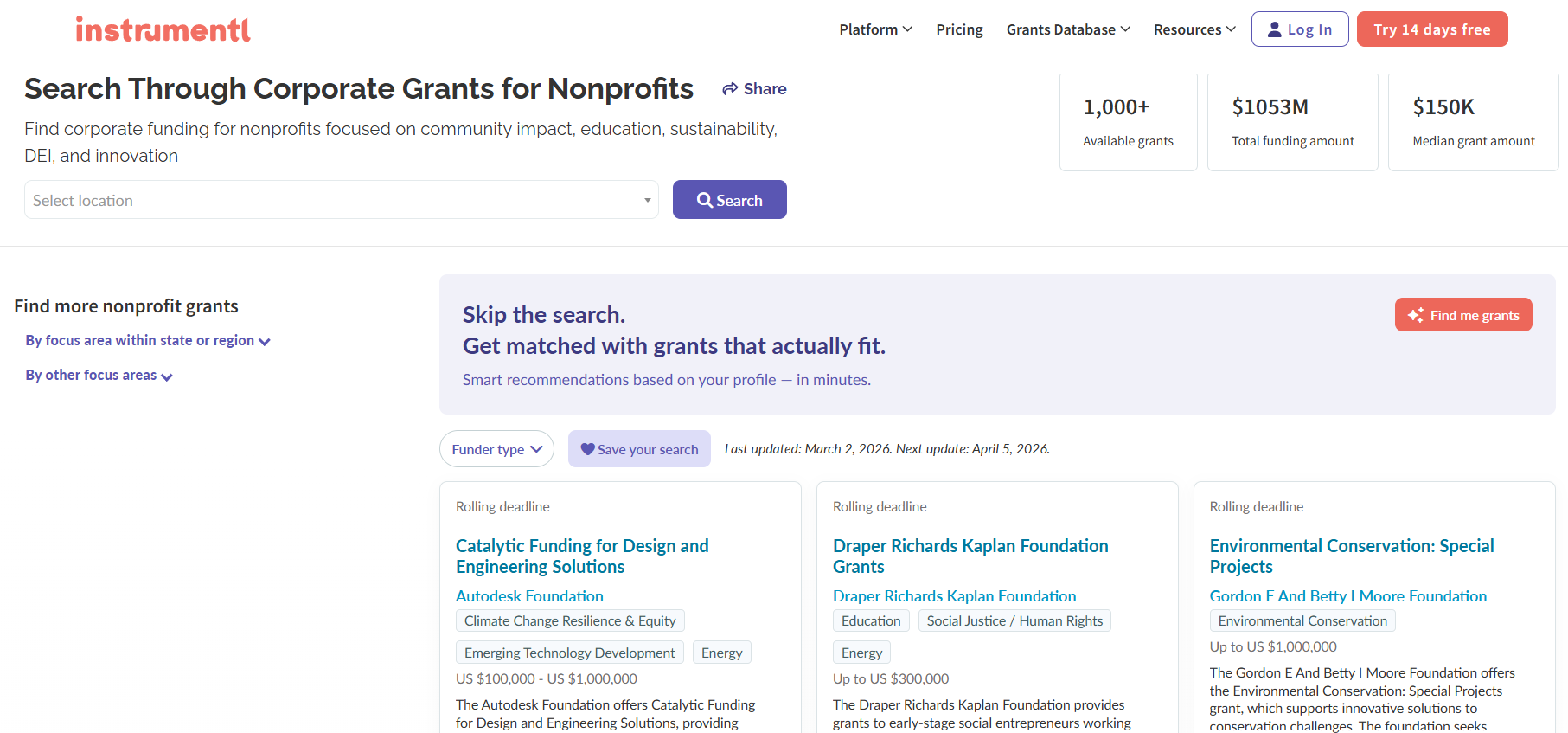
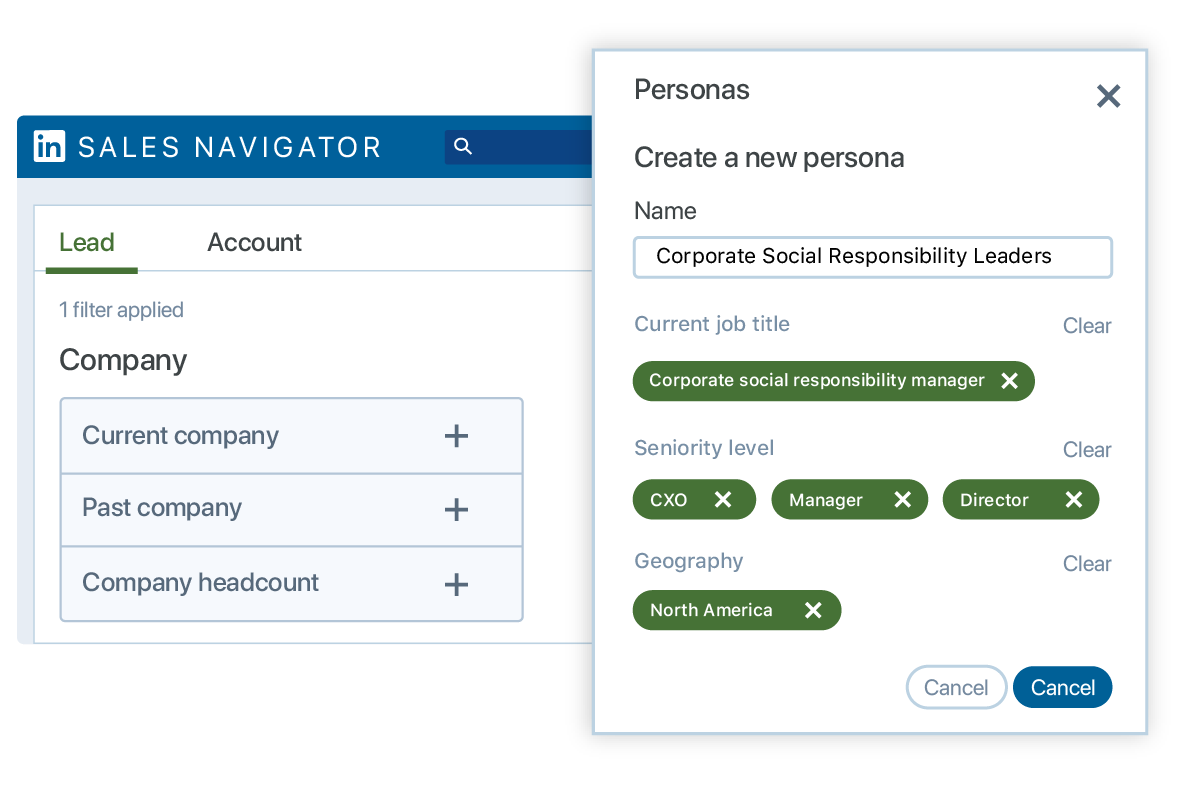
The broad framework of institutional philanthropy in which businesses allocate corporate resources, including direct cash investments, corporate foundation funding, employee matching donations, and in-kind business services, to support nonprofit organizations and community initiatives.
Learn more about corporate giving here!

CRM (Fundraising Database)

The master customer relationship management system used by a nonprofit to house all supporter history, corporate profiles, and communication logs. It serves as the central operational hub where tracking files link individual records to corporate matching data.

Explore highly recommended nonprofit CRMs here!

CSR Vendors

Third-party software engines hired by corporations to manage corporate social responsibility programs, distribute matching gifts, and track employee volunteer time. Nonprofits must register with these platforms to clear electronic funding transfers.

Learn how to register your org with leading CSR vendors here!

Donation processing glossary - terms that start with the letter D

Data Dictionary

A technical metadata guide that defines the exact structure, name formatting, and character limits for every data field used in an organization’s information setup. It serves as an integration rulebook to prevent file transfer errors during donor software updates.

De-Duplication

The database cleaning process that scans incoming contact details to identify and merge identical user profiles. Clean matching rules prevent system errors, such as sending repetitive appeals or email follow-ups to a single donor.

Donation (Gift) Processing

The comprehensive sequence of capturing, validating, recording, and depositing incoming charitable contributions. This core administrative pipeline transforms raw cash, checks, or digital tokens into accurate accounting data and completed bank settlements.

Learn more about modern gift processing strategies here!

Donor-Advised Funds (DAF)

A specialized financial account managed by a public charity that allows individual donors to make tax-deductible contributions and later recommend grants to nonprofits. Processing these transactions requires attributing the bank credit to the managing fund manager while tracking the original individual for stewardship purposes.

Learn more about effective DAF processing here!

Double the Donation

The industry-leading workplace giving automation platform and comprehensive corporate philanthropy database. For gift processing teams, this tech-for-good software integrates directly with online fundraising pages and donor management portals to instantly identify match-eligible supporters, automate personalized email reminders, and power secure auto-submission protocols that unlock matching gift revenue, volunteer grants, and payroll contributions with zero administrative friction.

Learn more about Double the Donation here!

Donation processing glossary - terms that start with the letter E

Electronic Funds Transfer (EFT) Payments

An overarching umbrella term for any digital transfer of money from one bank account to another, encompassing wire transfers, direct deposits, credit card settlements, and online banking transactions. Within corporate social responsibility systems, this broader method handles the electronic delivery of large, aggregated employee payroll donations and matching gift distributions directly into a nonprofit’s bank account.

Employee Giving (Workplace Giving)

A category of corporate giving programs that allow corporate employees to support eligible 501(c)(3) nonprofit organizations and educational institutions directly through matching gifts, volunteer grants, payroll deductions, and more.

Learn more about the programs here!

Employer Identification

The critical validation workflow in which a supporter profile is linked to their current employer within a fundraising database. This employment data, whether collected directly through engagement (such as on a donation form or volunteer registration) or an appending service, allows software to instantly check corporate matching gift rules and trigger automated outreach campaigns.

Learn more about the value of employer data here!

Donation processing glossary - terms that start with the letter F

Fair Market Value (FMV)

The objective estimated retail price that a donated corporate product or specialized professional service would sell for on the open commercial market. When processing in-kind donations, such as technology equipment or pro bono legal services, both the corporate donor and the recipient nonprofit must utilize this valuation standard for tax and accounting tracking.

Fund Coding

The systematic assignment of alphanumeric tracking codes to incoming contributions, which routes them to the correct financial categories. This system maps every gift to its specific campaign, division, or legal spending restriction in the master ledger.

Donation processing glossary - terms that start with the letter G

General Ledger

The master financial record repository that houses an organization’s entire accounting history. Gift processing teams must ensure that daily donation batches align perfectly with general ledger entries to guarantee accurate audit compliance.

Gift Receipting

The regulatory workflow for generating and sending official tax acknowledgments to contributors. These legal documents must state the total cash value received, confirm tax-exempt status, and specify if any goods or services were provided in exchange for the gift.

Gift Sorting

The early administrative step of organizing incoming mail, physical checks, and digital transaction files by payment category or campaign type. Grouping similar payment streams streamlines verification routines and keeps processing lines running efficiently.

Gift Valuation

The process of determining the objective economic value of non-cash contributions, such as physical equipment or professional pro bono services. Teams utilize fair market value standards to record these assets on balancing ledgers without violating regulatory guidelines.

Donation processing glossary - terms that start with the letter H

Hard Credits

The primary database entry that logs the explicit legal ownership of a financial payment to the exact legal entity that issued the funds. For instance, a matching check from a business creates a hard credit on that company’s corporate profile.

Learn more about hard credits for donation processing here!

HEPdata

A legacy matching gift software provider that assists nonprofit organizations in identifying match-eligible supporters within their donor bases. In donation processing systems, this platform provides company lookup tools and automated follow-ups to help organizations discover corporate giving benefits and capture missing corporate matching dollars.

Learn more about HEPdata here!

Donation processing glossary - terms that start with the letter I

In-Kind Donation

A non-cash contribution of tangible goods, software licenses, physical commodities, or professional pro bono services provided directly to a nonprofit organization. For gift processing teams, these assets require unique database tracking to record their objective fair market value at the time of receipt, ensuring accurate corporate tax receipting and compliance with standard nonprofit accounting audit guidelines.

Learn more about in-kind donations here!

Internal Controls

The collection of tracking rules, data protocols, and validation methods deployed to safeguard financial assets and prevent accounting fraud. These systematic boundaries ensure that every step of the donation process is fully tracked and verified.

Donation processing glossary - terms that start with the letter L

Lifetime Value (LTV)

A strategic fundraising metric that calculates the total net contribution amount a single donor provides to a nonprofit over the entire duration of their relationship. Within gift processing and workplace giving ecosystems, this calculation must dynamically account for both the donor’s personal out-of-pocket transactions and the associated soft credits from corporate matching gifts, payroll giving, and volunteer grants to accurately reflect the true financial impact of that supporter.

Lump Sum Disbursements

A consolidation method where a corporate giving manager or vendor combines multiple individual employee donations or matching gifts into a single bank transfer. Processing teams must break down the accompanying data layouts to distribute credits to individual profiles.

Donation processing glossary - terms that start with the letter M

Matching Gifts

A widespread form of corporate philanthropy where a company matches the charitable contributions made by its employees to eligible nonprofit organizations. Within the gift processing framework, when a supporter makes an initial donation, the processing system flags their employer, tracks the match request from inception through fulfillment, and automatically applies a secondary soft credit to the donor’s profile once the company disburses the matching funds.

Learn more about matching gifts here!

Merchant Account

A specialized bank account established by a nonprofit that enables the organization to accept and process digital payments, including credit cards, debit cards, and electronic checks. In the fundraising pipeline, it serves as the necessary holding destination where secure transaction tokens are converted into cash deposits before the funds are officially transferred to the nonprofit’s primary operating bank account.

Donation processing glossary - terms that start with the letter N

NTEE Codes

The National Taxonomy of Exempt Entities code is a highly structured alphanumeric classification system used by the IRS to categorize nonprofit organizations based on their primary institutional purpose, mission focus, or operational field of activity. Corporations frequently configure their automated giving programs to dynamically approve or decline match applications based on these codes.

Donation processing glossary - terms that start with the letter O

Online Donation Platforms

The customer-facing digital software utilities that host checkout pages and capture online credit card payments. These tools must integrate smoothly with lookup systems to identify corporate match opportunities immediately during checkout.

Learn more about highly recommended donation platforms here!

Donation processing glossary - terms that start with the letter P

Payment Processors

The financial tech vendor that serves as the secure middleman for transmitting credit card and electronic check details between a donor bank and a nonprofit merchant account. They authenticate payment security parameters for settlement.

Learn more about highly recommended payment processing tools here!

Payroll Deductions

An automated giving method in which a donation is deducted directly from an employee’s salary during their regular pay cycle. The collective funds are handled as a stable, recurring revenue pipeline that settles through bulk corporate disbursements.

Learn more about payroll giving programs here!

Donation processing glossary - terms that start with the letter Q

Qualified Charitable Distributions (QCD)

A direct financial distribution made from an individual retirement account to an eligible non-profit organization. Because these funds move directly from the tax-advantaged account, processing rules require unique handling to ensure the donor receives an accurate, non-deductible receipt.

Learn more about effective QCD processing here!

Donation processing glossary - terms that start with the letter R

Record Reconciliation

The mandatory accounting step of cross-referencing your internal donor database transactions against actual bank deposits. Spotting and correcting variances ensures that your general ledger is perfectly balanced for auditing schedules.

Remittance Slips

The paper form or document returned alongside a donation check that provides clear instructions on how the funding should be applied. These notes outline donor intent and state specific designations for the gift processing team.

Remote Deposit Capture

A physical check scanning technology that allows processing staff to digitize and deposit paper checks directly from their office computer. This tool eliminates the need for manual trips to the bank, drastically reducing payment settlement lag times.

Restricted Gift

A charitable contribution that is designated by the donor for a specific program, project, campaign, or purpose. Within the gift processing workflow, these funds must be tagged with unique tracking codes to ensure they are allocated to the correct ledger accounts and spent in strict accordance with the donor’s explicit legal intent.

Restrictive Endorsement

A security stamp applied to the back of a physical check the exact moment it is opened, limiting its use to a specific non-profit bank account. This basic internal control minimizes the risk of fraud before the check enters the processing lines.

Donation processing glossary - terms that start with the letter S

Securities & Stocks

Charitable gifts provided in the form of corporate investment shares rather than standard liquid cash. Processing pipelines require coordinating with investment brokerages to track the exact fair market value at the time of transfer before liquidating the assets.

Separation of Duties

An essential internal security protocol that requires separate staff members to handle different parts of the financial pipeline. For example, ensuring the person who opens mail checks cannot also approve general ledger modifications blocks internal fraud.

Soft Credits

A secondary database credit that recognizes a specific supporter role in motivating or arranging a donation without naming them as the legal donor. Nonprofits use soft credits to map matching gifts back to the individual employee who applied for the corporate match.

Learn more about soft credits for donation processing here!

Split Receipting

The advanced calculation method used to create a tax document when a donor receives a physical item or benefit in exchange for their gift. The receipt must separate the total transaction cost from the true tax-deductible amount.

System Integration

The structural connection that allows payment forms, donor management tools, and workplace platforms to share data points seamlessly. Strong connections eliminate the need for manual file exports, saving administrative staff time.

Donation processing glossary - terms that start with the letter T

Tax-Deductible Amount

The explicit portion of a charitable contribution that a supporter can legally claim for annual tax deduction benefits. This value equals the total cash received minus the fair market value of any perks given back to the donor.

Transaction Fee

The processing charge assessed by financial intermediaries, including payment processors, merchant account providers, and credit card networks, for securely routing and settling a donation. These friction costs are typically calculated as a fixed cents-per-transaction fee plus a variable percentage of total gift volume.

Donation processing glossary - terms that start with the letter U

Unrestricted Gift

A charitable contribution given with no donor-imposed limitations, allowing the nonprofit to allocate the funds wherever the operational need is greatest. During the gift processing sequence, these transactions are directed to the organization’s general operating fund.

Donation processing glossary - terms that start with the letter V

Verification

The official administrative check in which a nonprofit confirms, within a corporate giving platform, that a supporter base donation actually cleared their bank gateway. This validation step is mandatory before a business will release matching funds.

Volunteer Grants

A corporate giving incentive⁠ where companies award monetary grants to nonprofits where their employees regularly volunteer. The software tracks cumulative service hours over a defined period and triggers a corporate grant payout once the hours are verified. Also known as “Dollars for Doers” programs.

Learn more about volunteer grants here!

Donation processing glossary - terms that start with the letter W

Workplace Gift Processing

The combined operational workflow of tracking, auditing, and recording contributions originating from employer-sponsored corporate donation initiatives. This track handles the complex data layers needed to balance individual donations alongside corporate matching checks.

Learn more about workplace gift processing here!


Wrapping Up

Upgrading your internal processing and workplace giving vocabulary is a critical step toward building a more resilient and integrated fundraising operation. When your database administrators and finance teams master the appropriate terminology, your organization can actively prevent data corruption, eliminate manual tracking errors, and speed up corporate giving timelines.

For more information on next-level gift processing strategies, we recommend checking out these additional resources:

Ready to Power Up Your Processing Workflows?

Find out how Double the Donation can streamline processing for matching gifts, volunteer grants, payroll deductions, and more!

Book a Demo With the Industry’s #1 Automation Solution →

How to Manage Workplace Giving Disbursements & Reconciliation

Before diving into the complex world of corporate philanthropy management, fundraising leaders must establish a clear framework for handling incoming corporate funds. Managing workplace giving disbursements and reconciliation is a critical yet frequently overlooked component of a modern nonprofit toolkit. This guide explores how to establish rigorous tracking systems, navigate corporate vendor portals, leverage automation technology, and centralize processing operations to ensure your organization captures, attributes, and reconciles every single dollar of workplace giving revenue.

The final phase of the workplace giving lifecycle begins when a corporation releases funds; yet for many accounting departments, this milestone marks the start of a prolonged administrative bottleneck. When a corporate entity approves employee-driven philanthropic actions, the financial distribution does not arrive as an instantaneous or perfectly transparent transaction. Instead, the revenue moves through external digital channels, clearinghouses, and payment processors before reaching your bank account. To maintain financial compliance and prevent severe reporting discrepancies, development teams must understand the precise backend mechanics that govern how corporate funds are grouped, transmitted, and verified.

The Anatomy of Workplace Giving Disbursements

To build efficient accounting workflows, you must understand that workplace giving disbursements are fundamentally different from standard individual online donations. Individual gifts typically flow directly from a donor credit card into your merchant account, generating immediate donor metadata. Corporate workplace giving revenue, however, is almost always aggregated and distributed on fixed temporal schedules by third-party intermediaries.

These disbursements encompass multiple programmatic streams, each with unique operational workflows. Let’s take a closer look at the three main channels that workplace giving disbursements are likely to come through:

  • Corporate Matching Gifts: These distributions require an initial, verified contribution from an eligible employee to a qualifying 501(c)(3) organization. Once the donor submits the request, the company reviews it against minimum and maximum thresholds and specific matching ratios.
  • Volunteer Grants: Often referred to as “Dollars for Doers” programs, these grants convert accumulated employee volunteer service hours into direct corporate funding. These programs rely on specific service thresholds, such as a minimum requirement of 20 hours per calendar year, before a financial payout is triggered.
  • Payroll Giving: This stream enables employees to set up a recurring payroll deduction from their paychecks. These transactions are typically processed on a pre-tax basis, lowering the employee’s taxable income immediately while consolidating the accumulated funds into a singular corporate distribution.

Corporate disbursements rarely happen in real time. Instead, companies or their processing agents combine hundreds of individual employee actions into a single lump-sum disbursement. This aggregation occurs on fixed monthly, quarterly, or bi-annual payout cycles.

Because of this delay, a match marked as “verified” or “approved” within a corporate portal does not indicate that the cash is in-house. As workplace giving continues to grow (a key trend we’re seeing in corporate philanthropy), managing internal expectations regarding these payout delays is essential to maintaining accurate cash flow projections.

The Operational Challenges of Disbursement Detective Work

Unfortunately, workplace giving disbursements can introduce a few administrative bottlenecks within the gift processing cycle. Therefore, it’s essential to examine the primary hurdles that can slow down your operations when handling incoming corporate funds.

Why? Establishing structured workflows to proactively address these issues can significantly lower the administrative burden on your staff. When you identify these specific roadblocks early, your development team can shift from one-off troubleshooting to establishing a highly scalable reconciliation system.

Here are the primary operational challenges that turn your fundraising reconciliation into complicated detective work:

Lump-Sum Payments Missing Donor Context

The most common roadblock occurs when a financial team discovers a substantial direct deposit or physical check from an entity such as “Pfizer” or even “Benevity” with no documentation attached. This lack of information forces staff to perform intensive administrative sleuthing to reconcile the revenue with the correct accounts.

Stripped Remittance Paperwork Due to Corporate Anonymity Settings

This challenge is severely compounded by donor anonymity settings on corporate social responsibility platform interfaces. When an employee checks an “anonymous” box within their company’s internal giving portal, the system intentionally strips the donor’s name, email, and specific fund designations from the standard remittance paperwork.

Manual Pattern Identification and Internal Data Cross-Referencing

Without structured automation systems, gift entry teams often seek visual patterns to resolve these payout mysteries. Staff are forced to spend hours cross-referencing the incoming lump-sum amount against pending matches, historical donor records, and known employment affiliations within their database. And if internal searches fail, they may resort to manual searches on Google or LinkedIn to track potential donor employment changes.

Inefficient Outreach Tactics and Interdepartmental Guesswork

When internal database records provide no clear answers, processing teams may resort to blasting emails across departments to determine if anyone is expecting a specific corporate match. If this guesswork also fails, staff are left with no choice but to call the company or corporate social responsibility vendor to hunt down the missing information.

Displaced Revenue Tracking for Peer-to-Peer Events

For P2P fundraising organizations, a lack of disbursement clarity creates massive friction when match funds should almost certainly go to a specific participant. When a peer fundraiser works tirelessly to raise funds for an event, a missing or uncredited match can damage trust and hurt retention. If the processing team cannot accurately identify the target account, matching funds may sit in a general corporate holding account, ultimately stalling your stewardship efforts.

Navigating Corporate CSR Vendor Portals for Clean Reconciliation

To move from chasing payments to systematically managing them, your organization must go beyond paper remittance slips to master CSR vendor platforms. CSR (corporate social responsibility) vendors act as technical intermediaries hired by companies to host giving portals, track volunteer hours, verify eligibility, and distribute aggregated funding.

These CSR vendors can be extremely valuable resources in the workplace giving disbursement process, but the first step is registering for the various platforms.

While workplace fundraising software like Double the Donation identifies matching and other employee-led opportunities for nonprofits at the front end of the giving experience, CSR vendor platforms are where backend verification and payout processing occur.

To unlock the data required for accurate reconciliation, your gift processing team must maintain secure login credentials for every CSR platform used by your donors’ employers. When an email or check arrives without an explicit data breakdown, the necessary information is almost always waiting inside the portal.

Centralizing workplace giving disbursement and reconciliation with insights from CSR portal vendors

While it can vary from one platform to the next, the reconciliation workflow typically follows five operational steps:

  1. Securely log into the target third-party CSR vendor platform.
  2. Navigate to the backend admin dashboard and locate the “Giving,” “Payments,” or “Transactions” infrastructure.
  3. Access the comprehensive list of historical and pending disbursements for your specific organization.
  4. Enter the physical check number, deposit amount, or unique payment reference ID into the portal’s search database to locate the correct transaction.
  5. Review the online ledger, which typically lists names of contributing employees, donation amounts, match ratios, and program types associated with the payment.

Rather than manually copying this information, experts recommend that gift processing teams download the reconciliation spreadsheet (typically a CSV or Excel export) directly from the vendor portal. This asset provides a comprehensive audit trail that your finance team can use to upload the data to your internal database.

Centralization Strategies for Large Nonprofits and Federated Chapters

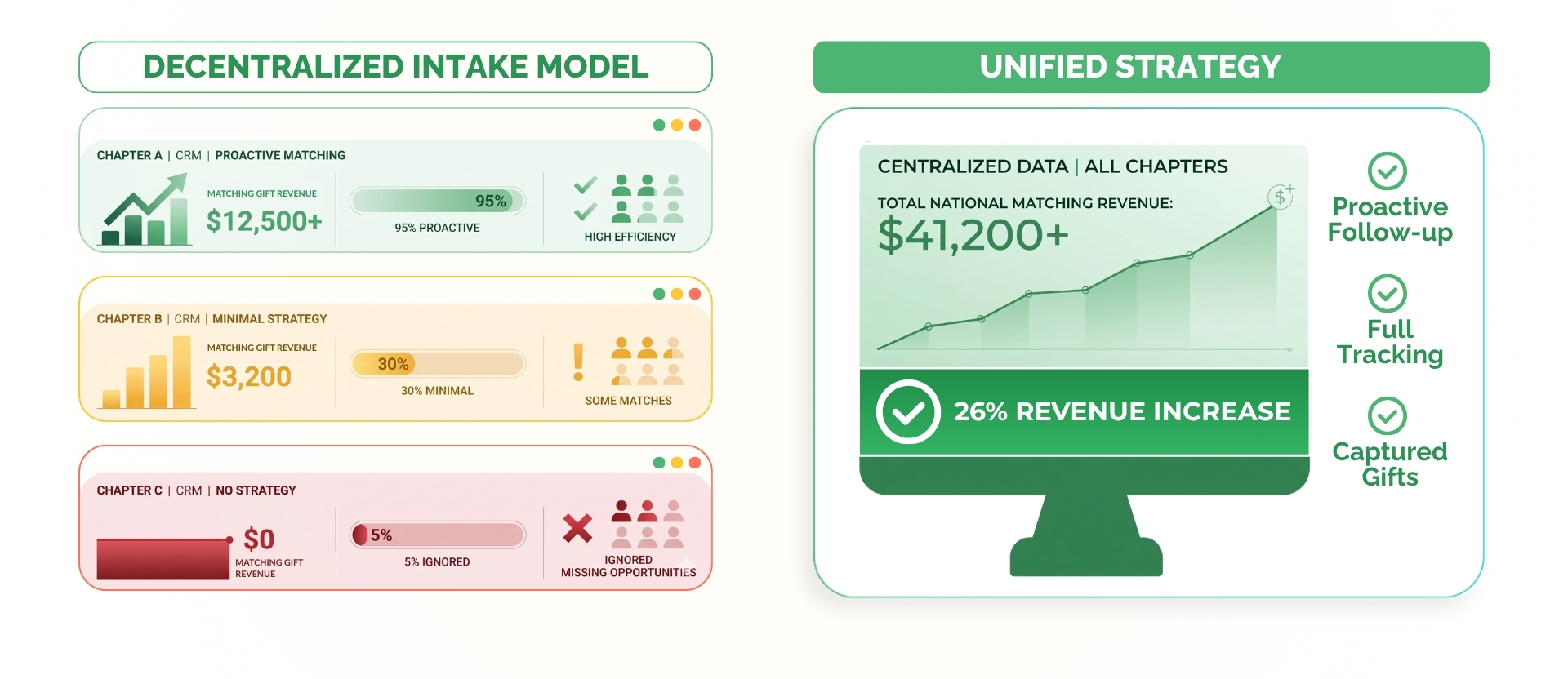
For large, multi-chapter organizations or nationwide federated nonprofits, a decentralized gift-processing model (or leaving each chapter or affiliate to its own devices) can lead to significant revenue loss and messy data.

To combat these inefficiencies, leading organizations are increasingly routing corporate philanthropy inquiries through a single, centralized team. Workplace giving centralization streamlines operations and drives massive revenue growth.

Centralizing workplace giving disbursement and reconciliation

Standardizing corporate gift-processing delivers several clear organizational benefits. These include:

  • Accelerated Verification Speeds. A single dedicated team can establish a highly efficient (and consistent) turnaround time for confirming corporate matching gift requests, helping your organization beat rolling corporate submission deadlines.
  • Minimized Administrative Errors. Eliminating multiple uncoordinated hands from touching the same corporate gift prevents duplicate entries, accidental profile creation, and fractured records.
  • Optimized Workflow Capacity. Funneling complex corporate workflows away from local teams allows field staff to stop wearing so many hats and instead focus entirely on increasingly impactful local programming. Meanwhile, advanced operations teams can build next-level automated data import systems to code and process high-volume data files with ease.

The results of such a transition can be astounding! When the Crohn’s & Colitis Foundation centralized its workplace giving process, the organization achieved a 26% increase in matching gift revenue and a 48-hour verification turnaround time in its first fiscal year.

Data Architecture & the Power of Soft Credits in CRM Management

To maintain clean donor data, your CRM architecture must distinguish between financial recognition and actual revenue. Legally, a matching gift or volunteer grant is a direct contribution from the company. That means the corporate entity must receive the hard credit within your financial ledger. However, to track donor engagement metrics accurately, the employee who initiated the match should receive a soft credit. This allows your development team to capture a 360-degree view of an individual’s impact without double-counting cash-in-the-door.

Take a look at the following example:

Let’s say a donor personally contributes $500 but secures an additional $500 via a matching gift from their employer. A properly structured CRM will reflect a $500 hard credit on the donor’s record, a $500 hard credit on the corporate record, and a $500 soft credit tied back to the donor.

This structure accurately indicates a $1,000-level supporter, ensuring they are appropriately recognized during annual giving tier evaluations.

By establishing and sustaining clean data-entry practices and integrating your fundraising software with tools like Double the Donation, your team can build a comprehensive tracking system. This will also provide you with real-time visibility into corporate giving engagements, allow you to follow up on incomplete requests, and identify top corporate partners with whom your organization can deepen relationships.

Actionable Frameworks for Modern Gift Processing Teams

To convert these insights into a reliable day-to-day routine, your development team should implement structured frameworks designed to minimize cognitive load and streamline gift processing. Here’s what we recommend:

#1: Establish a Dedicated Matching Gift Inbox

Rather than letting notifications and verification requests flood your general email accounts, we suggest creating a single, dedicated email address. (For example, matchinggifts@university.edu or workplacegiving@yournonprofit.org.) This isolates all incoming digital confirmations, portal links, and supporter inquiries into a single repository.

#2: Implement Batch Processing and Structured Imports

It’s generally not a great idea to manually key in individual matching gifts or payroll deductions as they trickle in. Instead, batch similar administrative tasks together. Processing staff can then step away from day-to-day firefighting and block out specific times to enter “workplace giving mode.” This enables them to regularly handle batch verifications and portal updates when focused and ready.

To get started, set aside a weekly two-hour window to download data from each CSR platform you’ve registered for. From there, you can clean up duplicate contacts, match transaction details, and upload large quantities of corporate payments at once.

#3: Set Realistic Timeline Expectations Across the Board

To protect donor trust, explicitly communicate corporate processing delays across all fundraising channels. Clearly state that corporate matching gifts can take weeks or months to officially arrive. This proactive transparency prevents supporters from worrying about missing credits.

Then, when the match clears the reconciliation pipeline, update the individual’s fundraising total and trigger a follow-up celebrating the win.

#4: Standardize Your Corporate Policy Reviews

Corporate philanthropic guidelines are not set in stone. Companies frequently update their match caps, adjust hour minimums for volunteer grants, or change their focus pillars. Therefore, task your gift-processing team with using a company database tool to conduct a comprehensive policy review once or twice a year. If you discover a change in your eligibility status for a specific program, log it within the company’s CRM record.

This prevents your team from wasting time chasing invalid requests and ensures your outreach strategies reflect the most accurate guidelines.


Wrapping Up & Next Steps for Workplace Giving Disbursements

Managing workplace giving disbursements and reconciliation does not have to be a huge undertaking for your team. By moving away from fragmented processing and leaning into a unified model supported by the right technology and clear data tracking, your organization can eliminate administrative bottlenecks and drive more corporate revenue to completion.

Doing so protects your data integrity, saves valuable staff time, and strengthens corporate relationships. Plus, it allows your team to focus on what matters most: advancing your mission.

Ready to Power Up Your Workplace Giving Workflows?

Find out how Double the Donation can help! Join 8,000+ nonprofits and schools in using the industry’s #1 automation solution.

Book a Demo to Get Started →

Double the Donation vs. HEPdata: The Definitive Comparison

When comparing Double the Donation vs. HEPdata, the choice is between a modern, automated growth engine and a stagnant legacy database.Double the Donation provides a daily-updated database, 100+ turnkey integrations, and full automation that maximizes revenue, whereas HEPdata’s tech often leads to missed matches, manual data entry, and a clunky donor experience. By choosing a solution that prioritizes daily data integrity, WCAG accessibility, and SOC 2 security, you can avoid the costs of stale software and ensure every corporate-matching dollar is claimed.

In the rapidly evolving landscape of corporate social responsibility and nonprofit technology, the tools you choose to power your fundraising efforts are the engines of your mission. For decades, matching gifts have represented one of the most accessible yet underutilized revenue streams for nonprofits. Research indicates that while $2 to $3 billion is donated through corporate matching programs each year, an additional $4 to $7 billion is left unclaimed.

However, as the sector’s digital transformation accelerates, the gap between legacy solutions and modern technology has become a chasm. For organizations currently using HEPdata’s matching gift tools or evaluating it alongside modern alternatives, the choice can feel complicated. This comprehensive guide will help you make the right decision for your team.

We’ll cover:

You’ll learn about why the industry has shifted toward Double the Donation, the hidden risks of relying on stagnant technology, and why your choice of a matching gift partner directly impacts your bottom line.

Here’s a quick overview to get started.

Key Feature Double the Donation HEPdata
Database Status Live & Updated Daily Legacy / Static
Integrations 100+ Native APIs Limited / Manual CSV
Matching Automation ✔ Yes ✘ No
Other Workplace Giving Programs ✔ Yes ✘ No
Security & Accessibility Fully Compliant Legacy Standards
Pricing Models Transparent Flat-Fee Custom / Hidden Fees

The Core Philosophy: Innovation vs. Stagnation

To understand the difference between these two providers, one must look at their trajectory over the last decade.

Double the Donation was built on the premise that matching gift revenue should be automated, integrated, and data-driven. By focusing exclusively on the donor experience and automating the identification-to-submission pipeline, Double the Donation has become the industry standard, powering the matching gift programs of thousands of nonprofits, from local animal shelters to international universities.

HEPdata, conversely, is often viewed as a legacy provider. While they were early pioneers in the space, the platform has not kept pace with the API-driven world of modern fundraising. Many users find that while the tool still exists, it no longer evolves. In a world where corporate giving policies change overnight, a tool that is not constantly innovating becomes a liability rather than an asset.

Database Integrity as the Foundation of Matching Gifts

The single most important component of any matching gift software is its database. If a donor searches for their employer and finds outdated information (or worse, doesn’t find their employer at all), the conversion funnel breaks instantly.

Double the Donation’s Data Advantage

Double the Donation maintains the most comprehensive and up-to-date matching gift database in the world. This isn’t just a marketing claim; it’s the result of a massive, ongoing investment in data science and manual verification.

  • Daily Updates: Double the Donation monitors thousands of corporate giving pages, news releases, and annual reports to ensure that when a company adjusts its matching gift policy, the system reflects the change quickly.
  • CSR Partnerships: Unlike legacy tools, Double the Donation maintains direct integrations with CSR software providers. This allows the system to pull updated program information, matching ratios, and submission links straight from the source, ensuring the data is verified by the corporations themselves.
  • Subsidiary Mapping: Double the Donation also tracks complex corporate structures. If a donor works for a subsidiary of a larger parent company, their advanced search functionality uses “fuzzy logic” to ensure they find the correct program every time.

HEPdata’s Data Problem

In contrast, HEPdata’s database is widely considered stagnant. Reports from former clients suggest that the data is often out of sync with current corporate policies.

  • Expired Links: Donors are frequently directed to dead URLs or old PDF forms that companies no longer accept.
  • Missing New Programs: As startups grow into tech giants and implement new CSR programs, legacy databases often lag months or years behind in adding them.
  • Inaccurate Ratios: If a company moves from a 1:1 match to a 2:1 match and your software shows the old rate, you effectively leave 50% of your potential revenue on the table.

Bottom line: Your matching gift database is the single point of failure or success in the donor journey. When you rely on a platform that prioritizes regular program updates, you build trust with your supporters and ensure that no revenue is left behind.

The Integration Ecosystem Comparison

In a modern nonprofit tech stack, your organization’s tools need to talk to each other. Your donation form should talk to your CRM; your CRM should talk to your email marketing tool; and your matching gift tool should sit right in the middle of that conversation. For that reason, it’s important to examine your workplace giving solution’s existing partnership network.

Double the Donation’s 100+ Turnkey Integrations

Double the Donation currently features over 100 turnkey integrations with the leading providers in the space, including:

  • Donation Forms: Classy, Funraise, Givebutter, and DonorDrive
  • CRMs: Salesforce, Blackbaud, Microsoft Dynamics, Virtuous, and Neon One
  • Peer-to-Peer Fundraising Tools: Bloomerang, Funraisin, GoFundMe Pro, and Neon Fundraise
  • Volunteer Management Systems: Bugle, Better Impact, Civic Champs, and PlanHero
  • CSR Portals: Millie, Givinga, Field Day, and Uncommon Giving
  • Event Platforms: DonorBox, OneCause, GiveSmart, and Handbid
  • Data Enhancement Solutions: DonorSearch and Windfall Data
  • And more!

When a supporter engages via a platform integrated with Double the Donation, the system immediately captures their employer information. No manual data entry is required from your staff.

As a result, the automated donor journey typically looks like this:

  • Search: During a donation, the donor enters their employer in a streamlined search bar.
  • Immediate Confirmation: On the thank-you screen, the donor can access their company guidelines and a direct link to their matching gift portal.
  • Automated Outreach: If the donor doesn’t click the link, Double the Donation triggers a personalized, branded email (from your organization’s own domain) reminding them to complete the match.
  • Activity Tracking: Your team can see exactly which donors opened the email, clicked the link, and confirmed their match submission.

HEPdata’s “Manual” Experience

While HEPdata offers a few legacy partnerships, it lacks the deep, bi-directional API integrations that define modern software. Therefore, using HEPdata often requires your nonprofit’s team to:

  • Collect employment information on your own
  • Export a CSV of donors from your CRM
  • Clean the data manually
  • Upload it to the HEPdata portal
  • Manually send emails to donors

This batch processing model is a relic of the past. It means your donors aren’t being engaged at the peak of their passion, or the moment they hit the donate button. By the time you send an email three days later, the supporter has likely moved on.

In other words, the journey is often fragmented. The donor might see a link, but there is rarely a sophisticated follow-up sequence. If the individual forgets to submit the match, that revenue is lost. There is no automated nudge to bring them back to the finish line.

Capturing All Forms of Workplace Giving

It’s important to recognize that matching gifts, while powerful, are merely a subset of the larger, continuously expanding category of workplace giving. If your organization is only focusing on the standard corporate match, you’re likely missing out on:

Double the Donation is positioned as a comprehensive workplace giving partner. Their tools are designed to identify corporate volunteer opportunities and provide supporters with the specific instructions needed to log their hours. It’s also expanded its database to encompass payroll giving programs and, more broadly, corporate sponsorships and grants (which we explored in more detail in this recent blog).

HEPdata, on the other hand, remains largely focused on the traditional employee matching gift model, leaving these newer, high-growth revenue streams untapped.

The True Cost of Doing Nothing (or the Risk of the Status Quo)

Many nonprofits stay with a legacy software provider, even when it is no longer meeting their needs, because the pain of change feels greater than the pain of staying the same. However, the hidden costs of stagnant technology include:

  • Donor Attrition: Donors who have a clunky, manual experience are less likely to complete their matching gift request
  • Reduced Visibility: Without modern integrations, your team has no real-time visibility into which gifts are being matched
  • Manual Labor: Your staff spends hours manually cross-referencing spreadsheets: hours that could be spent on major gift cultivation

When CFOs or Development Directors look at software pricing, they often focus on the subscription cost alone. But the true cost of software is as follows:

Total Cost = Subscription Price + Opportunity Cost + Labor Hours

Let’s break that down a bit further.

Subscription Price

When comparing Double the Donation vs. HEPdata, the initial subscription price often tells two very different stories about value. Double the Donation uses a transparent, tiered pricing model that starts with a pay-per-use Essentials plan for smaller nonprofits and scales to the Standard plan for mid- to large organizations (and to Enterprise for their largest users). This pricing is most often structured as a flat annual fee, meaning costs remain predictable and fixed even as your revenue grows.

In contrast, HEPdata often operates on a custom-quoted legacy model that can appear lower on the surface. However, it lacks the comprehensive value of a modern SaaS platform required to actually move the needle on your fundraising goals.

Opportunity Cost

If your matching gift tool has a lower “capture rate” due to poor data quality or a lack of automation, you are losing money. For example:

  • Nonprofit A (using Double the Donation) captures $100,000 in matching gifts with a $5,000 subscription. Net Gain = $95,000.
  • Nonprofit B (using HEPdata) captures $40,000 in matching gifts (due to missed opportunities and stale data) with a $2,000 subscription. Net Gain = $38,000.

By trying to save a few dollars, Nonprofit B actually lost out on $57,000 in potential revenue.

Labor Hours

How much is your staff’s time worth? If your team spends 5 hours a week managing matching gift data because your software doesn’t integrate with your CRM, that equates to an estimated 260 hours a year. At a rate of $30/hour, that’s $7,800 in wasted salary every year. Next-level automation eliminates this cost almost entirely.

Security, Reliability, Accessibility, and Trust

In an era of increased data privacy regulations and a heightened focus on digital equity, how your vendors handle donor data and donor access is paramount. An insecure tool puts your reputation at risk, and an inaccessible tool excludes a significant portion of your donor base.

The Legacy Gap

As a legacy provider, HEPdata often lacks the modern security certifications and rigorous accessibility standards that IT departments now require. Using a tool that hasn’t been updated for modern accessibility standards doesn’t just hurt your conversion rates. It creates a barrier between your mission and a significant portion of your supporters.

Security and SOC 2 Compliance

Double the Donation maintains the highest standards of security in the nonprofit technology industry, understanding that it is a custodian of your donors’ trust. For this reason, it offers:

  • SOC 2 Type II Compliance: Unlike legacy providers, we undergo rigorous third-party audits to ensure our internal controls and data security protocols meet the highest global standards.
  • Complete Data Privacy: The platform is fully aligned with modern regulations like GDPR and CCPA, ensuring that donor information is handled with the sensitivity it deserves.
  • Uptime Reliability: Double the Donation’s infrastructure is built on modern, scalable cloud technology. This ensures that our tools are available 24/7, maintaining 99.9% uptime even during high-traffic surges like Giving Tuesday or year-end giving campaigns.

Leading the Way in Digital Accessibility

Accessibility is no longer an extra feature; it is a paramount requirement for modern nonprofits. If your matching gift tool is not screen-reader or keyboard-only navigation-friendly, you are effectively turning away support. For this reason, Double the Donation has made significant investments to ensure its interface is inclusive and highly accessible.

These include:

  • WCAG Standards: Double the Donation’s tools are designed and tested to meet the Web Content Accessibility Guidelines (WCAG) 2.1 Level AA. This ensures high color contrast, screen reader compatibility, and clear focus indicators.
  • Inclusive Design: We believe every donor, regardless of ability, should have a seamless path to doubling their impact. By prioritizing accessibility, we help you reach a wider audience and demonstrate your organization’s commitment to DEI (Diversity, Equity, and Inclusion).
  • Mobile Accessibility: Double the Donation’s search tools are fully responsive and optimized for touch-screen accessibility, ensuring that donors on mobile devices have the same high-quality experience as those on desktops.

A nonprofit’s technology should be a bridge to its mission, not a barrier. By choosing a partner that prioritizes security and accessibility, you aren’t just checking a compliance box. You are safeguarding your organization’s reputation and ensuring that every donor has the opportunity to engage with your cause.


Conclusion: It’s Time to Move Forward

The comparison between Double the Donation and HEPdata is clear. One platform is an active participant in the future of fundraising, investing millions into data accuracy, automation, and integrations. The other is a static tool that largely remained the same while the world around it changed.

If your organization is serious about maximizing corporate revenue, you cannot afford to rely on stagnant data or manual processes. You need a partner who helps you capture every available dollar, not just the ones that are easy to find. The choice is yours: stay with the “good enough” technology of yesterday, or embrace the automated, data-driven future of today (and tomorrow).

Ready to see the Double the Donation difference? Discover how much matching gift revenue (and other workplace giving support) your organization is currently leaving on the table, and how Double the Donation can help you claim it with ease.

Request a personalized demo to get started today.

Top 5 Tools for Finding Corporate Sponsorships and Grants

Whether you’re a small local nonprofit or a global enterprise organization, the quest for sustainable funding often leads to the same two doors: corporate sponsors and grants. But simply sending out generic proposals and hoping for the best is quickly becoming a relic of the past. Luckily, there are innovative tools for finding corporate sponsorships that ensure the process is relatively quick and easy.

In 2026, corporate philanthropy has evolved into a data-driven field in which businesses seek specific alignment with their overarching goals. Meanwhile, the grant landscape is more competitive than ever. To stay ahead, your development team needs a comprehensive tech stack that does the heavy lifting.

In this post, we’re breaking down 5 tools that will transform your prospecting from a guessing game into a high-yield strategy. These include:

  1. Double the Donation (the corporate giving powerhouse)
  2. Candid (the gold standard for corporate foundation research)
  3. GrantWatch (the grant-focused search engine)
  4. Instrumentl (the all-in-one grant management suite)
  5. LinkedIn (the ultimate corporate networking tool)

As the digital landscape continues to shift, these five platforms have emerged as “must-haves” for any serious fundraising team. By leveraging these leading tools, your nonprofit or school can move beyond simple discovery and toward creating high-impact partnerships that fuel your mission for years to come.

Let’s dive in with our top suggestion!

Double the Donation is a top tool for finding corporate sponsorships and grants.

Corporate Sponsorship Research Tool #1: Double the Donation

If you’re looking to get more corporate sponsors for your organization, Double the Donation is our #1 pick. Historically known for its matching gift and workplace giving automation services, the platform has recently expanded its industry-leading database to include thousands of corporate sponsorships, including grants and in-kind donations, as well!

Unlocking Opportunities With Double the Donation’s Sponsorships Database

Double the Donation’s comprehensive database tool is meticulously indexed to reveal specific corporate giving opportunities. Therefore, this platform empowers nonprofits and other fundraisers to secure corporate sponsors by providing…

  • Detailed Sponsorship Specifics: Double the Donation identifies companies that offer event sponsorships, in-kind donations, and more, uncovering potential prospects with a quick database search.
  • Ease of Access: Rather than hunting through a company’s “About Us” page, organizations can access direct links to CSR guidelines and online application portals. You can even filter the sponsorships directory by mission vertical to ensure alignment with your cause!
  • Direct Integration: Double the Donation partners with many leading event software providers, enabling your team to access sponsorship information from the directory immediately within your event fundraising platforms.

Double the Donation is a top tool for finding corporate sponsorships and grants.

Leveraging the “Warm Lead” Advantage Through Employee Analytics

One of the most overlooked aspects of corporate sponsorship is the internal champion. Double the Donation’s unique position at the intersection of individual giving and corporate data allows nonprofits to easily perform Employee Density Analysis.

By using the fundraising platform to identify which companies have the highest number of employees already donating to your cause, you can approach those businesses with a data-backed proposal. Rather than a cold pitch, your message becomes: “Your employees are already passionate about our mission; a formal sponsorship is the logical next step to amplify their impact.”

Learn more about Double the Donation’s tools for finding corporate sponsorships here.

Candid is a top tool for finding corporate sponsorships and grants.

Corporate Sponsorship Research Tool #2: Candid

Formerly known as Foundation Directory Online, Candid is one of the most comprehensive databases of grantmakers worldwide. If you need to know who a foundation is, what they’ve funded in the past, and who is on their board, this is where you go.

The Power of Candid’s “Professional” Access

While Candid offers a basic tier, the Professional subscription is where the real corporate sponsorship magic happens. This level provides access to more than 240,000 grantmakers, including corporate giving programs that don’t always have a public-facing website.

It also offers…

  • Complete 990 Insights: Easily view a funder’s IRS Form 990s in a readable format. This allows you to see the exact dollar amount of grants given to organizations similar to yours.
  • A Detailed Recipients Map: Use interactive maps to see where a corporation’s money is actually going. If a company claims to support education but only funds schools in the Midwest, you’ll know before you waste time applying.
  • Seamless LinkedIn Integration: Candid enables you to see if anyone in your network (or your board’s network) is connected to the foundation’s existing leadership.

Candid is a top tool for finding corporate sponsorships and grants.

Decoding Funder Personas with “Key Staff & Board” Insights

Beyond the raw numbers of a 990 form, Candid’s platform allows you to build a Relational Map of a foundation’s leadership. Successful sponsorship seekers can then use this to identify shared values at the executive level.

For instance, if Candid reveals that a corporate foundation board member also sits on the board of a local university or museum, you can tailor your pitch to highlight your organization’s educational or cultural impact. This biographical prospecting ensures that when your proposal reaches a human desk, it resonates with the personal and professional interests of the decision-makers.

Learn more about Candid’s tools for finding corporate sponsorships here.

GrantWatch is a top tool for finding corporate sponsorships and grants.

Corporate Sponsorship Research Tool #3: GrantWatch

If you are looking for a tool that balances a massive database with user-friendly accessibility, GrantWatch is a powerhouse. It is designed specifically to help nonprofits, small businesses, and even individuals identify live funding opportunities that are currently accepting applications.

Why GrantWatch Is a Sponsorship Game-Changer

This platform excels at real-time tracking. While some databases focus on historical data (i.e., who gave what five years ago), GrantWatch focuses on the now. It scans thousands of sources daily to ensure that the open grants you see on your screen are actually active.

GrantWatch also provides…

  • Granular Filtering: Filter results by precise categories (such as “Veterans,” “Environment,” or “Arts and Culture”) and further narrow them by geographic focus at the state or local level.
  • Deadline Alerts: One of its most praised features is the ability to track upcoming deadlines, ensuring your development team has enough lead time to craft a quality proposal rather than rushing at the last minute (or missing the mark altogether).
  • Researcher-Verified Data: Each grant or sponsorship listing is verified by a team of researchers, significantly reducing the dead ends often encountered with free search engines.

GrantWatch is a top tool for finding corporate sponsorships and grants.

Navigating the “Small Business” Sponsorship Frontier

While many tools focus on the Fortune 500 giants, GrantWatch provides a unique window into local and Small-to-Medium-Sized Business (SMB) grants. These sponsorships are often less competitive and offer a higher ROI on your time. Additionally, the platform identifies “Micro-Grants,” or small, quick-turnaround funding bursts that are perfect for supporting immediate needs, such as a new community garden or a local event.

Learn more about GrantWatch’s tools for finding corporate sponsorships here.

Instrumentl is a top tool for finding corporate sponsorships and grants.

Corporate Sponsorship Research Tool #4: Instrumentl

In 2026, the trend in nonprofit tech is automation, and Instrumentl is the poster child for this movement. It isn’t just a database; it’s a personal assistant that finds grants for you while you sleep.

Instrumentl’s Smart Matching Initiative

Unlike other tools that require manual searching, Instrumentl first asks you to set up a project. After defining your mission, location, and funding needs, the platform’s AI algorithm matches you with active Requests for Proposals.

Instrumentl also offers:

  • Complete End-to-End Workflows: It combines prospecting, tracking, and reporting. You can save a grant to your “Tracker,” and Instrumentl will automatically update you if the deadline changes or if the funder releases new guidelines.
  • Funder Trend Mapping: The platform visualizes Form 990 data into easy-to-read charts, showing whether a funder is open to “New Grantees” or only renewing existing partnerships.
  • Ongoing Collaboration: Multiple team members can assign tasks and leave notes on specific prospects, eliminating the need for messy internal spreadsheets.

Instrumentl is a top tool for finding corporate sponsorships and grants.

Master Your Data-Backed Strategy With Insight Reports

While many platforms provide data, Instrumentl provides intelligence. This sponsorship research tool offers a number of invaluable Insights Reports, which represent deep-dive analyses that help your team decode the specific behaviors of corporate and other grantmakers. Instead of guessing where the money is, these reports (including on Regional Corporate Powerhouses, Success Rate Analytics, Operational Efficiency, and more) allow you to align your sponsorship and grant-seeking strategy with actual market trends.

Learn more about Instrumentl’s tools for finding corporate sponsorships here.

LinkedIn is a top tool for finding corporate sponsorships and grants.

Corporate Sponsorship Research Tool #5: LinkedIn

It might seem unconventional to list a social network alongside dedicated grant and sponsorship databases, but in the world of corporate giving, interpersonal relationships are the currency.

How to Use LinkedIn for Corporate Sponsorship Prospecting

While the other tools tell you who gives, LinkedIn tells you how to get in. Corporate sponsorships are rarely awarded via unsolicited email; rather, they are secured through conversations with CSR Managers, Marketing Directors, and Community Relations Officers.

LinkedIn helps by offering…

  • The “Company” Search: Use filters to find companies in your zip code. Filter by “Industry” to find businesses whose brand aligns with your mission (e.g., an environmental nonprofit targeting a sustainable clothing brand).
  • Employee Insights: Before you reach out, look at the “People” tab on a company’s profile. Find the person in charge of social impact or community relations. That’s going to be your best bet for pitching your sponsorship!
  • Warm Introductions: Use the “Mutual Connections” feature to make the most of your network! If your Board Member is connected to the VP of Marketing at a target corporation, a personal intro is worth ten cold calls.

LinkedIn is a top tool for finding corporate sponsorships and grants.

Leveraging the “Sales Navigator” for Philanthropic Intelligence

While the free version of LinkedIn is powerful, development teams can use LinkedIn Sales Navigator as a high-octane prospecting engine. By setting up lead lists for CSR executives at target companies, you can receive real-time alerts when they post about their new social impact goals. From there, you can reach out with a relevant, timely sponsorship proposal.

Learn more about LinkedIn’s tools for finding corporate sponsorships here.

Bonus: A Quick Comparison Overview

Interested in examining the pros, cons, and standout features for each of the above-referenced research tools? Check out this helpful table:

Platform Best For… Standout Feature Sponsorship Focus
Double the Donation Searching for corporate grants and in-kind donation opportunities Leading Companies Reports High: Direct links to CSR portals and local office giving
Candid (fka Foundation Directory) Deep historical research and 990 data Visual Grant Recipient Maps Medium: Excellent for corporate foundations; less for marketing sponsorships
GrantWatch Finding currently active, open RFPs Real-time deadline tracking Medium: Strong for community grants and localized small business awards
Instrumentl Automated prospecting and team management AI-driven Grant Matching High: Built-in private funding landscape and funder reliability scores
LinkedIn Relationship-building and facilitating warm intros Mutual Connection Networking Medium: Great for outreach/networking, but does not list raw sponsorship data

Final Thoughts on Finding Corporate Sponsorships and Grants

Securing a lucrative corporate sponsorship or grant isn’t about luck. It’s about alignment.

Ready to get started? Pick the tool (or tools) that fit your current budget and growth goals, and begin building the pipeline your mission deserves. We recommend adopting a three-step approach:

  1. Audit your current data: Use Double the Donation to see where your current corporate connections lie.
  2. Build your pipeline: Use Candid and GrantWatch to identify at least 10 “best-fit” new prospects.
  3. Manage the relationship: Use Instrumentl to track your deadlines and LinkedIn to find the humans who will champion your cause from the inside.

Investing in the right software to uncover strategically aligned opportunities is an investment in your mission’s future. By moving away from manual spreadsheets and embracing data-driven prospecting, your organization can spend less time searching and more time doing the work that matters.