
Modernizing the Gift Processing Cycle: A Higher Ed Guide
Transitioning an advancement office away from legacy systems toward a digital-first framework requires a comprehensive review of every operational touchpoint. From the moment a donor lands on your giving page to the final ledger entry in your institution’s financial database, every step must be optimized for speed and clarity.
By embracing modern financial technology and automated tracking, university fundraisers can eliminate processing friction, protect donor intent, and uncover substantial pools of unclaimed corporate support. And we’re here to show you how you can do so!
- Enable modern payment methods.
- Integrate matching directly within the donation process.
- Automate designated fund accounting (and route matches to those same funds).
- Implement split-receipting for event tickets and more.
- Track and report on donor engagement metrics.
- Prioritize registration and recertification with CSR portals.
- Plan for Donor-Advised Funds and Qualified Charitable Distributions.
- Count soft-credited donations toward higher giving levels.
Read on to explore our expert-proven processing strategies, recommended by institutions like the Florida Institute of Technology, University of San Diego, and more.
1) Enable modern payment methods.
Modern donors expect the same seamless transaction experience on a university giving website that they encounter when shopping online. Requiring a supporter to locate their physical wallet, pull out a credit card, and enter a 16-digit number introduces significant friction into the gift-processing cycle. This friction frequently leads to abandoned shopping carts and incomplete donations, especially during time-sensitive fundraising campaigns like annual giving days.
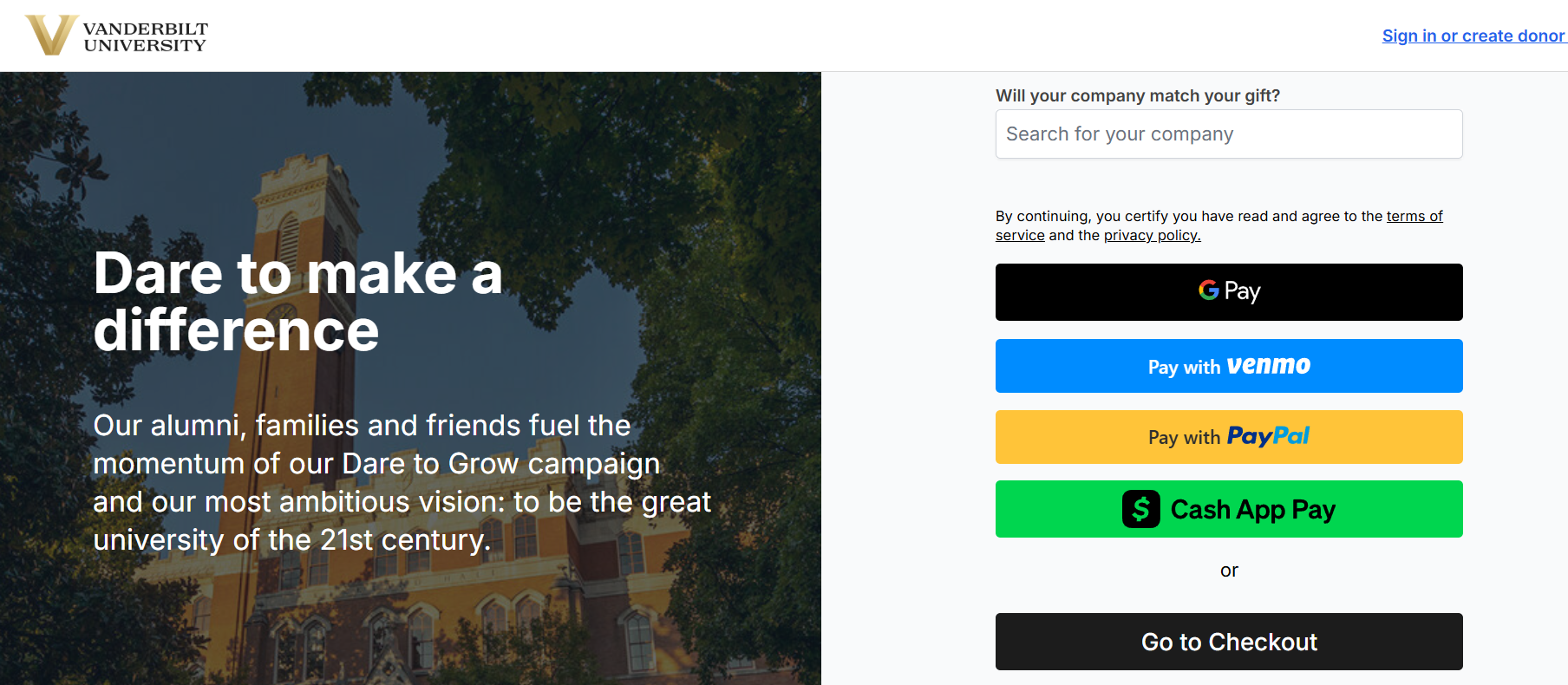
To maximize conversion rates, higher education institutions should be integrating modern digital payment options into their checkout systems. Adding digital wallets like Apple Pay and Google Pay allows mobile users to complete a secure transaction in seconds with a simple biometric scan. Not to mention, offering modern bank transfers through services like Venmo and PayPal, or direct ACH processing, gives donors the flexibility they desire while reducing standard credit card transaction fees.
2) Integrate matching directly within the donation process.
Corporate matching gift programs represent a multi-billion-dollar opportunity for higher education institutions, yet a massive portion of these funds goes completely unclaimed because donors simply do not know that their employers offer the benefit. And unfortunately, waiting until weeks after a transaction has cleared to mail out a matching gift appeal rarely yields results. To capture these lucrative corporate dollars, advancement offices must integrate employer lookup tools directly into the primary donation interface.
Daniel Blucker, FIT’s Director of Advancement Services, recently joined a panel at Double the Donation’s Workplace Fundraising Summit to discuss effective matching gift processing and its role in donor stewardship. In this conversation, Blucker shared many actionable strategies that other higher ed institutions can draw on. Notably, he emphasized that matching should never be treated as an administrative burden tacked onto the end of a transaction, but rather as an essential, organic element of the primary giving pipeline.
By implementing matching gift search tools directly within their giving forms, the Florida Institute of Technology empowers donors to check their companies’ matching gift policies in real time as they give. This continuous integration ensures that each online supporter is prompted to double their impact before they even leave the page.
3) Automate designated fund accounting (and route matches to those same funds).
Colleges and universities often manage complex, multi-tiered financial structures containing hundreds of distinct restricted accounts, varying from specific athletic teams to niche academic research funds. Tracking individual donor restrictions manually can quickly become an absolute operational nightmare for your advancement services team. For this reason, experts typically recommend opting for a single primary donation form with multiple designation options rather than implementing a unique form for every need.
To address this challenge, the University of San Diego successfully optimized its digital footprint by shifting away from a massive library of more than 150 separate forms. Instead, its advancement team built a single streamlined form with a searchable field for intended designations.
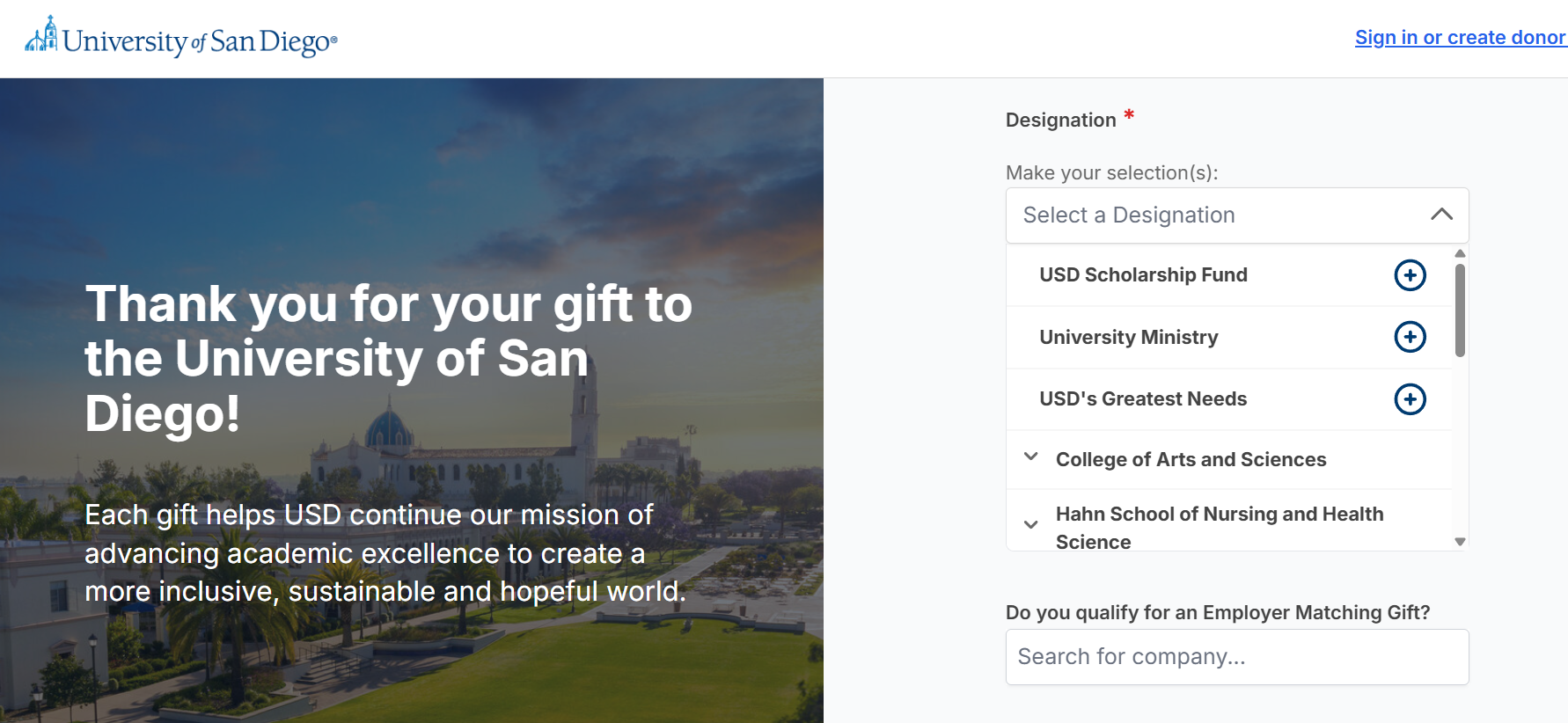
Streamlining your front-end web forms also makes it much easier to automate restricted fund accounting on the backend. When a donor selects a specific designation from a dropdown menu, your fundraising software should instantly tag the transaction with the correct general ledger allocation code.
From there, the automated tagging should also extend to any incoming corporate match funds generated by that transaction. When a matching gift check or electronic payout arrives later, the system must recognize the original donor intent and route the matching portion to that same designation.
4) Implement split-receipting for event tickets and more.
Higher education fundraising often involves complex transactions where a donor receives something of material value in exchange for their payment. Typical examples include purchasing a ticket to an alumni gala dinner, buying a spot in a university charity golf tournament, or participating in a high-value charity auction. In these scenarios, the transaction cannot be treated as a purely tax-deductible contribution, which requires your advancement services team to execute split-receipting.
Split-receipting divides the total transaction value into two clear components: the Fair Market Value of the goods or services received by the participant, and the remaining tax-deductible donation amount. For instance, when an alumnus purchases a $200 ticket to a fundraising gala that includes a catered meal worth $50, only $150 would count as a tax-deductible contribution.
Isolating these values at the time of purchase makes tax season and matching gift requests much simpler for your supporters. Most corporate matching guidelines strictly prohibit matching the non-deductible portion of a gift that includes personal benefits such as meals, entertainment, or merchandise. By providing a clean, pre-split receipt, you give donors the exact documentation they need to submit an accurate match request to their employer’s CSR portal.
This transparency reduces payment processing delays, protects your institution’s compliance with Internal Revenue Service regulations, and prevents corporate audits from stalling your incoming matching revenue.
5) Track and report on donor engagement metrics.
Data-driven higher education advancement operations rely on clean, accessible metrics to evaluate the overall health of their fundraising pipelines. Tracking basic donation totals is no longer enough. Instead, teams must monitor detailed donor engagement metrics to understand how supporters interact with the institution. These metrics should include donor retention rates, gift frequency, email click-through rates, and more across all supporter segments.
Plus, experts recommend that schools and other nonprofits explicitly include KPIs related to matching gift performance in their broader engagement metrics to increase organizational buy-in for corporate matching.
During his panel presentation, Daniel Blucker of Florida Tech highlighted how tracking matching behaviors within the school’s broader internal engagement scoring system motivated its entire advancement team to prioritize corporate giving:
“We included matching in our engagement metrics. We make sure that when somebody donates and completes a match, they get boosted above someone who just donates. That helps provide more visibility to those particular donors. When we focus on them for annual fund appeals and similar campaigns, we make sure those people are in the mix because they are worth more than a donor who is not engaged with matching.”
In other words, when matching gift milestones are tracked as primary success indicators, university fundraisers begin to view workplace giving as a strategic revenue driver rather than a back-office administrative task.
6) Prioritize registration and recertification with CSR portals.
Corporate social responsibility (or CSR) vendors serve as technical gatekeepers for corporate support, including matching gifts, payroll giving, volunteer grants, and more. When an employee submits a request on behalf of your university, the payout is typically processed through one of these secure third-party portals. If your institution fails to register with or provide banking details for these platforms, the match requests will stall and eventually be canceled.
For this reason, university advancement teams must prioritize official platform registration and complete the required annual recertifications across all major CSR systems to maintain a smooth gift processing cycle. The FIT team recently emphasized the value of securing portal access:
“My gosh, all the information is there, but if you don’t register and maintain that login, you won’t have it.”
Ensuring your team maintains active login credentials and keeps your federal tax ID numbers, direct deposit details, and institutional name listings up to date is essential to unlocking the data needed to effectively reconcile lump-sum corporate checks.
7) Plan for Donor-Advised Funds and Qualified Charitable Distributions.
Major gift pipelines at higher ed institutions are increasingly driven by non-traditional giving vehicles like Donor-Advised Funds (DAFs) and Qualified Charitable Distributions (QCDs). Therefore, having a clear operational workflow for processing these contributions is vital.
Because these funds arrive from financial custodians rather than personal accounts, gift processing teams must follow distinct accounting workflows to maintain regulatory compliance:
- Manage hard and soft credit splits: For DAFs, the primary hard credit belongs to the financial sponsor (e.g., Fidelity Charitable), while the individual supporter receives a soft credit. For QCDs, on the other hand, the hard credit is assigned directly to the individual, but must be explicitly flagged as an IRA distribution.
- Verify origin and sponsor rules: Ensure that QCD funds originate directly from an IRA trustee, as these transfers cannot touch the donor’s personal account and cannot legally be transferred into a DAF or private foundation.
- Deploy specialized acknowledgment language: Written receipts for QCDs must explicitly state that the contribution came from an IRA custodian and that no goods or services were provided. However, it should omit standard tax-deductible language so the donor does not accidentally double-claim the deduction.
Connecting these asset-based contributions to dynamic matching programs allows advancement teams to maximize the value of every incoming distribution. Many prominent employers (such as Bank of America, Chevron, and American Express) match grant distributions recommended by DAF accounts, provided the employee presents valid documentation from the receiving university. In this case, using a matching gift database makes it easy for donors to navigate complex corporate guidelines and double their institutional impact.
8) Count soft-credited donations toward higher giving levels.
Soft-crediting is an essential administrative tool that allows a university to recognize a supporter’s influence over a financial contribution, even when the legal tax credit belongs to a separate entity. This scenario occurs every time a donor initiates a corporate matching request or recommends a grant from a Donor-Advised Fund. If your system only tracks hard-coded legal tax receipts, your data will fail to reflect your supporters’ true institutional impact.
Counting soft credits toward university giving circles and leadership levels enables advancement teams to accurately reflect their supporters’ true lifetime value. If a loyal alumnus contributes $5,000 personally every year and consistently uses their employer’s matching program to bring in an additional $5,000, their true annual value to your campus amounts to $10,000 or more.
FIT’s Daniel Blucker highlighted that higher education institutions should intentionally factor these matches into their internal recognition ladders:
“As we connect the credit for matching gifts, we include it [within giving level tracking] so we can boost them into whatever category or other goals they are trying to reach all the faster.”
Refining your processing workflows to count soft-credited funds toward lifetime giving totals drastically improves the quality of your stewardship efforts. Donors appreciate it when an institution acknowledges the full scope of their philanthropy, and such recognition paves the way for higher retention rates and future engagements. Plus, by ensuring matches actively elevate donors into higher engagement tiers, universities create a powerful incentive for supporters to complete their corporate match requests each time they give.
Final Thoughts for Colleges and Universities
Modernizing your gift processing cycle is far more than a simple back-office software upgrade. It’s a strategic evolution that empowers your advancement office to operate at peak efficiency.
Higher education institutions no longer afford to rely on fragmented, legacy systems that slow down processing times, obscure donor metrics, and allow valuable corporate support to slip through the cracks. By breaking down internal silos and embracing fully integrated technology systems, your university can build a smooth, frictionless giving experience that delights your supporters and protects their true intent. Investing in a modern, automated workflow ensures that every donation is captured with ease, giving your advancement team the clean data and financial resources required to drive long-term institutional success.
To continue learning, check out the following insightful resources:
- A Fundraiser’s Donation Processing Glossary: Key Terms to Know. Make sure you’re familiar with the essential terminology surrounding donation processing workflows. Use our extensive glossary guide to grow your knowledge!
- How to Manage Workplace Giving Disbursements & Reconciliation. Workplace giving is a powerful component of effective gift processing for higher ed institutions like yours. Uncover everything you need to know about managing these payments here.
- Matching Gift Processing FAQ: Your Top Questions, Answered. Still curious about how the matching gift processing process actually works? Check out our comprehensive FAQ guide for the insights you need to drive effective efforts.
Ready to Power Up Your Gift Processing Cycles?
Find out how Double the Donation can streamline processing workflows for matching gifts, volunteer grants, payroll deductions, and more!