
How to Secure Corporate Sponsors for University Events
For university advancement and alumni relations departments, the annual calendar is a marathon of high-stakes engagement. From the nostalgia-soaked ceremonies of Homecoming to the networking-heavy atmosphere of Alumni Weekends, these events are the lifeblood of institutional affinity. However, as budgets tighten and expectations for high-production value rise, the “how” of funding these initiatives has shifted.
Securing corporate sponsors for university events is no longer just about asking for a handout; it’s about building a mutually beneficial ecosystem. When done correctly, these partnerships provide the financial runway you need to pull off successful events while giving companies direct access to your community.
In this comprehensive guide, we’ll explore eight proven strategies to help your development team secure, maintain, and grow corporate sponsorships that stand the test of time. These include:
- Uncovering connections with employment data
- Not overlooking in-kind sponsorships
- Taking a look at your school’s own vendors
- Exploring peer universities’ corporate partners
- Investing in a corporate sponsorship database
- Using real metrics to demonstrate value
- Activating social proof by highlighting previous sponsors
- Encouraging customizable packages
The landscape of higher education fundraising is evolving. While individual giving remains a cornerstone, the corporate sector represents a massive, often under-utilized reservoir of support. To tap into it, your team must move beyond the donation mindset and into a partnership mindset. When done well, this transition involves data-driven outreach, creative packaging, and a deep understanding of what a modern brand actually wants from a university association.
Let’s dive in!
Uncover connections with employment data.
One of your university’s most valuable assets is its employment data. When you know where your alumni and other donors work, you can uncover their powerful connections to potential corporate sponsors!
Most corporate social responsibility (CSR) programs or marketing departments are much more likely to greenlight a sponsorship if there is an internal “champion” advocating for the cause. If a Vice President at a Fortune 500 company is a proud alumnus of your Business School, that company is significantly more likely to sponsor your next Entrepreneurship Summit.
The Power of the Inside Track
By leveraging tools that collect and utilize donor employer information, you can segment your outreach. Instead of sending a cold email to a generic “info@company.com” address, you can reach out to your alumnus and say, “We see you’re doing great work at Starbucks. We have a Neighborhood Grant opportunity that fits perfectly with your corporate mission. Would you be willing to introduce us to your community engagement team?”
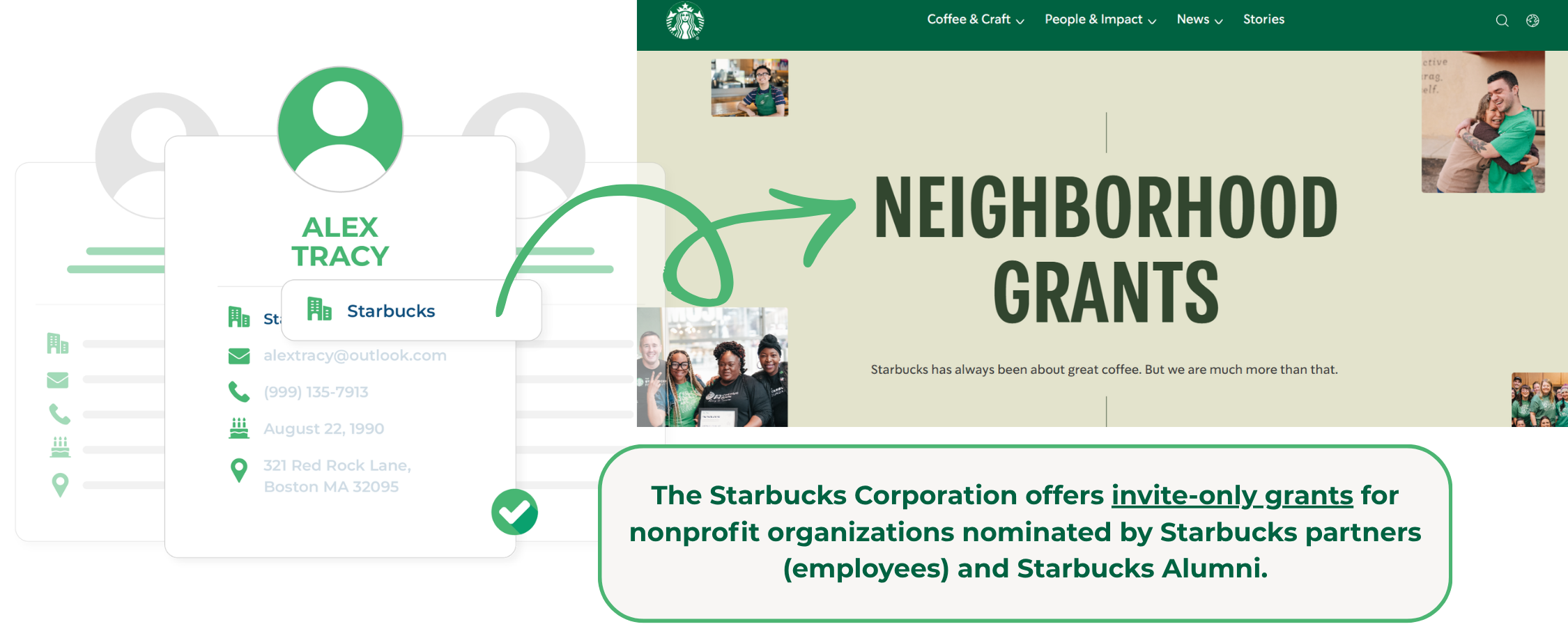
As shown in the example above, many corporations offer invite-only grants or sponsorship tiers specifically for nonprofit organizations nominated by their team members. Without employment data, these “golden tickets” remain largely invisible to your fundraising team.
Don’t overlook in-kind sponsorships.
It might be tempting to focus solely on securing a big check for your upcoming Alumni Reunion or Homecoming Weekend. But if you’re overlooking non-financial support, you’re surely missing out on some really valuable opportunities.
In-kind sponsorships (or gifts of goods or services instead of cash) can drastically reduce your event’s overhead. Every dollar you don’t have to spend on catering, equipment, or technology is a dollar that stays in your foundation’s pocket.
Here’s a snippet from the University of Florida’s website:
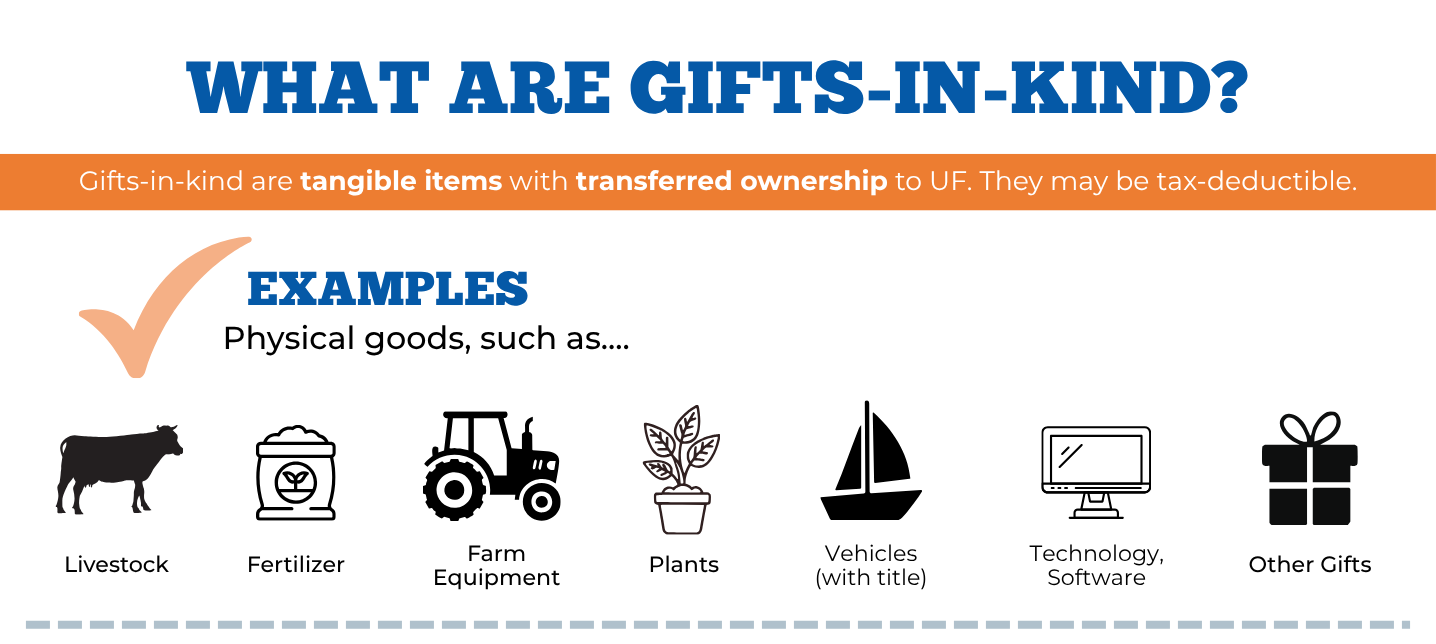
When approaching a tech company, for instance, a request for 50 licensed tablets for an alumni networking event might be easier for them to approve than a $10,000 cash donation, yet the value to your event remains the same.
Take a look at your school’s own vendors.
Your university likely already works with many vendors to maintain successful operations, from your food and beverage provider to your facilities and maintenance services. These companies have a vested interest in your success, and they can make great potential sponsors!
Why? They understand your campus culture and, more importantly, they value the ongoing contract they have with your institution. Sponsoring a high-profile event like Homecoming is a way for them to strengthen their relationship with the university administration while gaining visibility among the students and faculty who use their services daily.
Think about:
- The Campus Bookstore: Often managed by external partners like Follett or Barnes & Noble.
- Dining Services: Companies like Aramark, Sodexo, or Compass Group.
- Financial Institutions: The credit union or bank that handles student accounts or campus ATMs.
- Software Providers: The CRM or LMS companies that keep your digital campus running.
These organizations are often eager to show they are more than just a vendor by appearing as a community partner.
Explore peer universities’ corporate partners.
According to NC State University, peer universities are “a collection of universities to be used for benchmarking and comparison.” This is often used to weigh metrics such as enrollment, graduation rates, and tuition/fees. But it can also be a helpful tool for locating potential sponsors! If a company is sponsoring an event at a university with a demographic, size, and geographic location similar to yours, it has already signaled that it values the university event space.
For NC State, whose peer universities include the Georgia Institute of Technology, Michigan State, Purdue, and others, its development team might examine which companies sponsor Georgia Tech’s homecoming weekend to gain inspiration for its own upcoming event. For example, seeing brands like Chick-fil-A, New Realm Brewing Company, or University Credit Union on the college’s sponsor board (as shown in the Alumni Association materials below) can provide a helpful roadmap.
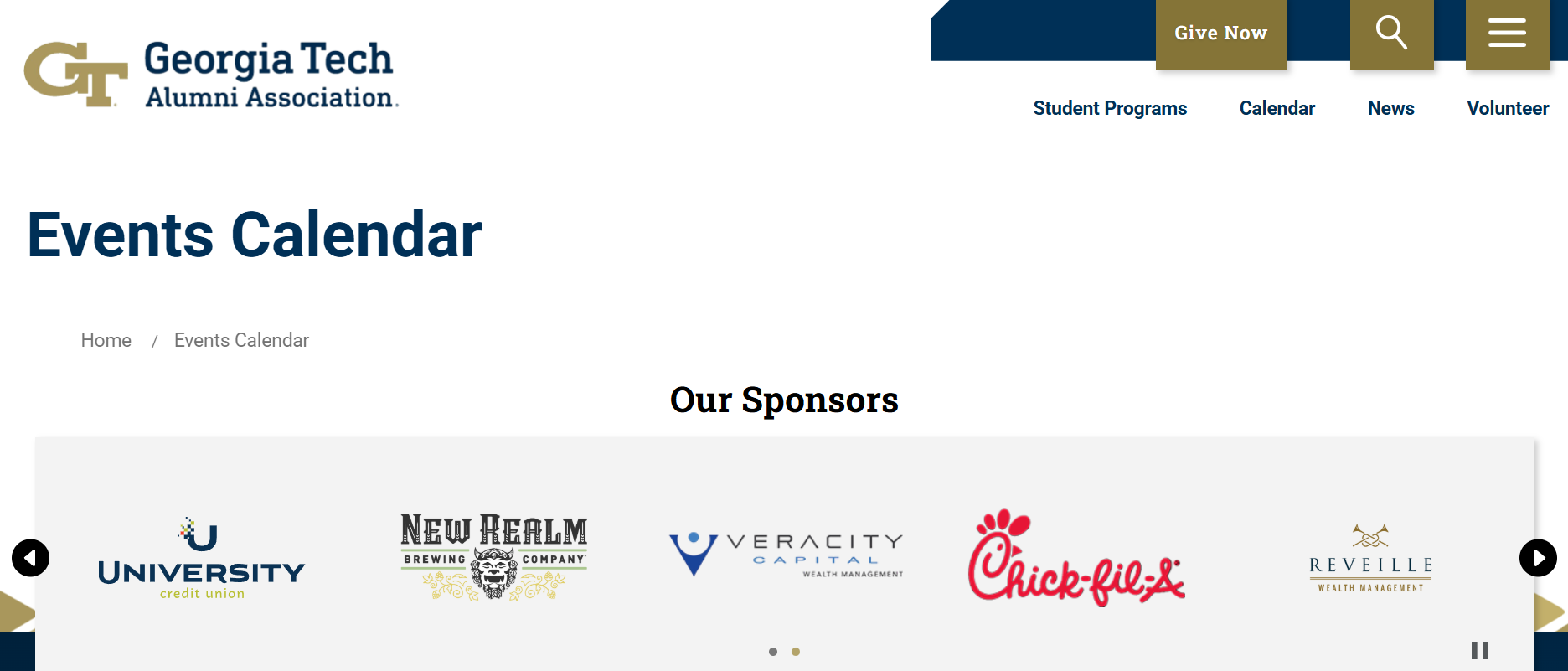
If New Realm Brewing sponsors an alumni event in Atlanta, they might be looking to expand their footprint to Raleigh. Your pitch then becomes: “We saw your fantastic activation at Georgia Tech, and we’d love to help you reach a similar, high-value audience here at NC State.”
Invest in a corporate sponsorship database.
Searching for sponsors manually is a bit like looking for a needle in a haystack while blindfolded. To truly scale your corporate giving, your advancement team needs a centralized, searchable repository of corporate philanthropic data.
A corporate sponsorship database allows your team to shift from a reactive, “hope-based” strategy to a proactive, data-driven one. These sponsorship research tools allow you to search for specific companies and locate their available programs, application guidelines, contact information, and more.
Our Top Recommendation: Double the Donation
When it comes to university advancement, Double the Donation is the gold standard. While many know them for their matching gift automation, the company’s underlying database of corporate information has recently been expanded to encompass tons of existing sponsorship opportunities as well.
Not to mention, investing in this type of infrastructure pays for itself the moment your first “found” sponsor signs a contract.
Use real metrics to demonstrate value.
In the past, a logo on a t-shirt was enough to satisfy a sponsor. Today, corporate marketing budgets are under intense scrutiny. To win the sponsorship, you must speak the language of Marketing ROI (Return on Investment).
According to recent surveys, here are the top sponsorship KPIs companies like to track:
- Sales leads (preferred by 48% of corporate respondents)
- Booth traffic (preferred by 46% of corporate respondents)
- Attendance/participation (preferred by 38% of corporate respondents)
- Social media impressions (preferred by 28% of corporate respondents)
- Return on investment (preferred by 24% of corporate respondents)
- Brand impressions (preferred by 23% of corporate respondents)
- Website traffic (preferred by 23% of corporate respondents)
- Post-event surveys (preferred by 17% of corporate respondents)
- Media coverage (preferred by 12% of corporate respondents)
Take a look at how the Florida State University Alumni Association pitches its sponsorship value. They don’t just say “we have a lot of alumni.” They provide hard numbers:
- A network of over 400,000 alumni worldwide.
- Social media platforms with over 89,000 followers.
- Email outreach to 102,000+ friends with a staggering 50% open rate.
- An average of 60,492 unique website visitors annually.
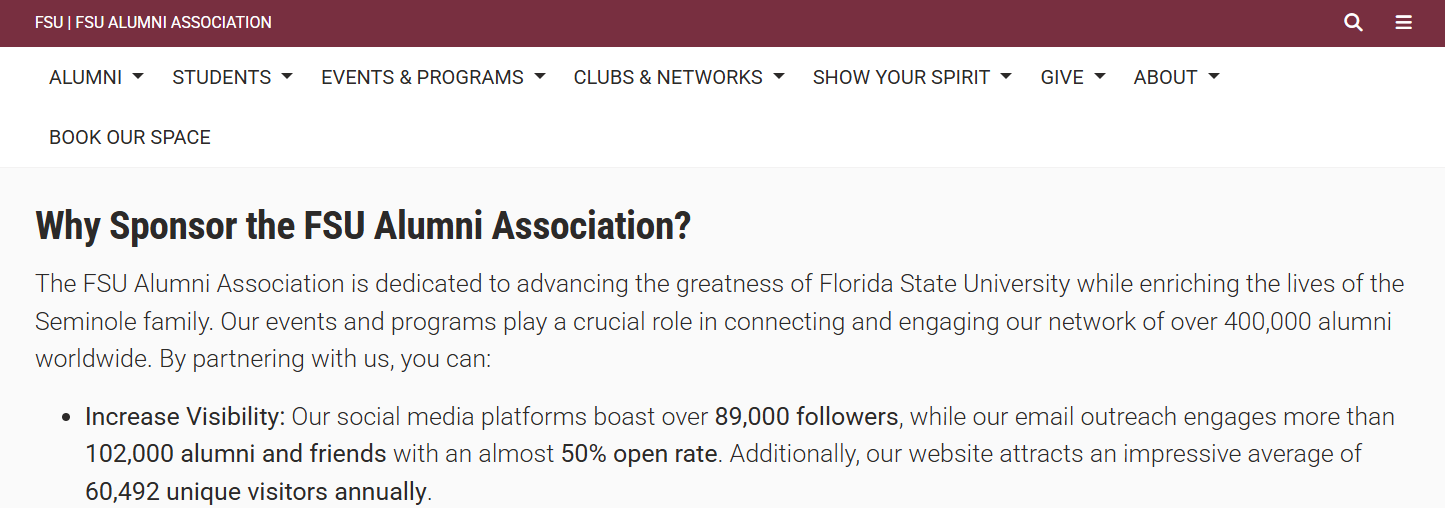
By highlighting its sizable social media following, email engagement, and website visitor traffic, the university makes a strong case for why companies should get involved. When you present a prospective partner with a 50% email open rate, you aren’t asking for a gift; you’re offering a high-performance marketing channel.
Activate social proof by highlighting previous sponsors.
Companies are more likely to sponsor your event if you have a proven track record of successful partnerships. In the corporate world, nobody wants to be the first to try something unproven, but everyone wants to be part of a winning tradition.
Therefore, demonstrate that you can provide real results by showcasing other businesses that have supported your initiatives in the past. If you can get a quote or a testimonial from a satisfied sponsor to feature on your website or sponsorship brochure, even better!
The Power of Testimonials
Carnegie Mellon University’s Integrated Innovation Institute does this masterfully. The organization features video interviews with sponsors (such as Honda 99P Labs) discussing their experiences working with the university.
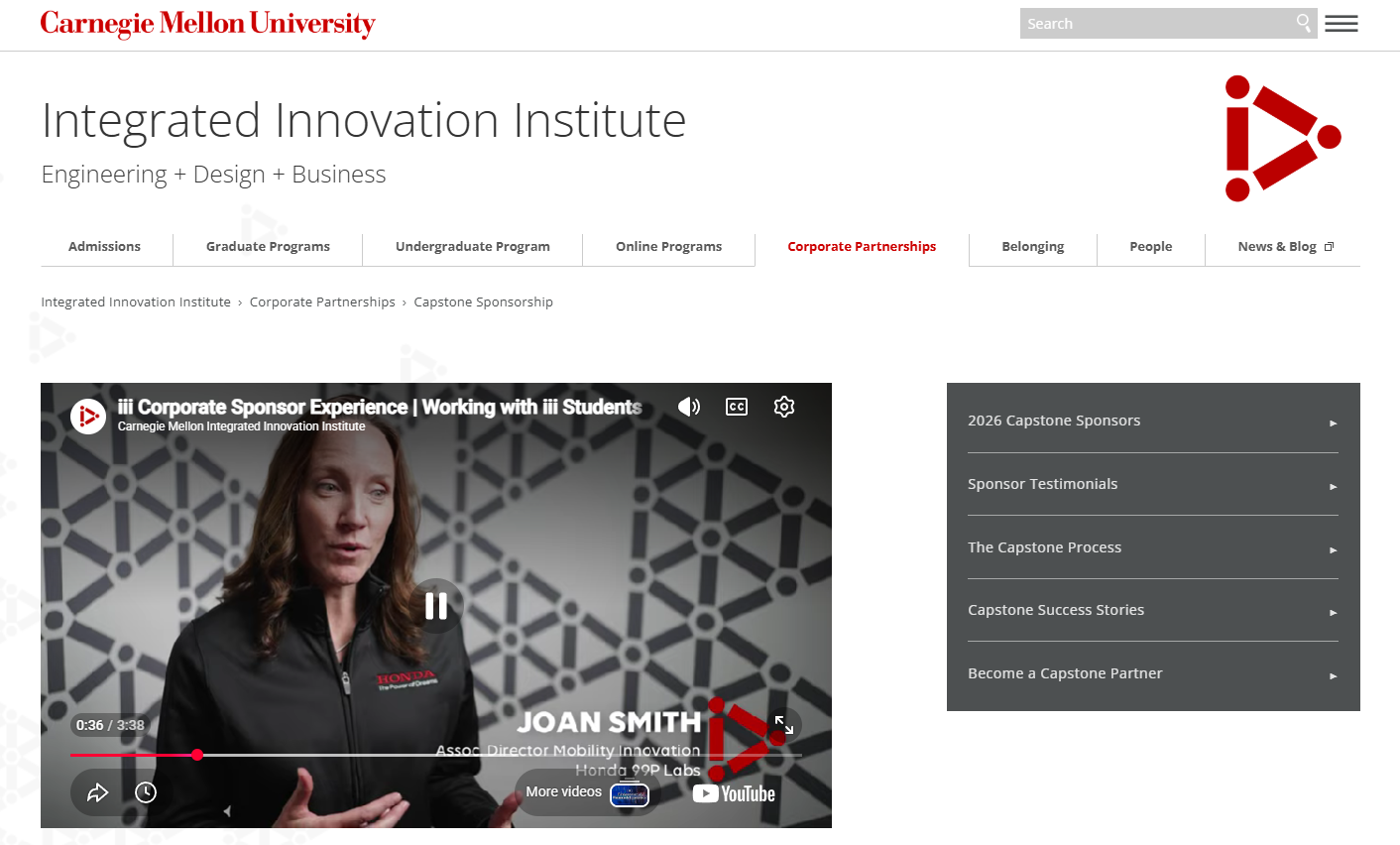
Hearing a peer executive discuss the value of the corporate sponsor experience is infinitely more persuasive than a sales pitch from the university’s development office. It proves that the university knows how to handle a corporate relationship with professionalism and results.
Encourage customizable packages.
The era of strict “Gold, Silver, and Bronze” tiers is fading. Instead, modern brands desire partnerships that align specifically with their current business goals. A local startup might want booth traffic to hand out product samples, while a national bank might prefer brand impressions via your highly trafficked mobile app.
A recent study by Exhibitor Online reports that over 52% of companies prefer à la carte options to sponsorship packages that bundle multiple items at a fixed price.
Therefore, it’s a good idea to offer a range of options to suit various budgets. By offering custom packages, your university can utilize flexibility as a key selling point.
This will:
- Lower the barrier to entry: A small business can sponsor a single “Coffee Break” rather than a whole day.
- Increase the sponsorship ceiling: A major partner can combine digital ads, physical signage, and speaking opportunities into a high-dollar mega-sponsorship.
- Show respect for various budgets: You aren’t forcing companies to pay for “Social Media Mentions” if they don’t value them.
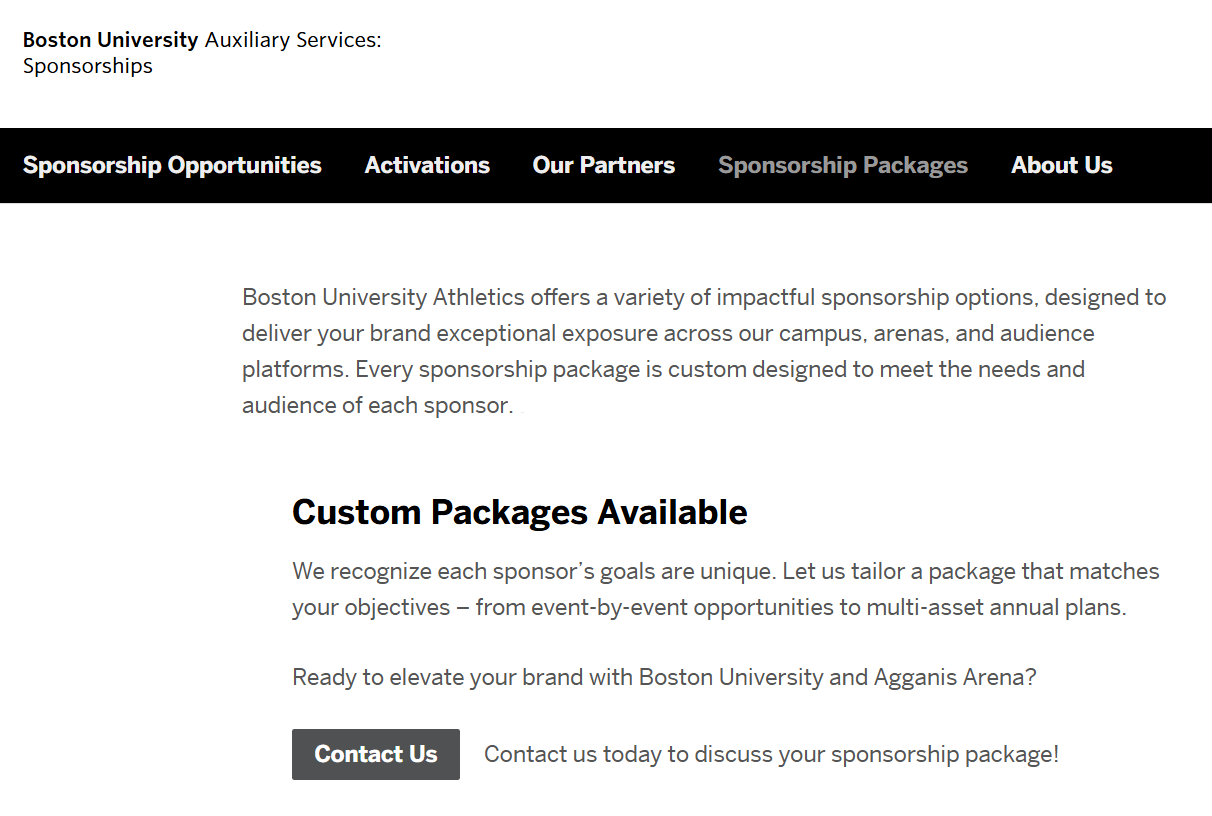
Take a cue from Boston University’s corporate sponsor page. Their team explicitly states: “We recognize each sponsor’s goals are unique. Let us tailor a package that matches your objectives, from event-by-event opportunities to multi-asset annual plans.”
In conclusion
Gaining corporate sponsors for university events is a sophisticated blend of data science, relationship building, and strategic marketing. By uncovering employment data, looking toward your existing connections, investing in the right tools, and presenting sponsors with hard metrics, you can transform your upcoming event from a line item into a long-lasting partnership.
Remember: the most successful sponsorships are those where the company feels like a hero in your school’s story. By treating sponsors as strategic partners rather than just line items in a budget, you ensure that when the next big event rolls around, they won’t just be on your list; they’ll be the first ones calling you to renew.
Have more questions about identifying, securing, or marketing corporate sponsorships? Check out our helpful FAQ guide here.