
Corporate Grants FAQ: Prospecting, Applying + Other Tips
Corporate philanthropy is one of the most accessible, yet underutilized, revenue streams in the nonprofit sector. Today’s companies are no longer just looking for tax write-offs; they are seeking strategic community partners. They want to solve problems that affect their employees, their customers, and their bottom line. And corporate grants are the way they’re doing it!
If your nonprofit is ready to move beyond small-scale bake sales and individual appeals to tap into the billions of dollars corporations allocate annually, this guide is for you. We’ll cover:
- Understanding the Corporate Grant Landscape
- Prospecting and Identifying Corporate Grant Opportunities
- Crafting a Winning Corporate Grant Application
- Post-Award Strategy and Relationship Management
For many nonprofit professionals, the idea of a corporate grant evokes images of massive checks, mahogany boardrooms, and an impenetrable wall of bureaucracy. That can make them feel really out of reach. But it’s not always the case!
Keep reading to find out how your organization can overcome this common misconception and discover the “secret handshake” that unlocks corporate support.
Download “How to Secure Corporate Grants & In-Kind Gifts”
Ready to turn your donor data into a powerhouse for corporate funding? Download Double the Donation’s exclusive guide to access a step-by-step roadmap for building high-impact partnerships that last.
Section I: Understanding the Corporate Grant Landscape
Before you can win a grant, you must understand where the money lives. Corporate giving is not a monolith; it flows through distinct channels, each with its own set of rules, stakeholders, and motivations. Knowing which door to knock on will dictate your entire approach.
What is the difference between a corporate grant and a sponsorship?
These terms are sometimes used interchangeably, but it’s important to note that there are some core differences between them. A corporate sponsorship is typically a marketing or advertising expense. The company gives you money, and in exchange, you provide them with publicity: a logo on a banner, a mention in a press release, or a booth at your annual gala. The company’s goals are largely brand exposure and customer acquisition.
A corporate grant, however, is intended for social impact. While the company still appreciates recognition, its primary goal is to see a measurable change in a specific program or area.
What are the benefits of corporate grants for nonprofits?
A successful grant often unlocks a multi-channel revenue stream, including matching gifts and volunteer grants. Beyond the initial funding, winning a grant from a brand like Google or Walmart establishes organizational credibility. This “halo effect” encourages a company’s employees to utilize their workplace giving programs, creating long-term, recurring revenue.
Where does corporate grant money actually come from?
Corporate grant funding can generally be sourced through a few different means. These include:
- Corporate Foundations: A separate legal entity (like the Walmart Foundation), corporate foundations have their own boards and specific endowments. They are more transparent and structured, often with rigid annual grant cycles and public reporting requirements, but can be highly competitive in nature.
- Direct Company Giving: This money comes directly out of a company’s operating budget. It is often managed by a CSR Manager or a Community Relations team, and decisions are often more flexible and aligned with the company’s current business goals throughout the fiscal year as needs arise.
- Branch-Level/Discretionary Funds: Many large retail or service-based companies also provide individual store managers with a small budget to support local causes. These are typically the easiest grants to win but offer the smallest dollar amounts (such as $500 to $5,000).
Identifying which source you are targeting for support is crucial for customizing your grant proposal or application. You’ll want to approach a regional branch manager differently than the CSR head of a major national corporation!
What companies currently offer corporate grants for nonprofits?
While thousands of companies have existing giving programs, a few heavy hitters consistently lead the pack. If you’re just beginning your corporate prospecting, these household names are excellent places to start:
- Bank of America: Focusing heavily on economic mobility and community development, Bank of America offers specific grant cycles throughout the year for nonprofits tackling housing, health, and jobs.
- Walmart and Sam’s Club: Through Spark Good Local Grants, individual stores and clubs award a wide range of grants to selected nonprofits. This is one of the most accessible programs for local grassroots organizations, with three application cycles per year.
- State Farm Insurance: Offering “Good Neighbor” grants specifically for safety, education, and community development, State Farm is known for supporting local disaster relief and teen driver safety programs.
- Google: Beyond its famous Google Ad Grants (which provide up to $10,000/month in search advertising), Google.org offers substantial cash grants to nonprofits that use technology to solve complex social problems.
Check out Double the Donation’s list of companies that give grants to nonprofits to explore even more opportunities!
How much are companies actually giving to nonprofits via grants?
According to a Giving USA report, total corporate giving in the U.S. (including cash grants, matching gifts, sponsorships, and more) reached an estimated $44.4 billion, with the top 10 companies alone contributing over $2 billion each year to the nonprofit sector. But how much of that sum can you expect your nonprofit to receive?
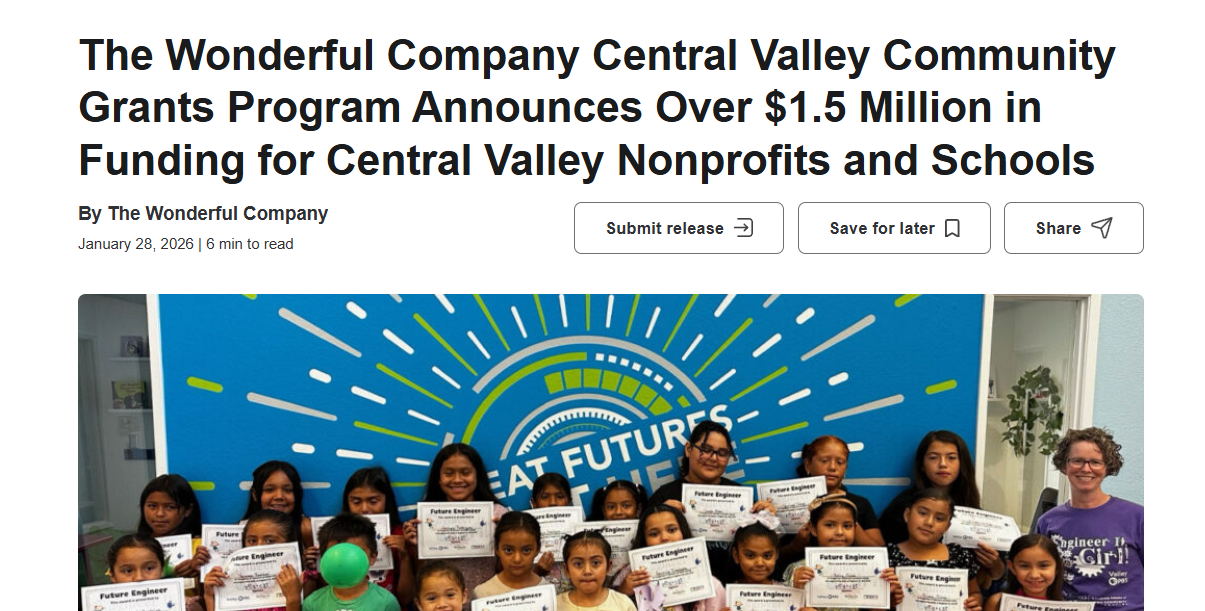
While mega-grants are more likely to make headlines (see above), they are unfortunately not the norm for most organizations. Rather, industry data suggests the following breakdown for corporate grants:
- Local/Community Grants: These usually range from $500 to $5,000 and are designed for community-specific impacts, such as a neighborhood food pantry or a school garden.
- Mid-Level Programmatic Grants: For regional or statewide nonprofits, corporate grants typically range from $10,000 to $50,000.
- National Strategic Partnerships: These are often “invite-only” and offered by major Fortune 500 companies, and can range from $100,000 to $500,000+, sometimes spread over multiple years.
It’s also worth noting that the industry is seeing a significant shift toward General Operating Support (GOS). Recent studies show that over 40% of corporate grants are now earmarked as unrestricted or GOS, significantly up from previous years. This means companies are increasingly trusting nonprofits to use funds where they are needed most, rather than requiring every dollar to be tied to a specific project.
What are corporate in-kind grants and “pro bono” corporate support?
In-kind grants are donations of a company’s own products or professional services, such as software or logistics, rather than financial contributions. These non-cash assets can significantly reduce an organization’s overhead, allowing more of its funding and resources to go toward mission-related programming.
Meanwhile, pro bono support is a form of in-kind grant in which corporate employees provide expertise or hands-on services, such as legal, IT, or marketing, at no cost. These skills-based volunteering programs allow organizations to access high-value professional talent that would otherwise be out of their budget.
How can I determine if my nonprofit is eligible for corporate grants?
To qualify for most corporate grants, organizations must hold a valid IRS 501(c)(3) nonprofit status and align with a company’s specific focus. Most corporations require applicants to be public charities and provide a recent Form 990.
However, specific eligibility is strictly defined by a company’s grant-making guidelines. Many companies select a few core giving pillars, which are specific thematic areas (such as STEM education, sustainability, or food security), often focusing on causes that align with their business expertise or employee interests.
Before applying for a grant, be sure to verify that your nonprofit’s mission fits into one of these defined categories to avoid an automatic disqualification.
How has the shifting corporate landscape influenced modern grant-making?
Corporate grant cycles are speeding up, and much of this is due to increasing business velocity. Most corporations review applications on a quarterly basis. But because they are tied to a for-profit business, they could have spending surges at the end of their fiscal year. If a company hasn’t met its CSR spending goals by Q4, it may be more inclined to approve a well-aligned request.
However, recent IRS policies are encouraging C-corporations to maintain consistent charitable contributions to maximize tax-advantaged 10% ceilings. This shift is leading many companies to pursue active grantmaking to meet their philanthropic quotas, and corporations are favoring high-ROI giving through programs that demonstrate clear community impact.
At the same time, corporations are also prioritizing direct employee-led giving, which includes matching gifts, volunteer grants, and payroll deductions. Today, firms are increasingly shifting budgets toward employee engagement initiatives because they often drive more company-wide benefits than top-down grants. And for nonprofits, they have higher approval rates than traditional competitive grants!
Section II: Prospecting and Identifying Corporate Grant Opportunities
The most successful grant-seekers typically spend 80% of their time on corporate research and 20% on the actual proposal writing. Finding the right match is the key to preventing grant-writing burnout and increasing your odds of a “yes.”
How do we find corporate grant opportunities without a dedicated researcher?
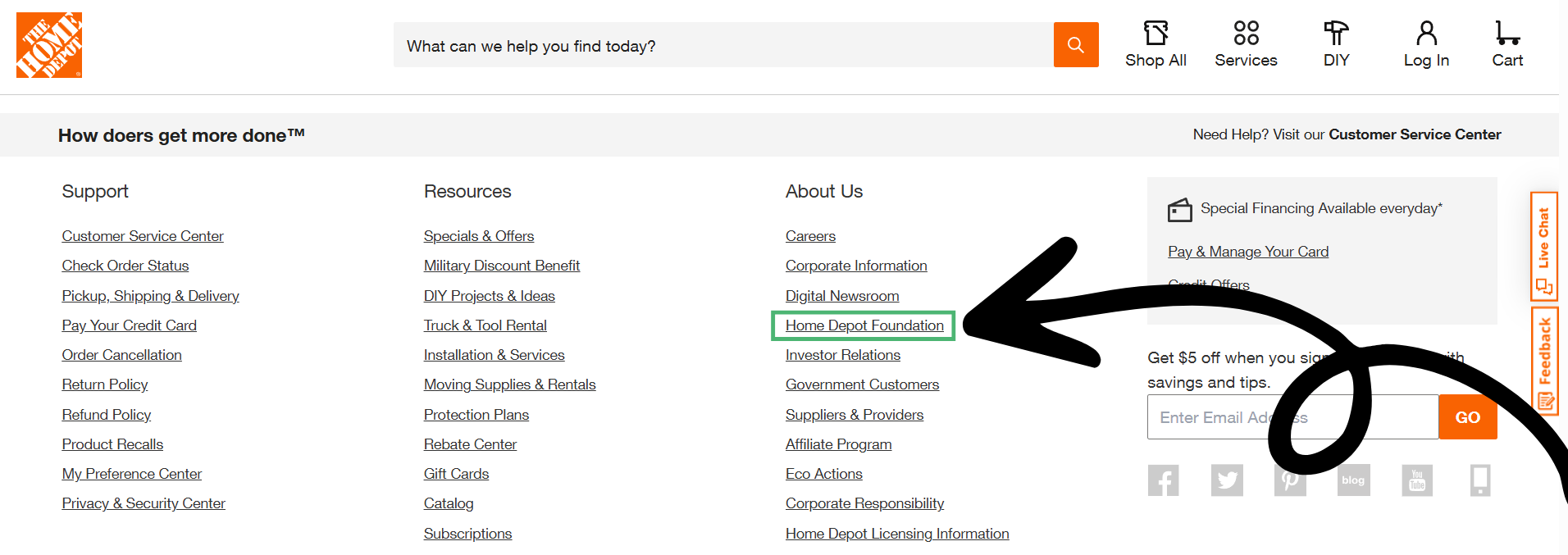
One of the best-kept secrets in fundraising is that many of the world’s largest corporations have open, long-standing application portals. For example, companies like Wells Fargo, Amazon, and Home Depot have year-round platforms where any 501(c)(3) can submit a request. (Just click each of the hyperlinked company names to see for yourself!)
To find these opportunities, identify the top 50 employers in your city or region. Visit their websites and search for keywords like “Community,” “Giving,” “CSR,” or “Foundation.” You might be surprised by how many have a Submit Grant Request button hidden in plain sight.
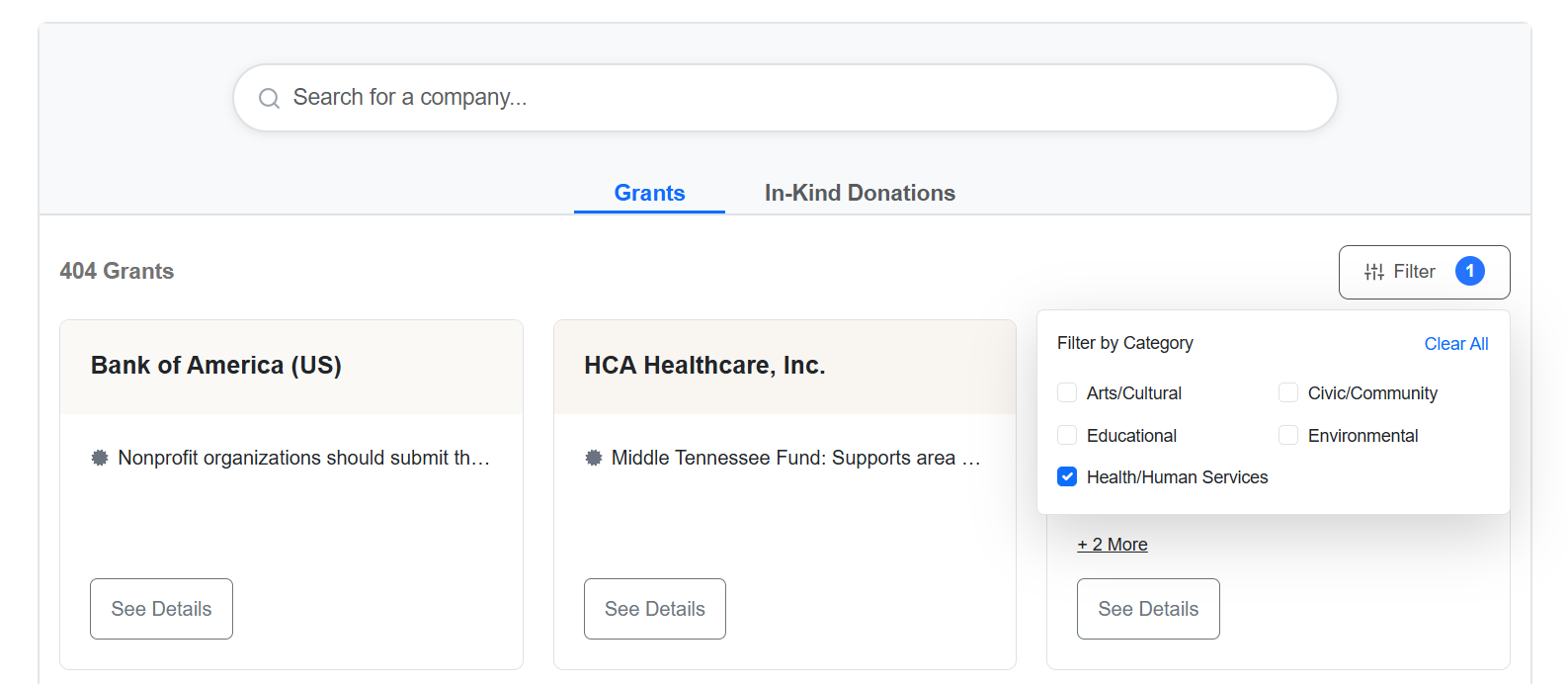
What tools can be used to identify corporate grant programs?
While you may be able to secure grant funding based on guesswork or endless Google searches alone, new technology advancements mean that’s no longer your only option. According to our recent analysis of top corporate grant-searching tools, your development team can use platforms like these to transform prospecting into a high-yield strategy:
- LinkedIn: As a social network, LinkedIn is the ultimate tool for finding the “human” side of a grant. It allows nonprofits to identify target companies’ CSR managers, leverage connections for warm introductions, and track corporate executives’ social impact goals.
- Candid: Often considered the gold standard for corporate foundation research, Candid (formerly Foundation Directory Online) provides deep historical data on over 240,000 grantmakers. It allows users to view IRS Form 990s, explore past grant recipients, and utilize relational mapping to see if your board members are connected to a foundation’s leadership.
- Double the Donation: A corporate giving powerhouse, this platform features a comprehensive database of corporate grants, sponsorships, and in-kind donation opportunities. It allows nonprofits to filter by mission vertical, provides direct links to guidelines and applications, and offers employee density analysis to identify companies where your supporters already work.
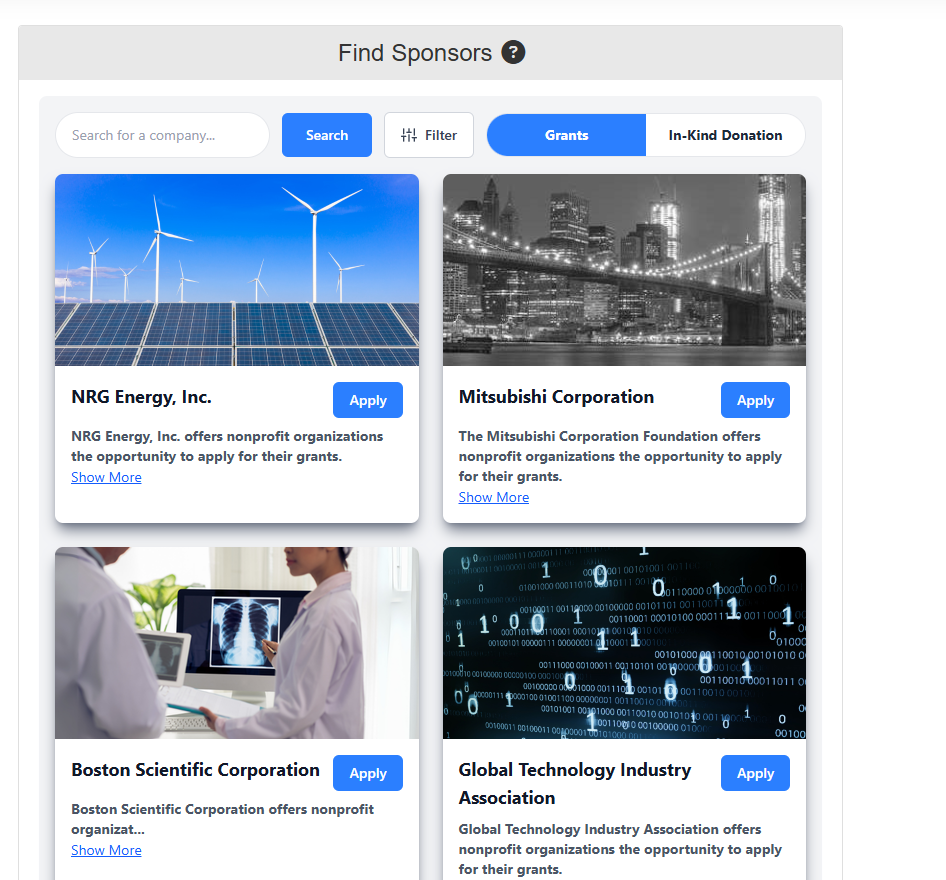
By combining the right digital resources with your internal data, you can create a prospecting engine that works year-round. The recommended platforms above will enable your team to establish a pipeline of companies whose philanthropic interests and employee footprints align perfectly with your nonprofit’s needs.
Is physical proximity a major factor in corporate grant prospecting?
Most corporations prioritize giving in the places where their employees live, work, and play. This geographic footprint is a critical filter for CSR teams because local impact is highly visible to their primary stakeholders: staff and customers. For this reason, a regional bank or a local utility provider is far more likely to fund a project in their own service area than a national organization three states away.
Some companies even list their geographic requirements directly in application materials or in corporate grant databases, such as Double the Donation (example from HCA Healthcare pictured below).
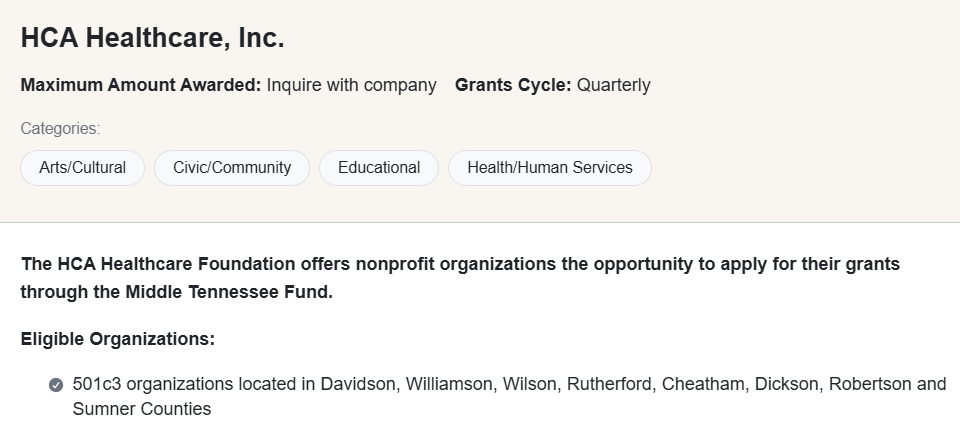
When prospecting for corporate grants, start by mapping out major employers, regional headquarters, and distribution centers located within a 20-mile radius of your primary service area.
How do we identify the best prospects based on mission alignment?
Beyond physical location, the most successful partnerships are built on the idea that your mission should naturally strengthen the company’s business ecosystem. To find these matches, ask yourself: Does our work solve a problem that impacts this industry’s future?
Check out these examples:
- Education and Literacy: Your best prospects are tech firms, law offices, or publishing houses that require a highly skilled and literate workforce to thrive.
- Environmental Conservation: Look toward outdoor retailers who need healthy natural spaces for their products to be used, or manufacturing companies looking to offset their carbon footprint.
- Food Insecurity and Health: Your first stops should be grocery chains, agricultural equipment manufacturers, or healthcare providers with a vested interest in the community’s nutritional well-being.
By aligning your mission with companies’ industry needs, you move the conversation from charity to community investment. This overlap makes it much easier for a CSR manager to justify the grant to their executive leadership, too.
How can we use our supporter data to uncover grant opportunities?
Most nonprofits are sitting on a goldmine of data they rarely use: the employer information of their donors and volunteers. But this data point can serve as your secret weapon for breaking through the noise!
Companies are significantly more likely to fund an organization that their employees already support. Doing so boosts employee retention and morale: two major business goals.
By analyzing employer data in your CRM, you can identify powerful internal champions who can help advocate for grant funding for your cause. If you see that ten of your regular volunteers work for a local manufacturer, that company can now be considered a warm lead. From there, you can ask those volunteers to facilitate a personal introduction between your team and their employer’s CSR lead, ensuring your grant proposal stands out from the pile.
What are employee-nominated corporate grants, and how can we access those programs?
Some businesses take employee-directed giving to the next level. Rather than simply welcoming employee recommendations, certain companies actually require them.
To understand the power of employee-driven grants, let’s take a look at the Starbucks Neighborhood Grants program. As of today, Starbucks does not allow nonprofits to apply directly through a public portal. Rather, they invite their “partners” (i.e., employees) to nominate organizations making an impact in their local communities.
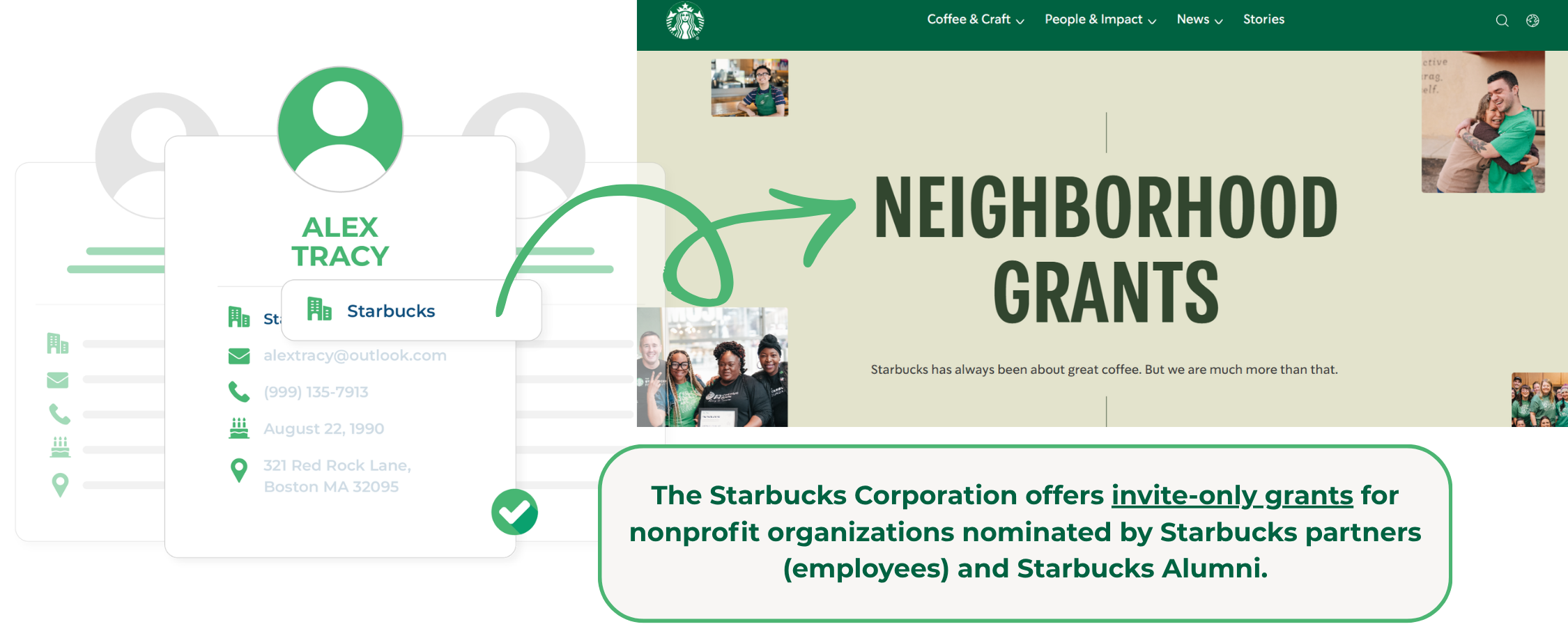
If your data shows that several qualifying employees volunteer with or donate to your cause already, you have a direct pathway to that grant. You just need to ask: “Would you be willing to nominate our nonprofit during the next grant cycle?”
Can we use volunteer grants as a stepping stone to larger funding?
Volunteer grants (also known as “Dollars for Doers”) are essentially bite-sized grants awarded to nonprofits once a company’s employee reaches a minimum number of volunteer hours. While these checks are generally limited in size (typically $250 to $1,000), their value certainly cumulates when scaled across your whole volunteer base!

Not to mention, if a company has already paid out several volunteer grants to your org, you are likely considered a vetted partner. When you later apply for a $50,000 grant, your application is no longer from a stranger; it’s from an organization the company (and its employees) are already invested in.
Unlock Direct Access to Corporate Grants
Ready to end the manual search for corporate partners? Double the Donation’s corporate giving database provides direct links to corporate grant applications, in-kind donation guidelines, and sponsorship program details for thousands of companies.
Section III: Crafting a Winning Corporate Grant Application
Corporate grant reviewers are often business professionals, not academic historians. They value brevity, data-driven logic, and clear outcomes. Not to mention, they’re typically looking at your proposal through the lens of a social investment.
What do corporate grant reviewers actually want to see in a proposal?
A winning corporate grant application generally focuses on five key pillars. These include:
- Alignment: Explicitly state how your nonprofit’s mission helps the company achieve its specific CSR goals.
- Example: For a tech company that prioritizes digital equity, highlight how your after-school program provides coding workshops to under-resourced students.
- Efficiency: Use real math to show you are a good steward of funds.
- Example: For every dollar granted, 90 cents goes directly into program services rather than administrative overhead.
- Scalability: Can this program grow if they give you more money next year?
- Example: Explain how a successful neighborhood pilot program can be replicated across the entire city with increased corporate investment.
- Sustainability: Will your team be able to sustain program operations after the grant ends?
- Example: Outline your diverse funding streams, including individual donors and event revenue, to demonstrate that the company’s grant is an investment in growth rather than temporary life support.
- Visibility: How will you recognize the grant-maker? Companies want the general public to know they are doing good.
- Example: Offer to feature the company’s logo on your website and provide co-branded social media content that celebrates the partnership’s impact.
Corporate reviewers are seeking professional, results-oriented organizations that understand the value of a dollar as well as the importance of brand reputation. When you address these concerns, you demonstrate that your nonprofit operates with the same strategic rigor as the company you are asking to invest in you.
How should we present data and impact metrics?
Corporate grant-makers are trained to look for efficiency and impact. When presenting your organization’s case for support, be sure to focus on high-level figures that demonstrate the return on investment of the company’s grant.
Core metrics (or KPIs) to highlight in your proposal may include:
- Reach and Volume: The total number of individuals, families, or communities directly impacted by your programs
- Cost-Efficiency: The breakdown of how much it costs to deliver a specific service (e.g., cost per meal provided or cost per student mentored)
- Success Rates: The percentage of participants who achieved a positive outcome, such as graduation, job placement, or housing stability
- Local Density: The portion of your impact that occurs within the company’s core “footprint” (i.e., neighborhoods where they have offices or customers)
When you effectively communicate these numbers to a prospective partner, they gain a better understanding of your organization’s work and the positive social change you could accomplish with their support.
What are the most common mistakes that lead to rejection?
Even the best nonprofits get rejected sometimes, but many dismissals stem from avoidable errors. For example:
- The “One-Size-Fits-All” Proposal: Never send a generic copy-and-pasted pitch. If you don’t mention its specific community goals (e.g., “Diversity in Tech” or “Clean Water”), the company is not likely to fund you.
- Asking for General Operating Support: Most corporations prefer to fund tangible projects rather than “keeping the lights on.” Frame your overhead as program implementation or capacity building to make it more palatable to a business mindset.
- Poor Financial Transparency: Corporations are risk-averse and want to ensure their funds won’t be mismanaged. Failing to provide a clear line-item budget or recent financial statement can be an immediate red flag around a lack of organizational maturity.
- Unpolished or Unprofessional Proposals: Corporate grant reviewers often equate the quality of your application with the quality of your program management. Proposals riddled with spelling errors or grammatical mistakes signal a lack of attention to detail that can make a company hesitate to trust you with a large financial investment.
A corporate grant reviewer is looking for reasons to say “yes” to a partnership, but a single oversight can lead to an easy “no.” By treating your application as a professional business case, you demonstrate that your nonprofit is a reliable, high-functioning entity capable of stewarding corporate resources. Taking the extra time to proofread, itemize your costs, and tailor your language to the funder’s goals ensures that your mission isn’t sidelined by technicalities.
How much should we realistically ask for?
This is a largely variable metric, and it can be hard to say without a solid understanding of your organization’s needs and the grant-making company’s capacity. However, you can typically narrow it down by researching a corporation’s past giving.
Most large companies list previous grant amounts on their application portals or in their annual CSR reports. If a corporation typically gives $10,000, don’t ask for $100,000 unless you have a massive, multi-year partnership proposal that will wow their team.
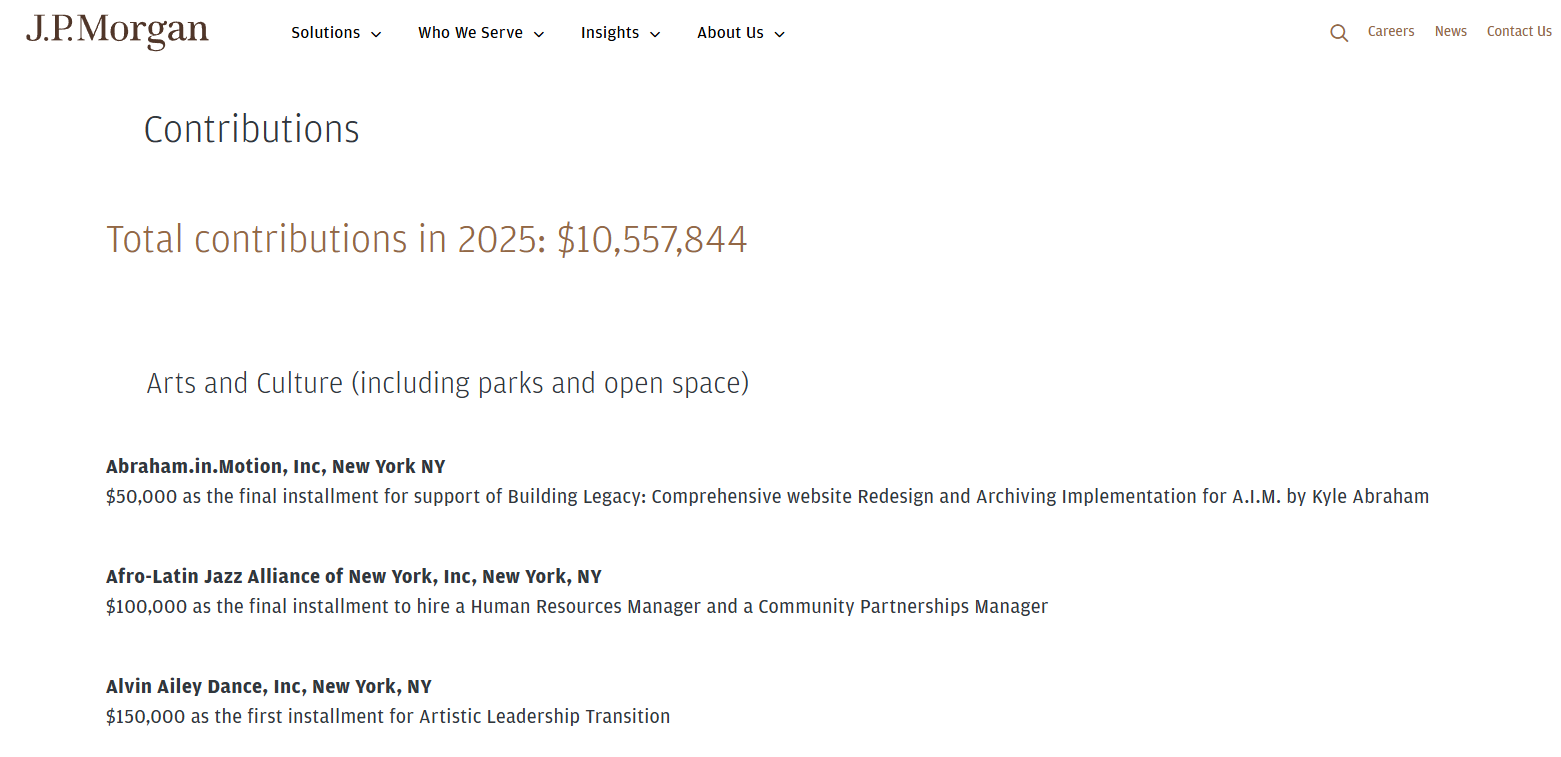
For the best results, a first-time ask should usually be at or slightly below their average grant size to build trust.
Section IV: Post-Award Strategy and Relationship Management
Winning the grant is only half the battle. Ideally, the goal is to turn a one-time grant into a multi-year partnership. In the corporate world, renewal is much easier than acquisition.
How do we report our performance to a corporate grantmaker?
Looking to build a long-term relationship with a company that contributed a grant to your organization? It’s important to provide an impact report that speaks their language. Rather than a narrative-heavy PDF, we recommend sending a sleek “Impact Summary” that includes:
- Visuals: High-quality photos of the program in action or statistic-backed, impact-focused infographics
- Human Stories: A brief, 2-3 sentence testimonial from someone who benefitted from your mission
- Hard Data: Reiterate the metrics you promised in the application with the real results you’ve achieved
When a company sees what its grant has accomplished, it will be increasingly likely to continue or grow its support.
What happens if we don’t meet our promised goals?
First off, don’t panic. The worst thing you can do is hide the data. Corporations understand that business doesn’t always go as planned. If your program falls short of its projected metrics, be proactive in your communication. Reach out to your point of contact, explain the challenges you’re facing, and share your intended pivot strategy.
This level of transparency builds more trust than a falsified success story ever could.
How can we deepen the relationship beyond the check?
Corporate grant funders want to be partners, not just ATMs. Therefore, it’s a good idea to offer them tangible ways to get skin in the game. This might include:
- Skill-Based Volunteering: Involve a company’s employees! Ask their marketing team to help revamp your newsletter, or their IT team to examine your database for growth opportunities.
- Board Placement: If a high-level executive at a grant-making company is looking for a seat on your board of directors, it creates a permanent bridge between your organizations.
- Site Visits: Invite the HR or CSR manager to see your nonprofit’s programming in action. Seeing a solved problem in person (especially a behind-the-scenes look) is often more powerful than a text-based report.
By fostering these connections, you transition from being a simple line item in a budget to a vital community partner.
When is the right time to ask for a renewal or a larger grant?
Don’t wait until the current grant runs out. The best time to talk about next year is immediately after you send a successful mid-year report. You can even use the momentum of your current success to say, “With your $10,000, we achieved X. If we were to scale this to $25,000 next year, we could achieve Y.”
Wrapping Up
Corporate grants represent one of the most significant opportunities for nonprofits to diversify their revenue and scale their impact. Shift your mindset from “asking for a donation” to “offering a partnership.” Doing so positions your nonprofit as a solution-provider for the company’s CSR goals.
The money is there, the portals are open, and the business world is looking for partners to make a difference. Now, it’s just a matter of making the connection. Good luck!
Are You Ready to Grow Corporate Giving Revenue?
Stop managing grants & sponsorships in silos. Scale your impact by integrating your corporate and workplace giving strategies into one system.
Join 8,000+ nonprofits using the world’s leading corporate giving database.