Corporate Grants FAQ: Prospecting, Applying + Other Tips

Corporate philanthropy is one of the most accessible, yet underutilized, revenue streams in the nonprofit sector. Today’s companies are no longer just looking for tax write-offs; they are seeking strategic community partners. They want to solve problems that affect their employees, their customers, and their bottom line. And corporate grants are the way they’re doing it!

If your nonprofit is ready to move beyond small-scale bake sales and individual appeals to tap into the billions of dollars corporations allocate annually, this guide is for you. We’ll cover:

For many nonprofit professionals, the idea of a corporate grant evokes images of massive checks, mahogany boardrooms, and an impenetrable wall of bureaucracy. That can make them feel really out of reach. But it’s not always the case!

Keep reading to find out how your organization can overcome this common misconception and discover the “secret handshake” that unlocks corporate support.

Download “How to Secure Corporate Grants & In-Kind Gifts”

Ready to turn your donor data into a powerhouse for corporate funding? Download Double the Donation’s exclusive guide to access a step-by-step roadmap for building high-impact partnerships that last.

Get My Free eBook →

Section I: Understanding the Corporate Grant Landscape

Before you can win a grant, you must understand where the money lives. Corporate giving is not a monolith; it flows through distinct channels, each with its own set of rules, stakeholders, and motivations. Knowing which door to knock on will dictate your entire approach.

What is the difference between a corporate grant and a sponsorship?

These terms are sometimes used interchangeably, but it’s important to note that there are some core differences between them. A corporate sponsorship is typically a marketing or advertising expense. The company gives you money, and in exchange, you provide them with publicity: a logo on a banner, a mention in a press release, or a booth at your annual gala. The company’s goals are largely brand exposure and customer acquisition.

corporate grant, however, is intended for social impact. While the company still appreciates recognition, its primary goal is to see a measurable change in a specific program or area.

What are the benefits of corporate grants for nonprofits?

A successful grant often unlocks a multi-channel revenue stream, including matching gifts and volunteer grants. Beyond the initial funding, winning a grant from a brand like Google or Walmart establishes organizational credibility. This “halo effect” encourages a company’s employees to utilize their workplace giving programs, creating long-term, recurring revenue.

Where does corporate grant money actually come from?

Corporate grant funding can generally be sourced through a few different means. These include:

  • Corporate Foundations: A separate legal entity (like the Walmart Foundation), corporate foundations have their own boards and specific endowments. They are more transparent and structured, often with rigid annual grant cycles and public reporting requirements, but can be highly competitive in nature.
  • Direct Company Giving: This money comes directly out of a company’s operating budget. It is often managed by a CSR Manager or a Community Relations team, and decisions are often more flexible and aligned with the company’s current business goals throughout the fiscal year as needs arise.
  • Branch-Level/Discretionary Funds: Many large retail or service-based companies also provide individual store managers with a small budget to support local causes. These are typically the easiest grants to win but offer the smallest dollar amounts (such as $500 to $5,000).

Identifying which source you are targeting for support is crucial for customizing your grant proposal or application. You’ll want to approach a regional branch manager differently than the CSR head of a major national corporation!

What companies currently offer corporate grants for nonprofits?

While thousands of companies have existing giving programs, a few heavy hitters consistently lead the pack. If you’re just beginning your corporate prospecting, these household names are excellent places to start:

  • Bank of America: Focusing heavily on economic mobility and community development, Bank of America offers specific grant cycles throughout the year for nonprofits tackling housing, health, and jobs.
  • Walmart and Sam’s Club: Through Spark Good Local Grants, individual stores and clubs award a wide range of grants to selected nonprofits. This is one of the most accessible programs for local grassroots organizations, with three application cycles per year.
  • State Farm Insurance: Offering “Good Neighbor” grants specifically for safety, education, and community development, State Farm is known for supporting local disaster relief and teen driver safety programs.
  • Google: Beyond its famous Google Ad Grants (which provide up to $10,000/month in search advertising), Google.org offers substantial cash grants to nonprofits that use technology to solve complex social problems.

Check out Double the Donation’s list of companies that give grants to nonprofits to explore even more opportunities!

How much are companies actually giving to nonprofits via grants?

According to a Giving USA report, total corporate giving in the U.S. (including cash grants, matching gifts, sponsorships, and more) reached an estimated $44.4 billion, with the top 10 companies alone contributing over $2 billion each year to the nonprofit sector. But how much of that sum can you expect your nonprofit to receive?
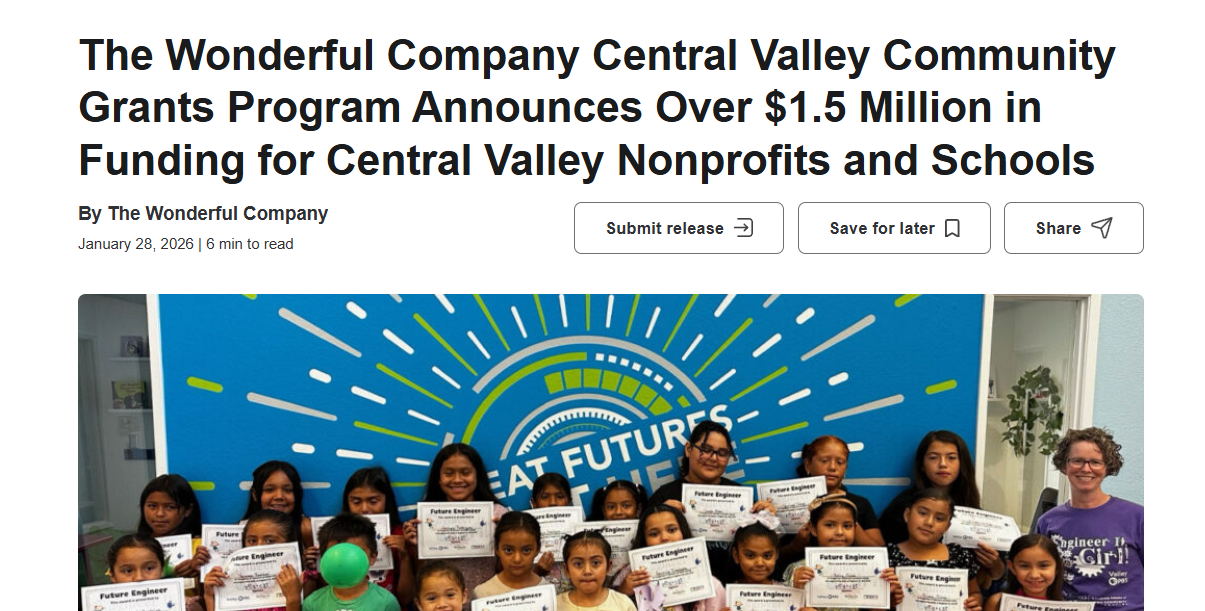
Mega corporate grants often make news headlines

While mega-grants are more likely to make headlines (see above), they are unfortunately not the norm for most organizations. Rather, industry data suggests the following breakdown for corporate grants:

  • Local/Community Grants: These usually range from $500 to $5,000 and are designed for community-specific impacts, such as a neighborhood food pantry or a school garden.
  • Mid-Level Programmatic Grants: For regional or statewide nonprofits, corporate grants typically range from $10,000 to $50,000.
  • National Strategic Partnerships: These are often “invite-only” and offered by major Fortune 500 companies, and can range from $100,000 to $500,000+, sometimes spread over multiple years.

It’s also worth noting that the industry is seeing a significant shift toward General Operating Support (GOS). Recent studies show that over 40% of corporate grants are now earmarked as unrestricted or GOS, significantly up from previous years. This means companies are increasingly trusting nonprofits to use funds where they are needed most, rather than requiring every dollar to be tied to a specific project.

What are corporate in-kind grants and “pro bono” corporate support?

In-kind grants are donations of a company’s own products or professional services, such as software or logistics, rather than financial contributions. These non-cash assets can significantly reduce an organization’s overhead, allowing more of its funding and resources to go toward mission-related programming.

Meanwhile, pro bono support is a form of in-kind grant in which corporate employees provide expertise or hands-on services, such as legal, IT, or marketing, at no cost. These skills-based volunteering programs allow organizations to access high-value professional talent that would otherwise be out of their budget.

How can I determine if my nonprofit is eligible for corporate grants?

To qualify for most corporate grants, organizations must hold a valid IRS 501(c)(3) nonprofit status and align with a company’s specific focus. Most corporations require applicants to be public charities and provide a recent Form 990.

However, specific eligibility is strictly defined by a company’s grant-making guidelines. Many companies select a few core giving pillars, which are specific thematic areas (such as STEM education, sustainability, or food security), often focusing on causes that align with their business expertise or employee interests.

Before applying for a grant, be sure to verify that your nonprofit’s mission fits into one of these defined categories to avoid an automatic disqualification.

How has the shifting corporate landscape influenced modern grant-making?

Corporate grant cycles are speeding up, and much of this is due to increasing business velocity. Most corporations review applications on a quarterly basis. But because they are tied to a for-profit business, they could have spending surges at the end of their fiscal year. If a company hasn’t met its CSR spending goals by Q4, it may be more inclined to approve a well-aligned request.

However, recent IRS policies are encouraging C-corporations to maintain consistent charitable contributions to maximize tax-advantaged 10% ceilings. This shift is leading many companies to pursue active grantmaking to meet their philanthropic quotas, and corporations are favoring high-ROI giving through programs that demonstrate clear community impact.

At the same time, corporations are also prioritizing direct employee-led giving, which includes matching gifts, volunteer grants, and payroll deductions. Today, firms are increasingly shifting budgets toward employee engagement initiatives because they often drive more company-wide benefits than top-down grants. And for nonprofits, they have higher approval rates than traditional competitive grants!

Section II: Prospecting and Identifying Corporate Grant Opportunities

The most successful grant-seekers typically spend 80% of their time on corporate research and 20% on the actual proposal writing. Finding the right match is the key to preventing grant-writing burnout and increasing your odds of a “yes.”

How do we find corporate grant opportunities without a dedicated researcher?

One of the best-kept secrets in fundraising is that many of the world’s largest corporations have open, long-standing application portals. For example, companies like Wells Fargo, Amazon, and Home Depot have year-round platforms where any 501(c)(3) can submit a request. (Just click each of the hyperlinked company names to see for yourself!)

To find these opportunities, identify the top 50 employers in your city or region. Visit their websites and search for keywords like “Community,” “Giving,” “CSR,” or “Foundation.” You might be surprised by how many have a Submit Grant Request button hidden in plain sight.
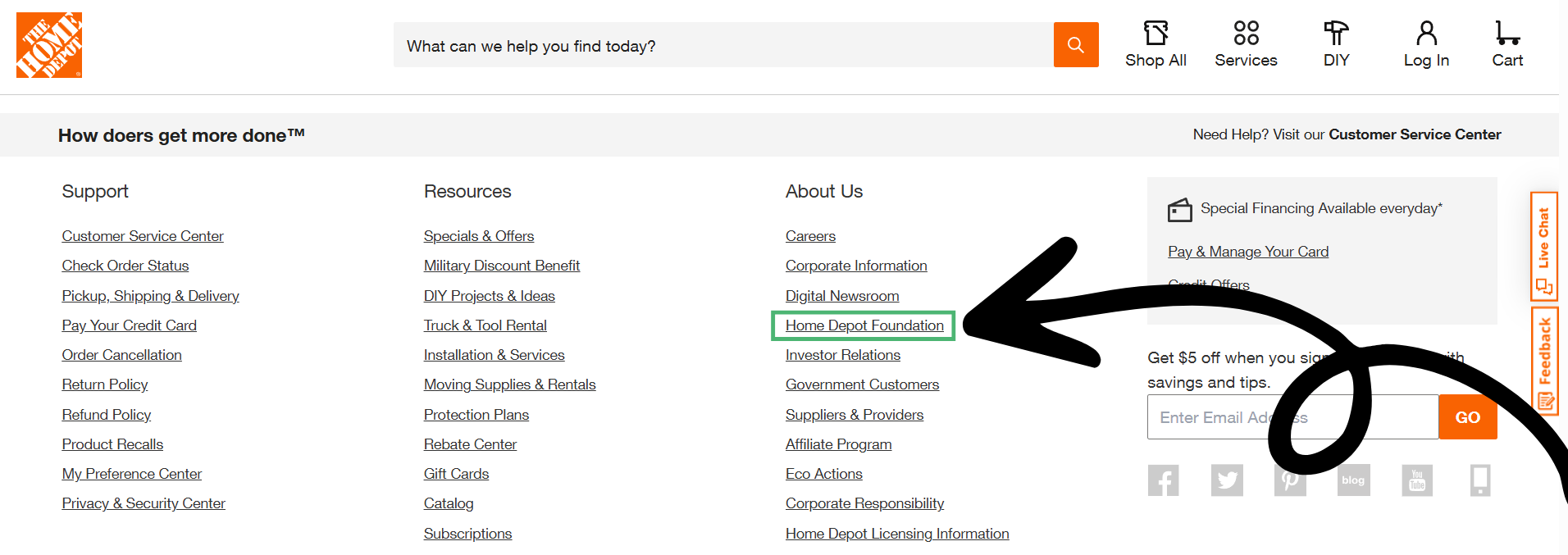
Corporate Grants - Company Website Example

What tools can be used to identify corporate grant programs?

While you may be able to secure grant funding based on guesswork or endless Google searches alone, new technology advancements mean that’s no longer your only option. According to our recent analysis of top corporate grant-searching tools, your development team can use platforms like these to transform prospecting into a high-yield strategy:

  • LinkedIn: As a social network, LinkedIn is the ultimate tool for finding the “human” side of a grant. It allows nonprofits to identify target companies’ CSR managers, leverage connections for warm introductions, and track corporate executives’ social impact goals.
  • Candid: Often considered the gold standard for corporate foundation research, Candid (formerly Foundation Directory Online) provides deep historical data on over 240,000 grantmakers. It allows users to view IRS Form 990s, explore past grant recipients, and utilize relational mapping to see if your board members are connected to a foundation’s leadership.
  • Double the Donation: A corporate giving powerhouse, this platform features a comprehensive database of corporate grants, sponsorships, and in-kind donation opportunities. It allows nonprofits to filter by mission vertical, provides direct links to guidelines and applications, and offers employee density analysis to identify companies where your supporters already work.
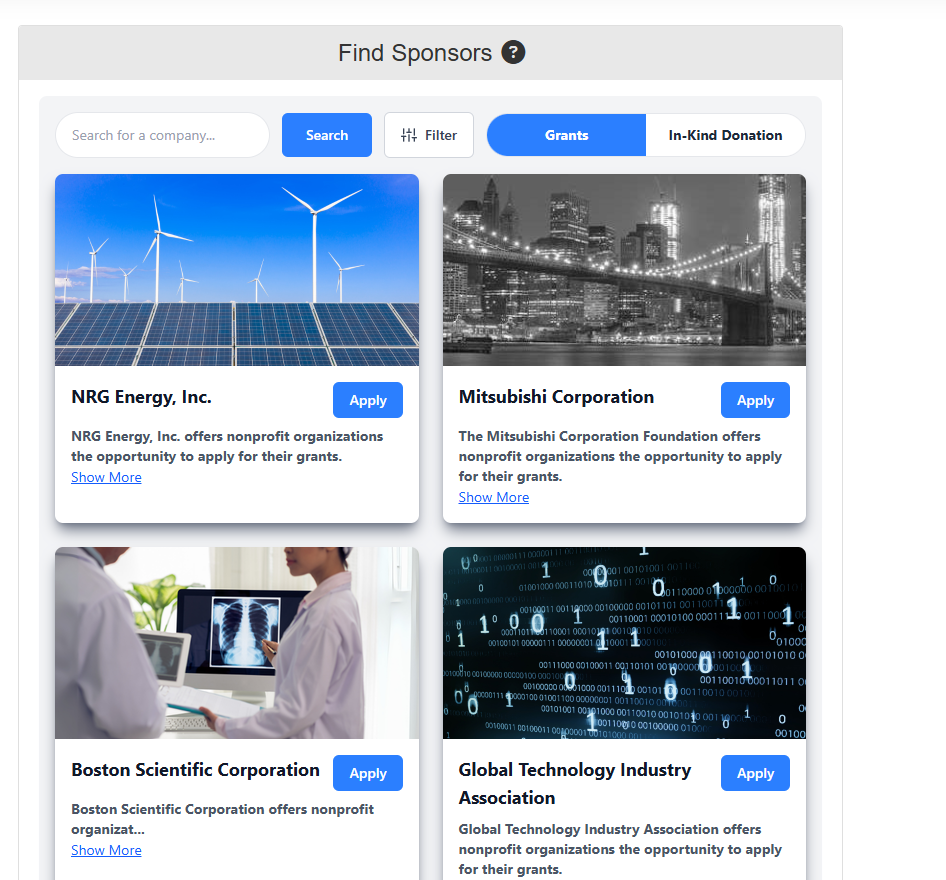
Get your nonprofit more corporate grants with an online directory

By combining the right digital resources with your internal data, you can create a prospecting engine that works year-round. The recommended platforms above will enable your team to establish a pipeline of companies whose philanthropic interests and employee footprints align perfectly with your nonprofit’s needs.

Is physical proximity a major factor in corporate grant prospecting?

Most corporations prioritize giving in the places where their employees live, work, and play. This geographic footprint is a critical filter for CSR teams because local impact is highly visible to their primary stakeholders: staff and customers. For this reason, a regional bank or a local utility provider is far more likely to fund a project in their own service area than a national organization three states away.

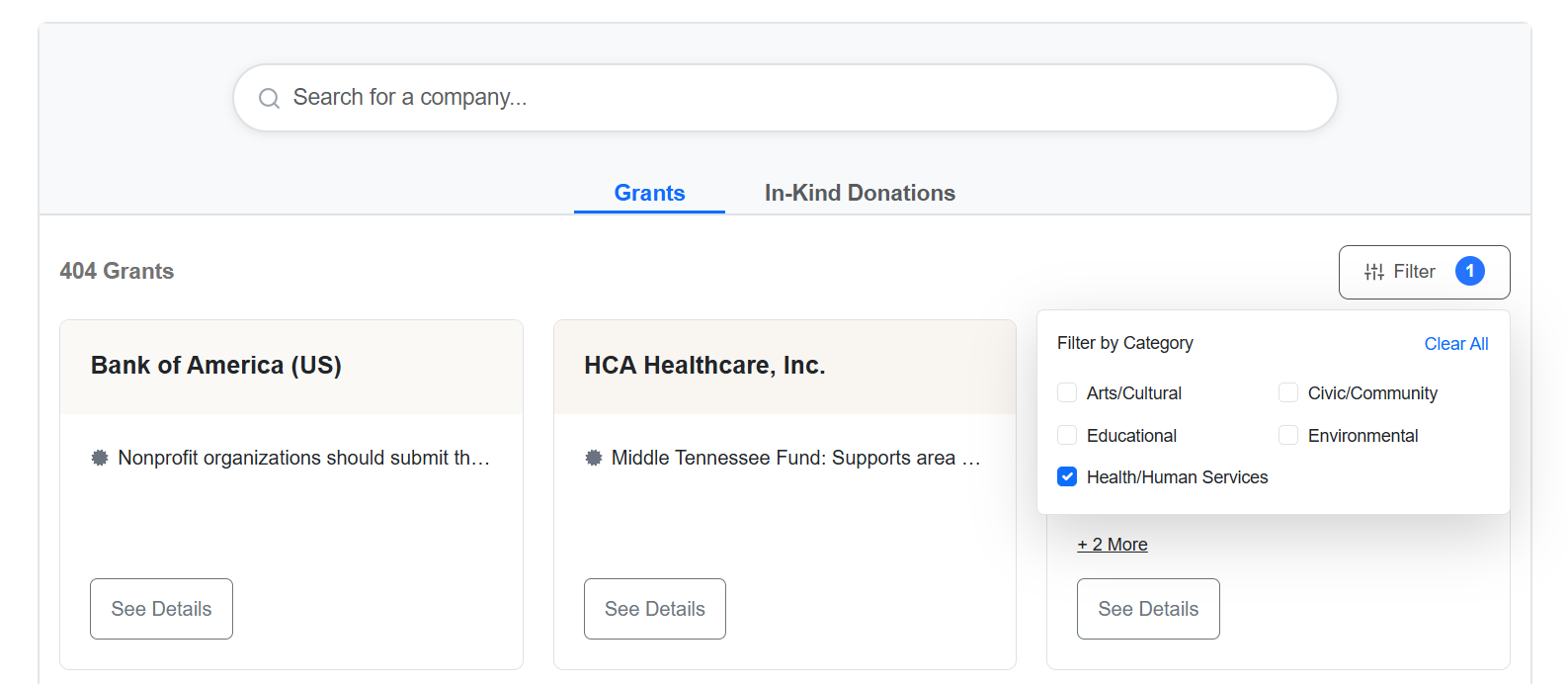
Some companies even list their geographic requirements directly in application materials or in corporate grant databases, such as Double the Donation (example from HCA Healthcare pictured below).
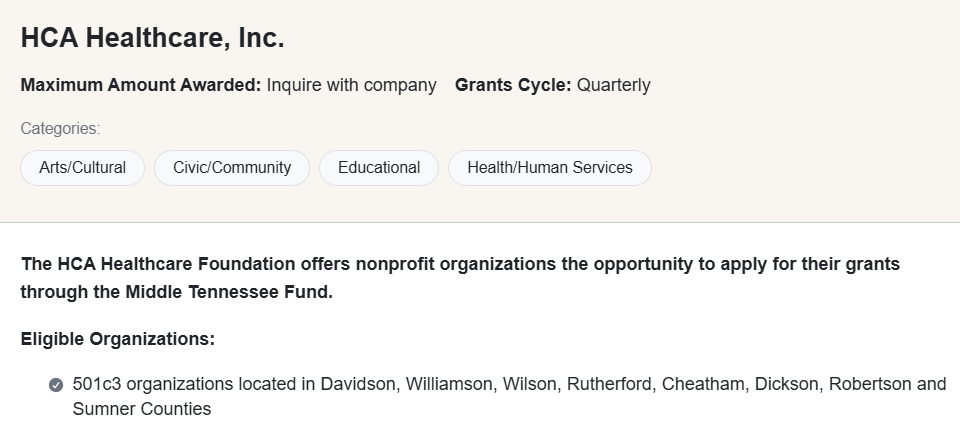
Corporate Grants FAQ - Geographic Requirements Example

When prospecting for corporate grants, start by mapping out major employers, regional headquarters, and distribution centers located within a 20-mile radius of your primary service area.

How do we identify the best prospects based on mission alignment?

Beyond physical location, the most successful partnerships are built on the idea that your mission should naturally strengthen the company’s business ecosystem. To find these matches, ask yourself: Does our work solve a problem that impacts this industry’s future?

Check out these examples:

  • Education and Literacy: Your best prospects are tech firms, law offices, or publishing houses that require a highly skilled and literate workforce to thrive.
  • Environmental Conservation: Look toward outdoor retailers who need healthy natural spaces for their products to be used, or manufacturing companies looking to offset their carbon footprint.
  • Food Insecurity and Health: Your first stops should be grocery chains, agricultural equipment manufacturers, or healthcare providers with a vested interest in the community’s nutritional well-being.
Filtering corporate grants by mission or vertical with Double the Donation's database

By aligning your mission with companies’ industry needs, you move the conversation from charity to community investment. This overlap makes it much easier for a CSR manager to justify the grant to their executive leadership, too.

How can we use our supporter data to uncover grant opportunities?

Most nonprofits are sitting on a goldmine of data they rarely use: the employer information of their donors and volunteers. But this data point can serve as your secret weapon for breaking through the noise!

Companies are significantly more likely to fund an organization that their employees already support. Doing so boosts employee retention and morale: two major business goals.

By analyzing employer data in your CRM, you can identify powerful internal champions who can help advocate for grant funding for your cause. If you see that ten of your regular volunteers work for a local manufacturer, that company can now be considered a warm lead. From there, you can ask those volunteers to facilitate a personal introduction between your team and their employer’s CSR lead, ensuring your grant proposal stands out from the pile.

What are employee-nominated corporate grants, and how can we access those programs?

Some businesses take employee-directed giving to the next level. Rather than simply welcoming employee recommendations, certain companies actually require them.

To understand the power of employee-driven grants, let’s take a look at the Starbucks Neighborhood Grants program. As of today, Starbucks does not allow nonprofits to apply directly through a public portal. Rather, they invite their “partners” (i.e., employees) to nominate organizations making an impact in their local communities.
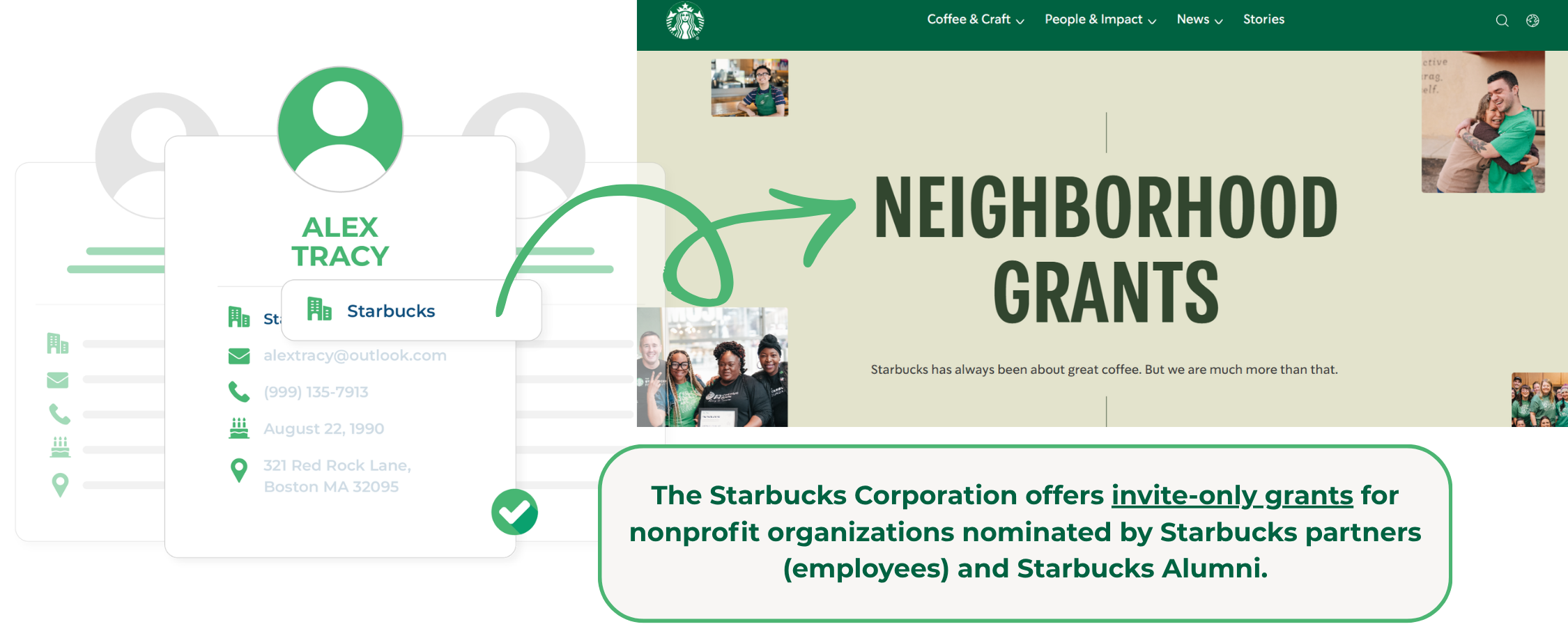
Secure corporate grants using donor employment data

If your data shows that several qualifying employees volunteer with or donate to your cause already, you have a direct pathway to that grant. You just need to ask: “Would you be willing to nominate our nonprofit during the next grant cycle?”

Can we use volunteer grants as a stepping stone to larger funding?

Volunteer grants (also known as “Dollars for Doers”) are essentially bite-sized grants awarded to nonprofits once a company’s employee reaches a minimum number of volunteer hours. While these checks are generally limited in size (typically $250 to $1,000), their value certainly cumulates when scaled across your whole volunteer base!
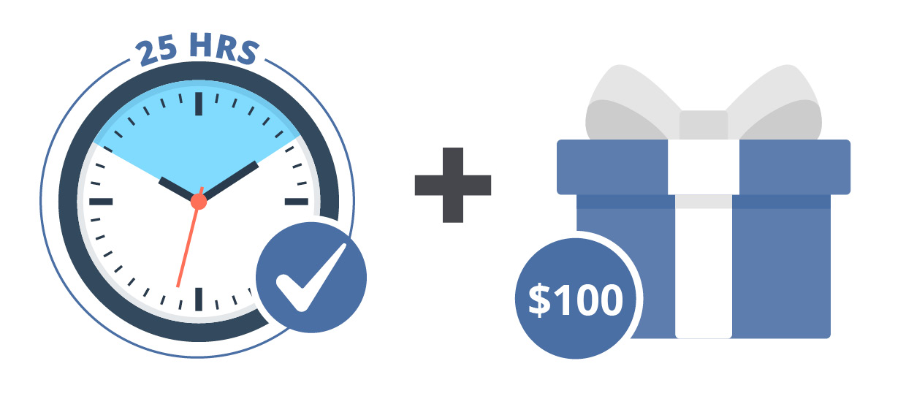
Volunteer grants are a particularly accessible form of corporate grants.

Not to mention, if a company has already paid out several volunteer grants to your org, you are likely considered a vetted partner. When you later apply for a $50,000 grant, your application is no longer from a stranger; it’s from an organization the company (and its employees) are already invested in.

Unlock Direct Access to Corporate Grants

Ready to end the manual search for corporate partners? Double the Donation’s corporate giving database provides direct links to corporate grant applications, in-kind donation guidelines, and sponsorship program details for thousands of companies.

See the Database in Action →

Section III: Crafting a Winning Corporate Grant Application

Corporate grant reviewers are often business professionals, not academic historians. They value brevity, data-driven logic, and clear outcomes. Not to mention, they’re typically looking at your proposal through the lens of a social investment.

What do corporate grant reviewers actually want to see in a proposal?

A winning corporate grant application generally focuses on five key pillars. These include:

  1. Alignment: Explicitly state how your nonprofit’s mission helps the company achieve its specific CSR goals.
    • Example: For a tech company that prioritizes digital equity, highlight how your after-school program provides coding workshops to under-resourced students.
  2. Efficiency: Use real math to show you are a good steward of funds.
    • Example: For every dollar granted, 90 cents goes directly into program services rather than administrative overhead.
  3. Scalability: Can this program grow if they give you more money next year?
    • Example: Explain how a successful neighborhood pilot program can be replicated across the entire city with increased corporate investment.
  4. Sustainability: Will your team be able to sustain program operations after the grant ends?
    • Example: Outline your diverse funding streams, including individual donors and event revenue, to demonstrate that the company’s grant is an investment in growth rather than temporary life support.
  5. Visibility: How will you recognize the grant-maker? Companies want the general public to know they are doing good.
    • Example: Offer to feature the company’s logo on your website and provide co-branded social media content that celebrates the partnership’s impact.

Corporate reviewers are seeking professional, results-oriented organizations that understand the value of a dollar as well as the importance of brand reputation. When you address these concerns, you demonstrate that your nonprofit operates with the same strategic rigor as the company you are asking to invest in you.

How should we present data and impact metrics?

Corporate grant-makers are trained to look for efficiency and impact. When presenting your organization’s case for support, be sure to focus on high-level figures that demonstrate the return on investment of the company’s grant.

Core metrics (or KPIs) to highlight in your proposal may include:

  • Reach and Volume: The total number of individuals, families, or communities directly impacted by your programs
  • Cost-Efficiency: The breakdown of how much it costs to deliver a specific service (e.g., cost per meal provided or cost per student mentored)
  • Success Rates: The percentage of participants who achieved a positive outcome, such as graduation, job placement, or housing stability
  • Local Density: The portion of your impact that occurs within the company’s core “footprint” (i.e., neighborhoods where they have offices or customers)

When you effectively communicate these numbers to a prospective partner, they gain a better understanding of your organization’s work and the positive social change you could accomplish with their support.

What are the most common mistakes that lead to rejection?

Even the best nonprofits get rejected sometimes, but many dismissals stem from avoidable errors. For example:

  • The “One-Size-Fits-All” Proposal: Never send a generic copy-and-pasted pitch. If you don’t mention its specific community goals (e.g., “Diversity in Tech” or “Clean Water”), the company is not likely to fund you.
  • Asking for General Operating Support: Most corporations prefer to fund tangible projects rather than “keeping the lights on.” Frame your overhead as program implementation or capacity building to make it more palatable to a business mindset.
  • Poor Financial Transparency: Corporations are risk-averse and want to ensure their funds won’t be mismanaged. Failing to provide a clear line-item budget or recent financial statement can be an immediate red flag around a lack of organizational maturity.
  • Unpolished or Unprofessional Proposals: Corporate grant reviewers often equate the quality of your application with the quality of your program management. Proposals riddled with spelling errors or grammatical mistakes signal a lack of attention to detail that can make a company hesitate to trust you with a large financial investment.

A corporate grant reviewer is looking for reasons to say “yes” to a partnership, but a single oversight can lead to an easy “no.” By treating your application as a professional business case, you demonstrate that your nonprofit is a reliable, high-functioning entity capable of stewarding corporate resources. Taking the extra time to proofread, itemize your costs, and tailor your language to the funder’s goals ensures that your mission isn’t sidelined by technicalities.

How much should we realistically ask for?

This is a largely variable metric, and it can be hard to say without a solid understanding of your organization’s needs and the grant-making company’s capacity. However, you can typically narrow it down by researching a corporation’s past giving.

Most large companies list previous grant amounts on their application portals or in their annual CSR reports. If a corporation typically gives $10,000, don’t ask for $100,000 unless you have a massive, multi-year partnership proposal that will wow their team.
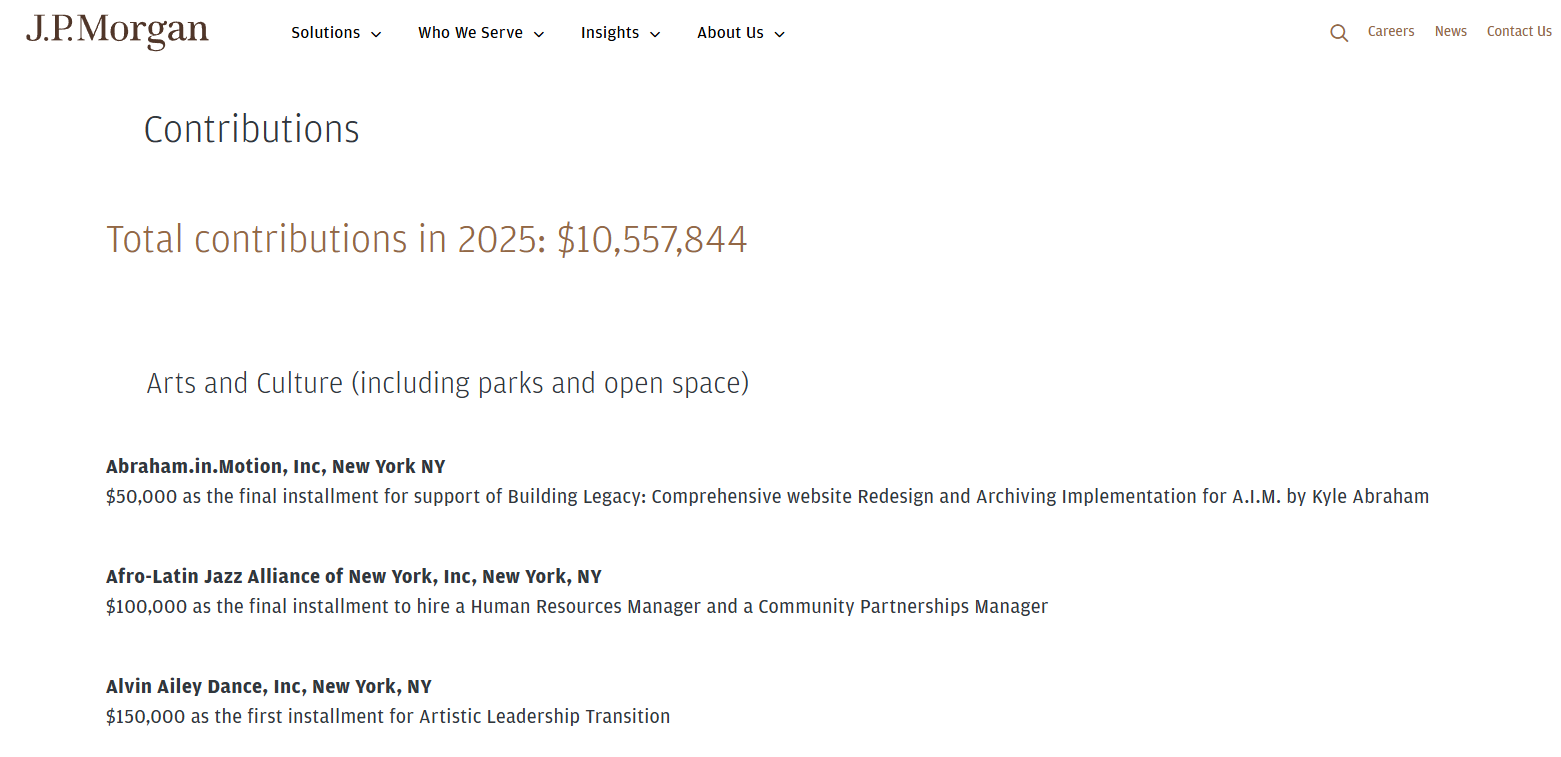
Average amounts of corporate grants from JP Morgan Chase

For the best results, a first-time ask should usually be at or slightly below their average grant size to build trust.

Section IV: Post-Award Strategy and Relationship Management

Winning the grant is only half the battle. Ideally, the goal is to turn a one-time grant into a multi-year partnership. In the corporate world, renewal is much easier than acquisition.

How do we report our performance to a corporate grantmaker?

Looking to build a long-term relationship with a company that contributed a grant to your organization? It’s important to provide an impact report that speaks their language. Rather than a narrative-heavy PDF, we recommend sending a sleek “Impact Summary” that includes:

  • Visuals: High-quality photos of the program in action or statistic-backed, impact-focused infographics
  • Human Stories: A brief, 2-3 sentence testimonial from someone who benefitted from your mission
  • Hard Data: Reiterate the metrics you promised in the application with the real results you’ve achieved

When a company sees what its grant has accomplished, it will be increasingly likely to continue or grow its support.

What happens if we don’t meet our promised goals?

First off, don’t panic. The worst thing you can do is hide the data. Corporations understand that business doesn’t always go as planned. If your program falls short of its projected metrics, be proactive in your communication. Reach out to your point of contact, explain the challenges you’re facing, and share your intended pivot strategy.

This level of transparency builds more trust than a falsified success story ever could.

How can we deepen the relationship beyond the check?

Corporate grant funders want to be partners, not just ATMs. Therefore, it’s a good idea to offer them tangible ways to get skin in the game. This might include:

  • Skill-Based Volunteering: Involve a company’s employees! Ask their marketing team to help revamp your newsletter, or their IT team to examine your database for growth opportunities.
  • Board Placement: If a high-level executive at a grant-making company is looking for a seat on your board of directors, it creates a permanent bridge between your organizations.
  • Site Visits: Invite the HR or CSR manager to see your nonprofit’s programming in action. Seeing a solved problem in person (especially a behind-the-scenes look) is often more powerful than a text-based report.

By fostering these connections, you transition from being a simple line item in a budget to a vital community partner.

When is the right time to ask for a renewal or a larger grant?

Don’t wait until the current grant runs out. The best time to talk about next year is immediately after you send a successful mid-year report. You can even use the momentum of your current success to say, “With your $10,000, we achieved X. If we were to scale this to $25,000 next year, we could achieve Y.”


Wrapping Up

Corporate grants represent one of the most significant opportunities for nonprofits to diversify their revenue and scale their impact. Shift your mindset from “asking for a donation” to “offering a partnership.” Doing so positions your nonprofit as a solution-provider for the company’s CSR goals.

The money is there, the portals are open, and the business world is looking for partners to make a difference. Now, it’s just a matter of making the connection. Good luck!

Are You Ready to Grow Corporate Giving Revenue?

Stop managing grants & sponsorships in silos. Scale your impact by integrating your corporate and workplace giving strategies into one system.

Book a Demo to Get Started →

Join 8,000+ nonprofits using the world’s leading corporate giving database.

Nonprofit Essentials: 14 Top Tools for Growth, Giving & More

Nonprofit essentials are the core digital tools (including fundraising software, marketing platforms, accounting systems, and more) that enable organizations to scale their impact efficiently. By prioritizing tools that automate revenue streams and streamline operations, nonprofits can minimize administrative burden and maximize the funds available for their mission.

Running a successful nonprofit organization often feels like a balancing act. You’re constantly juggling the need to secure new funding, manage donor relationships, and execute programs that drive real-world change. When you have a lean team and limited resources, the tools you use to get the job done become just as important as the mission itself.

From fundraising to day-to-day management, identifying the right tools for your needs can be the difference between a stalled strategy and a breakthrough year.

In this guide, we’ll highlight our suggestions for nonprofit essentials in the following categories:

Building an effective technology stack is not about acquiring every new gadget or software package that hits the market. Instead, it’s about selecting a cohesive set of tools that work together to remove friction from your fundraising and operations. By investing in the right infrastructure, your organization can move away from manual, time-consuming tasks and dedicate more energy to what matters most: serving your community.

Nonprofit Fundraising Platforms

Fundraising is the heartbeat of every nonprofit. While the donor relationship is deeply personal, the infrastructure supporting those gifts must be professional, secure, and automated.

After all, a high-quality fundraising tool does more than just collect money; it captures data, tracks donor behavior, and identifies new revenue opportunities (such as matching gifts).

Here are a few of our top recommendations.

Prepare your team with nonprofit essentials like Givebutter.

Givebutter: All-in-One Fundraising Software

Givebutter is a comprehensive fundraising platform that offers a modern, donor-centric experience. It is well-regarded for its versatility, providing tools for donations, ticketing, and auctions in one place. One of its standout features is its focus on transparency and social proof, allowing donors to comment on their contributions, thereby building community trust.

Because Givebutter integrates easily with other essential tools, it is a great choice for smaller to mid-sized nonprofits seeking an all-in-one solution without a steep learning curve. The interface is intuitive, which can help increase conversion rates on your donation pages.

Learn more at Givebutter.

Prepare your team with nonprofit essentials like Salesforce NPSP.

Salesforce Nonprofit Cloud: CRM Software

Salesforce is known for its immense flexibility and power, and its Nonprofit Cloud is a top choice for organizations that require a highly customizable solution. Unlike “out of the box” tools, Salesforce allows you to build workflows and processes that match your specific organizational structure. If your nonprofit has unique programs or complex data needs that standard software cannot handle, Salesforce provides the architectural freedom to create exactly what you need.

The platform also boasts the industry’s largest app ecosystem, the AppExchange. This means you can find pre-built integrations for almost any other tool you use, from marketing platforms to event registration systems.

Browse the Salesforce website to explore their offerings.

Prepare your team with nonprofit essentials like GoFundMe Pro.

GoFundMe Pro: Peer-to-Peer Fundraising Software

GoFuneMe Pro (formerly Classy) is a robust fundraising platform designed to manage campaigns of all shapes and sizes. This platform is built for nonprofits that need to manage high volumes of transactions and require deep analytical reporting to track their progress.

GoFundMe Pro also offers specialized features for peer-to-peer fundraising, which can be a powerful way to expand your donor base through the networks of your current supporters. For organizations focused on long term sustainability and growth, this solution provides the reliability and advanced features necessary to run sophisticated fundraising events and seasonal appeals.

Visit GoFundMe Pro for more information.

Prepare your team with nonprofit essentials like Double the Donation.

Double the Donation: Workplace Fundraising Software

Double the Donation is the industry-leading fundraising software designed to empower nonprofits and schools to grow revenue across all workplace giving programs. This platform is engineered to eliminate the friction that causes so much matching gift revenue to go unclaimed.

Because of the complexity of corporate philanthropy, Double the Donation provides comprehensive tools to streamline identification and follow-up processes. Their full suite of software includes workplace giving automation, access to an extensive database of 24,000+ companies, intuitive reporting capabilities, and more.

By utilizing this fundraising software, nonprofits can focus on building long-term relationships while the system manages the complex task of corporate giving program compliance. Plus, it offers ready-built integrations with 100+ leading fundraising solutions, including Givebutter, Salesforce, GoFundMe Pro, and more!

Visit Double the Donation to explore their full range of services.

Marketing and Communication Software

Once you have your fundraising infrastructure in place, you need tools to share your story and engage your audience. Nonprofit marketing is about meeting your supporters where they are, whether that is on social media, in their inbox, or on your website. Without the right software, your message can get lost in the noise of a digital world.

Prepare your team with nonprofit essentials like Canva.

Canva: Graphic Design Software

Visual content is non-negotiable in the nonprofit sector. Donors want to see the impact of their gifts, and high-quality images and graphics are the most effective way to show that. Canva is a design platform that democratizes graphic design, providing thousands of templates for social media posts, annual reports, flyers, and event materials.

For nonprofits with limited resources, Canva is a game-changer. It allows you to maintain brand consistency, which is vital for building trust with your donor base. When all your materials use the same colors, fonts, and professional layout, your organization appears more established and reliable. Not to mention, Canva offers free access to its premium features for qualifying nonprofits!

Find out more on the Canva website.

Prepare your team with nonprofit essentials like Mailchimp.

Mailchimp: Email Marketing Software

Mailchimp is one of the most recognized names in email marketing. What started as a simple tool for sending newsletters has evolved into a full-scale marketing platform that includes automation, audience segmentation, and website-building features. For nonprofits, Mailchimp offers a user-friendly interface that makes it easy to design professional emails without needing a background in coding or graphic design.

The platform’s strength lies in its ability to automate the donor journey. You can set up a welcome series for new supporters that provides information on corporate volunteerism or other ways to get involved beyond.

Visit Mailchimp online to learn more.

Prepare your team with nonprofit essentials like Hootsuite.

Hootsuite: Social Media Management Software

Social media is a crowded space, and it is easy to get overwhelmed by the constant need to post. Hootsuite is a social media management tool that lets you schedule posts across multiple platforms from a single dashboard. This is essential for maintaining a consistent presence without having to log in to every account throughout the day.

Hootsuite also provides analytics showing which posts are driving the most engagement. By understanding what content resonates with your audience, you can refine your social media strategy and ensure that your limited time is spent on the platforms that deliver the best results.

Visit Hootsuite to get started.

Financial and Accounting Systems

Financial management is the bedrock of donor trust. When supporters give to your nonprofit, they expect their funds to be managed with transparency, accuracy, and efficiency. Using professional accounting software is not just about keeping the books; it is about providing the detailed reporting that you need to stay above board, secure corporate sponsorships, and more.

Prepare your team with nonprofit essentials like Quickbooks.

QuickBooks: Accounting Software

QuickBooks is the industry standard for small- to mid-sized-business accounting. Even better, its nonprofit edition is specifically tailored to meet the unique needs of charitable organizations! This innovative solution simplifies tracking funds by donor, program, or grant, which is a requirement for many funding sources.

The platform is also designed to smooth the annual audit process by keeping all your financial data organized and accessible. Because many financial professionals are familiar with QuickBooks, it’s also easy to find support or outsource your bookkeeping tasks when the need arises.

Visit QuickBooks to get started.

Prepare your team with nonprofit essentials like Aplos.

Aplos: Fund Accounting Software

Aplos is a fund accounting software solution built specifically for nonprofits and churches. Unlike general-purpose accounting tools, Aplos is designed from the ground up to track fund restrictions. This is a crucial distinction, as nonprofits often receive restricted donations that must be spent on specific programs or initiatives.

By using Aplos, you can easily generate reports that show donors exactly how their gifts were used, which builds immense confidence and donor loyalty. The software also includes modules for donor management and contribution tracking, making it a cohesive solution for many smaller organizations.

Learn more on the Aplos website.

Prepare your team with nonprofit essentials like Sage.

Sage: Financial Management Software

For larger nonprofits that manage multiple programs, locations, or complex entities, Sage is a powerful financial management system. It provides advanced features for multi-dimensional reporting, allowing you to see your financial health from various perspectives, such as by department, project, or location.

Sage is also scalable and robust, making it the choice for organizations that need to consolidate financial data. It provides the high-level oversight required for complex grant management and ensures that your financial reporting meets the highest standards of transparency and compliance.

Visit Sage to explore their services.

Nonprofit Event Management Tools

Events are one of the best ways to build community and engage your supporters face-to-face. Whether you’re hosting a gala, a walkathon, or a community cleanup, the logistics can quickly become complicated. Luckily, event management software automates registration, ticketing, and communication processes, allowing you to focus on your guests’ experience.


Prepare your team with nonprofit essentials like Qgiv.

Qgiv: Event Giving Software

Qgiv is a fundraising platform with a robust suite of event management tools. Whether you are using text to solicit donations at a gala or setting up a registration page for a virtual event, Qgiv ensures the donation process is fast and secure.

The platform is known for its high level of customization and support. It integrates with many of the leading CRMs, ensuring that data from your events flows directly into your donor database. This integration is essential for turning event attendees into long-term donors.

Learn more about Qgiv’s event capabilities.

Prepare your team with nonprofit essentials like Bidding Owl.

BiddingOwl: Charity Auction Software

BiddingOwl is a dedicated auction management platform built to streamline this process for nonprofits. Whether you’re hosting a digital silent auction or facilitating a live gala, the success of your event often depends on the technology powering it. Luckily, platforms like BiddingOwl enable teams to manage item procurement, bidder registration, and real-time bidding with ease, thereby reducing administrative burden.

Another standout advantage of BiddingOwl is its focus on event fundraising and access to corporate sponsorship. Nonprofits utilizing BiddingOwl can utilize Double the Donation’s sponsorship directory directly within the platform. This allows your team to easily identify and pursue corporate sponsorship opportunities without leaving the ecosystem you use to manage your event.

Get started at BiddingOwl.com.
Prepare your team with nonprofit essentials like Eventbrite.

Eventbrite: Event Promotion & Ticketing Software

Eventbrite is one of the most accessible event management platforms available. It’s widely recognized, which means your donors will likely feel comfortable using it to register or purchase tickets. Eventbrite is particularly strong for public-facing events where you want to maximize reach and visibility.

The platform provides simple tools for creating event pages, managing attendee lists, and processing payments. It is an excellent choice for smaller events or for nonprofits that want a familiar, user-friendly experience for their supporters.

Find more information on the Eventbrite website.

Prepare your team with nonprofit essentials like Cvent.

Cvent: Virtual Event Software

Cvent is a comprehensive event management solution designed for organizations that host professional, large-scale events or conferences. It covers the entire lifecycle of an event, from venue sourcing and attendee registration to onsite check-in and post-event reporting. Cvent is ideal for nonprofits that hold high-stakes events where the guest experience is paramount.

The software provides deep customization options, allowing you to create branded registration sites and complex ticketing tiers. For organizations that rely on events as a major source of revenue or as a vehicle for corporate networking, Cvent provides the tools to manage every detail professionally.

Visit Cvent for additional details.


Wrapping Up & Next Steps

Assembling your nonprofit tech stack is a journey that requires careful planning. Start by auditing your current systems to identify where you spend the most time on manual labor. Are you still using spreadsheets to manage your financial data? Is your fundraising platform failing to identify corporate matching opportunities? Use these gaps as your roadmap for improvement.

The goal of implementing this software is not to change how you do your work. Instead, it’s to remove the barriers that prevent you from working effectively. When you have the right fundraising, marketing, financial, and event technology systems in place, you empower your team to focus on what truly matters: your mission and the people you serve.

8 Tips to Get More Corporate Sponsors at Your Nonprofit

In the modern philanthropic landscape, reliance on traditional funding sources is increasingly insufficient to meet the demands of expanding missions. Whether it’s a local food bank seeking to expand its warehouse or an international environmental group launching a new conservation project, the private sector (via corporate sponsors) has become an indispensable partner.

However, many development offices struggle to bridge the gap between asking for a donation and building a long-term partnership. The difference lies in strategy, data infrastructure, and professional positioning. To compete for corporate dollars in a crowded market, nonprofits must transition from a reactive posture to a proactive, data-driven sponsorship model.

In this guide, we’ll walk you through eight tried-and-true tips for doing so. These include:

  1. Building a high-converting sponsorship portal
  2. Identifying your warmest leads with employment data
  3. Utilizing a comprehensive corporate giving database
  4. Demonstrating ROI effectively
  5. Structuring your sponsorship tiers
  6. Navigating the legal and ethical considerations
  7. Implementing strong stewardship and reporting practices
  8. Leveraging technology for long-term success

An optimized inbound funnel is essential for capturing interest at the moment it peaks. For nonprofits, this means moving beyond a simple contact page and developing a sophisticated ecosystem that identifies, attracts, and retains corporate allies.

Let’s get started!

1. The Digital Front Door: Building a High-Converting Sponsorship Portal

A dedicated sponsorship page serves as your digital pitch deck. It signals that your nonprofit is prepared for professional business collaborations even without your team having to make the first move.

A well-designed resource should offer the following benefits:

  • Friction Reduction: Busy professionals want to know the who, what, and how within 30 seconds. A comprehensive sponsorships page provides immediate answers to their most pressing questions regarding audience reach and partnership tiers.
  • Professional Branding: An optimized sponsorship portal differentiates your nonprofit from smaller, less organized organizations. It demonstrates that you have the administrative capacity to manage a high-level partnership.
  • Lead Segmentation: Not all inquiries are equal. An integrated, structured contact form allows you to ask qualifying questions to determine budget range and specific areas of interest, such as event sponsorship, employee volunteerism, or cause marketing.

For the best results, use this online hub to highlight your collaborative value proposition. In other words, don’t just list your mission. Explain how a relationship with your cause solves a problem for the business. For example, you might demonstrate how a partnership helps a company achieve its sustainability goals or improve its local brand reputation.

From there, you’ll want to offer a menu of engagement opportunities that clearly list your products. This could include everything from sponsoring a high-profile gala to naming rights for a community garden.

2. The Power of Employment Data: Identifying Your Warmest Leads

Cold calling a CEO is rarely successful. However, reaching out to a business because a significant percentage of their employees already volunteer at your nonprofit is a warm lead. This is where employer data becomes your most valuable asset.

Did You Know? One of the most significant missed opportunities in fundraising is the failure to leverage the professional networks of your existing constituents. Your database is likely filled with donors, volunteers, and board members who work for companies with massive philanthropic budgets.

Consider these best practices for cleaning and utilizing your supporters’ employment insights:

  • Supporter Employment Tracking: Many corporations offer matching gifts and volunteer grants specifically for organizations where their employees donate or commit a certain number of hours. For this reason, it’s a good idea to collect employment information from supporters as they engage with your organization, whether that’s through an online donation form or volunteer registration.
  • Data Appending: Even after implementing supporter employment tracking practices, you’ll likely have some holes in your data. A data appending service can fill in these gaps, revealing that a large cluster of your donors works at a specific regional bank or tech firm.
  • Segmented Communication: Once you have employment data for your supporters, use it to ensure your communications are as segmented and personalized as possible. This can include tailored workplace giving outreach as well as highlighting opportunities for donors and volunteers to advocate for sponsorship with their employers (or even just make an introduction!).

When you approach a company with data showing that their staff is already invested in your mission, the conversation shifts. You are no longer just a charity looking for a handout. You are a vital part of their employees’ lives and the company’s internal culture.

3. Utilizing a Comprehensive Corporate Database

To truly grow your sponsorship efforts, it’s important that you move beyond the local businesses on your street. Large-scale corporate philanthropy is often managed through complex foundations with specific giving pillars. With so many opportunities to choose from, it can be difficult to narrow down your best options.

To navigate this process, your development team needs access to a robust corporate giving database.
Get your nonprofit more corporate sponsors with an online directory

This kind of specialized database allows you to identify generous companies and filter based on their existing giving programs (such as corporate grants and in-kind donations). It will even provide easy access to submission links and eligibility requirements, making the application quick and simple for your team.

4. Demonstrating ROI: Speaking the Language of Business

In the corporate world, every dollar spent must be justified. While a donation is a philanthropic act, a sponsorship is often a marketing or HR expense. To secure these funds, you must demonstrate a strong Social Return on Investment for any partnership you propose.

This can take on a few forms.

Brand Visibility and Marketing

For many sponsors, the primary goal is brand alignment. They want their company to be associated with a prestigious or trusted local organization.

If this is the case, you’ll want to focus your partnership efforts on:

  • Audience Metrics: Be prepared to share your reach. Provide numbers pertaining to how many people attend your events, the volume of monthly visitors your website receives, the extent of your email marketing list, and how many followers you have on social media.
  • Co-Branding: Offer opportunities for ‘presented by’ status on major newsletters, podcasts, or community outreach programs. Any chance you have to share the partner’s logo can be a significant win!

Growing Employee Engagement

Companies are in a constant war for talent and are struggling with employee retention. The right sponsorships can help with this.

If your prospective partner is primarily seeking employee engagement opportunities, consider highlighting:

  • Custom Volunteer Experiences: Offer sponsors exclusive, high-impact volunteer days that build team morale.
  • Leadership Positions: Allow corporate executives to serve on your junior boards or advisory committees. This provides professional development for their staff while giving your nonprofit access to corporate expertise.

By framing your sponsorship opportunities around these tangible business benefits, you transform the conversation from a request for charity into a strategic investment. Regardless of what a specific company is looking for, your goal is to show that a partnership with your nonprofit provides a measurable advantage to their bottom line.

5. Structuring Your Sponsorship Tiers

Complexity is the enemy of the sale. To make it easy for a business to say yes, provide a clear, multi-tiered structure of sponsorship opportunities. This allows businesses of varying sizes to find an appropriate entry point that fits their budget.

Consider the following sample nonprofit sponsorship tiers:

Tier Focus Typical Deliverables
Community Supporter Local small businesses, like law firms or retail shops Logo on the nonprofit website, mention in the annual report, and a window decal
Programmatic Partner Regional banks, medical groups, or mid-sized corporations Naming rights for a specific program, logo on event t-shirts, and social media spotlights
Strategic Visionary National corporations or major foundations Naming rights for facilities, seats on the board of directors, and primary branding on all channels

While the above levels can serve as a solid baseline, remember that the most successful partnerships involve a degree of customization. By using this structure as a starting point for dialogue, you can negotiate specific deliverables that align precisely with a corporation’s unique CSR goals, ensuring that both your mission and their business objectives are fully supported.

Corporate sponsorships can come with unique challenges. For this reason, it’s essential to have a clear corporate gift policy in place before you begin active solicitation.

Protecting Organizational Integrity

The primary concern for any nonprofit is ensuring that a corporate partnership does not compromise the mission or independence. Keep these items in mind as you draft your sponsorship policy:

  • Exclusivity Clauses: Be cautious about granting a sponsor exclusive rights that may prevent your organization from working with other partners in the future.
  • Endorsement Limits: Ensure that a sponsorship does not imply that the nonprofit endorses the company’s products or services.
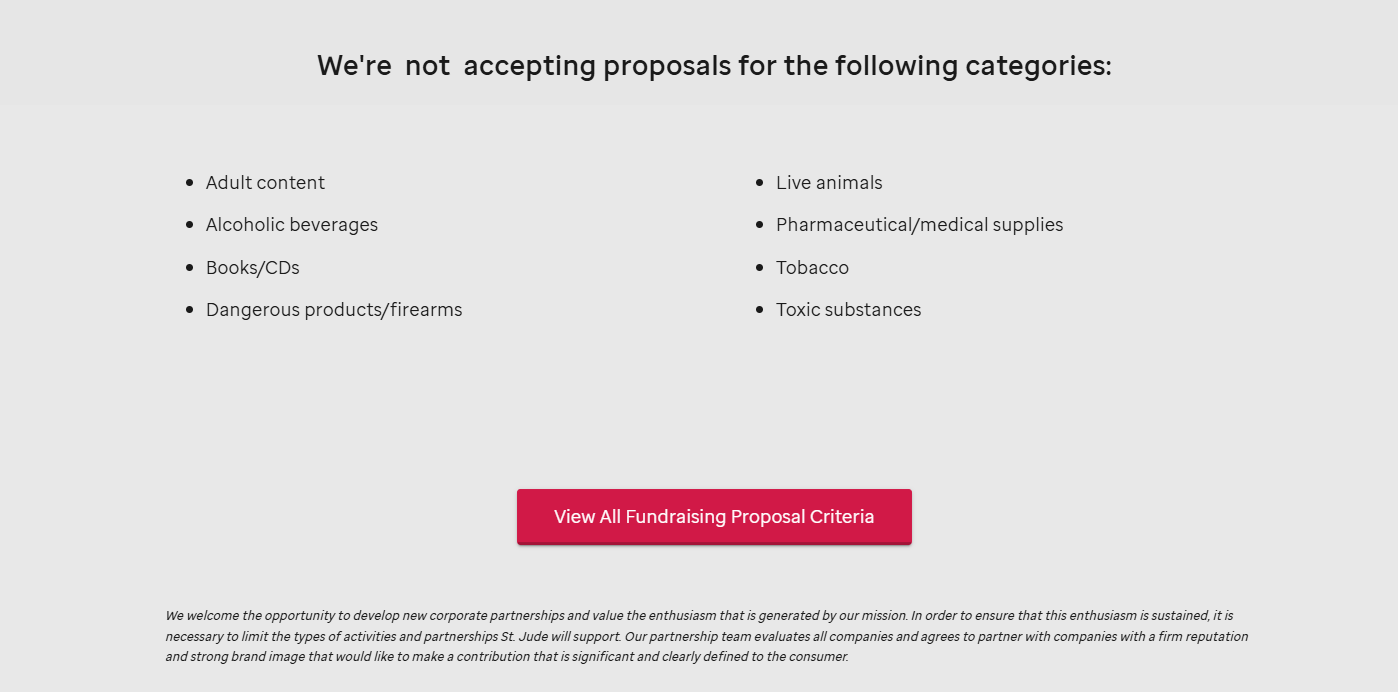
  • Vetting Processes: Establish a dedicated committee to vet potential sponsors to ensure their corporate values align with your ethical standards. This might involve avoiding partnerships with companies in controversial industries.

Here’s an example from the St. Jude Children’s Hospital website:

An example of how St. Jude Children's Hospital's website vets potential corporate sponsors

Tax Exemptions and Unrelated Business Income Tax

For nonprofits seeking corporate partnerships, it’s important to distinguish between a qualified sponsorship payment and advertising income. After all, qualified sponsorship payments are generally tax-exempt, while advertising income may be subject to UBIT, or Unrelated Business Income Tax.

Take a look at the table below to explore the differences in greater depth:

Feature Corporate Sponsorship Advertising
Primary Purpose Public recognition of a donor’s generous support for the mission Promoting a company’s products or services to induce a purchase
Language Used Value-neutral identification of the partner Qualitative or comparative language (e.g., “the best,” “fastest,” or “preferred”)
Visuals & Branding Inclusion of the donor’s official name, logo, and slogan (if the slogan doesn’t promote a product) Product displays, promotional slogans, or visuals that highlight specific merchandise
Price Information Strictly prohibited; no mention of discounts, sales, or pricing Often includes specific price points, percentage-off deals, or savings claims
Call to Action None. Can list a website URL or phone number for contact purposes only Contains clear calls to action (e.g., “Buy now,” “Stop by for a deal,” or “Call for a quote”)
Tax Treatment Generally considered a “Qualified Sponsorship Payment” and is tax-exempt for the nonprofit May be considered “Unrelated Business Income” (UBI) and subject to tax (UBIT)

Quick Note: Always consult a nonprofit tax professional to ensure your sponsorship agreements are properly structured.

7. The Importance of Stewardship and Reporting

The sale does not end when the check is signed. That is actually when the partnership begins.

As most fundraisers know, the most costly part of the process is acquiring a new donor. Meanwhile, the most efficient way to grow your revenue is to retain the ones you already have. The same is true for corporate sponsors! To keep them supporting your cause long into the future, it’s important that you invest time and effort in smart stewardship and reporting practices.

The Impact Report

Companies need data to show their stakeholders how their money was used. For this reason, an annual corporate impact report is essential. This report should include several key components.

  • Qualitative Stories: Include photos of the mission in action or testimonials from those your nonprofit serves.
  • Quantitative Data: Provide specific stats, such as how a sponsorship allowed the organization to serve 5,000 additional meals.
  • Marketing Metrics: Report on how many times a logo was viewed through your digital channels over the course of the year.

A Culture of Gratitude

Go beyond the automated receipt. Have those who benefit from your organization’s work write thank-you notes. Invite corporate representatives to see the programs they fund in action. When a sponsor feels like a hero, they’ll be much more likely to maintain or increase their commitment the following year.

8. Leveraging Technology for Long-Term Success

Modern sponsorship management has evolved beyond simple contact lists. To compete for high-level corporate investments, your organization needs a centralized command center that empowers your development team to shift from administrative work to proactive relationship-building.

A robust Constituent Relationship Management system optimized for corporate giving and sponsor relations serves as the institutional memory for your nonprofit, ensuring that, when a key staff member leaves, the history and nuances of your corporate partnerships remain.

Here are a few key features to keep an eye out for if you’re looking to upgrade your CRM:

  • Lifecycle Tracking: Managing a corporate sponsorship is a multi-step process that can take months from the initial inquiry to the signed contract. A good CRM lets you visualize this journey in a sales-style pipeline.
  • Centralized Asset and Deliverable Management: By checking off these deliverables in the system, you create a digital trail of accountability that makes end-of-year impact reporting seamless and accurate.
  • Corporate Database Integration: Pull in real-time data on corporate sponsorship policies and grant cycles through ready-built integrations with tools like Double the Donation.
  • Smart Relationship Mapping: The ability to link individual donors and volunteers to their corporate employers. This is key for workplace giving initiatives like matching gifts and volunteer grants!

Rather than struggling to remember which logo goes on which banner or when a contract is up for renewal, your team (powered by the right donor database) can focus on the high-touch interactions that actually move the needle. This level of organization not only boosts your internal efficiency but also projects an image of professional excellence to your partners.


Summary and Next Steps

Securing corporate sponsorships for a nonprofit requires a shift in mindset. You’re not asking for a favor. You are offering a high-value opportunity for a business to invest in their community, their brand, and their employees.

By building a professional inbound gateway, leveraging the power of employment data, and utilizing a comprehensive corporate database, you can transform your development office into a sophisticated sponsorship engine.

Corporate philanthropy is evolving, and companies are increasingly seeking nonprofits that can serve as professional, strategic partners. By implementing these data-driven strategies, you ensure that your organization stands out in a competitive market and secures the funding necessary to achieve your mission.